Air conditioning in Stevenage
We install, service, repair and regas air conditioning in homes and businesses across Stevenage, from the Old Town High Street and the 1950s streets of Bedwell and Broadwater to Great Ashby, Gunnels Wood and the villages around the town. Here's how Britain's first new town, its seven conservation areas, the new Local Plan and the permit zones affect an install.
single room, from £1,850
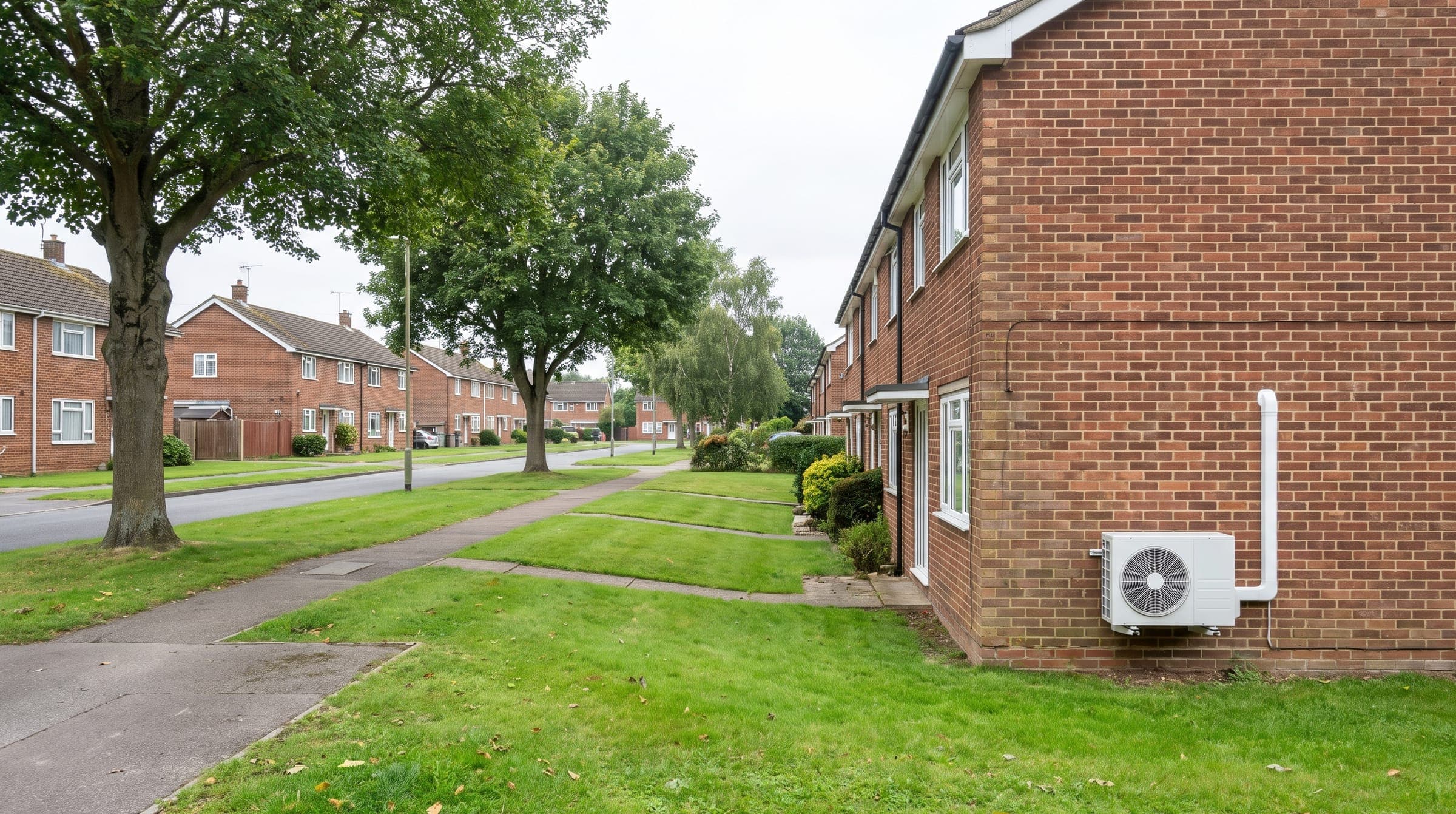
- single room, from
- £1,850
- designated the first new town
- 1946
- conservation areas in the borough
- 7
- of homes terraced (Census 2021)
- 46.1%
Air conditioning installation in Stevenage
We fit air conditioning in Stevenage homes, flats and businesses: wall-mounted units for a single room, multi-split systems for several rooms on one outdoor unit, and ducted systems where nothing should show. A single room starts from £1,850 fitted, two rooms on one outdoor unit from £3,650.
Every install starts with a free survey. Our engineer checks where the units and pipes can go and gives you a fixed price in writing, and most single rooms are fitted in a day. We install Daikin, Mitsubishi Electric, LG and more. See how installation works or get a free quote.
Servicing, repairs and regas
We service and repair split, multi-split and ducted systems across Stevenage, whoever fitted them. An annual service starts at £149, plus £120 for each extra indoor unit on the same visit, and keeps the manufacturer's warranty valid. Visits are booked at least a week ahead so we arrive with the right parts, and we confirm the cost of a repair visit when you book.
A system that needs a regas has a leak, because refrigerant doesn't get used up. We find and fix the leak first, then regas and test the system, so you're not paying for gas that escapes again. We work on homes and business premises, not cars: car air conditioning is a job for a garage.
What air conditioning costs in Stevenage
Our starting prices are the same here as across Hertfordshire and London. The survey turns them into a fixed written price, and any planning, consent or design pack fees are separate.
- from£1,850
A bedroom or study
2.5 kW wall unit, 5 m pipe, fitted in a day
- from£2,050
A living room
3.5 kW wall unit
- from£3,650
Two rooms, one outdoor unit
Multi-split
- from£5,100
Three rooms
Multi-split
- from£250
Premium range upgrade
Quieter, more efficient unit
- from£1,795
Commercial wall unit
Fitted in business hours
- from£2,750
Ceiling cassette
In a suitable suspended ceiling
- from£149
An annual service
Keeps the manufacturer warranty valid
Britain's first new town, and what it built
Stevenage grew up along the Great North Road. A market was granted in 1281, coaching inns lined the High Street, and the railway came in 1850. By 1939 the town had about 6,000 people, most of them in what is now the Old Town.
In 1946 Stevenage was designated the first new town in England, so that families could move out of bombed and crowded London. Lewis Silkin, the planning minister, said it would 'in a short time become world famous'. A Development Corporation ran the town's growth from 1946 until 1980. The first new homes were finished in 1951, the first new factory opened in 1953, and Queen Elizabeth II opened the new town centre in 1959, the first wholly pedestrianised shopping centre in the country.
The plan was a ring of self-contained neighbourhoods, each with its own shops and community buildings, joined by footpaths, cycleways and wide green verges. Bedwell came first, then Broadwater and Shephall from 1953, later Chells and Pin Green, and in the 1970s the neighbourhoods in the north of the town. In more recent times the town has spread east and north-east, into North Hertfordshire at Great Ashby. The council's Local Plan counts around 38,000 homes in the town today.
The 2021 Census found 46.1% of Stevenage homes are terraced, twice the 23.0% across England, with 20.1% in purpose-built flats, 19.5% semi-detached and only 11.9% detached. About 89,500 people live here, and 26.3% of households rent from the council or a housing association, so many installs here need a landlord's consent first.
Stevenage neighbourhoods and what they mean for an install
| Area | Homes and planning | What it means for the install |
|---|---|---|
| Old Town and the High Street | The medieval market street on the old Great North Road. 87 listed buildings in its conservation area, flats above shops and offices behind on Primett Road. | Expect listed building consent on many addresses. A rear yard or back wall, out of sight from the High Street, is the usual answer. |
| Orchard Road and Julians Road | Victorian and Edwardian villas and terraces that grew up by the old 1850 station, cut off from the High Street by Lytton Way in the 1970s. A conservation area. | Nothing on a wall or roof facing the road without permission. Side passages and rear walls work well on the villas. |
| Town centre, Queensway and Town Square | The 1950s and 1960s pedestrian precinct, a conservation area since 1988, with flats above shops and new blocks coming with the regeneration. | Mostly commercial. Flats need the freeholder first. A rear service yard or flat roof hidden from the square suits plant best. |
| Bedwell, Stoney Hall and Monks Wood | The first new town homes, occupied from 1951: short brick terraces and semis set along footpaths and greens. | Rear wall or ground pad. Many front doors face a green or a path, so we plan where the van stops and how far we carry the outdoor unit. |
| Broadwater and Marymead | The third neighbourhood, begun in 1953. Terraces of six to ten houses with long gardens, some early Wimpey no-fines houses with poured concrete walls. | Part is a conservation area, so the back is the place for the unit. Concrete walls need a proper core drill, which we bring. |
| Shephall and Shephall Green | A Domesday village kept as a green inside the new town neighbourhood built from 1953. The green has four listed buildings and is a conservation area. | Round the green, rear positions only. In the 1950s and 1970s streets beyond it the usual permitted development rules apply. |
| Bandley Hill and Poplars | Later new town and private housing in the south-east, with the Poplars district centre. The planned South East of Stevenage homes sit beyond. | Mostly semis and terraces with gardens: side or rear wall, short pipe runs, usually permitted development. |
| Chells and Chells Manor | A later neighbourhood in the east, built after the 1950s ones: terraces and semis, with flats above its neighbourhood centres. | Terraces take one heat pump under permitted development, so a multi-split often serves two or three bedrooms from one outdoor unit. |
| Pin Green | Homes in the north-east beside the Pin Green employment area, where Article 4 directions stop offices and light industry becoming flats. | Houses are straightforward: side or rear wall. The business units are the place for cassettes and wall units in offices. |
| St Nicholas and Rectory Lane | 1970s neighbourhood in the north, plus the old church hamlet: the Grade I church of St Nicholas and Rooks Nest, E. M. Forster's Howards End. | Rectory Lane's large detached houses are in a conservation area. A detached house can have two heat pumps, placed away from the lane. |
| Symonds Green | A small hamlet green with three listed cottages and barns, kept as a conservation area inside the later neighbourhood by the A1(M). | On the green, rear positions only. In the newer streets, side walls are easy, and we pick the quiet side away from the motorway. |
| Martins Wood, Roebuck and Longmeadow | Later estates of terraces, semis and detached houses on the north and south edges of the town, with cul-de-sacs and garage courts. | Usually permitted development. Check your deeds and any planning conditions on the estate before we fix anything to the wall. |
| Great Ashby | Newer housing on the north-east edge. Part of the town's built-up area, but in North Hertfordshire district. | Planning goes to North Herts Council, not Stevenage. Newer homes can overheat, so we size for the top floor first. |
| Flats and maisonettes across the town | One in five homes is in a purpose-built block, from 1950s low-rise to new town centre towers. Many are council or housing association. | Freeholder or landlord consent first. One heat pump per block up to 0.6 m³ can be permitted development; balconies and flat roofs suit. |
| Gunnels Wood | The main employment area west of the railway: pharmaceuticals, engineering, distribution and offices, with Article 4 directions on change of use. | Commercial installs in business hours. Cassettes in suspended ceilings, wall units in smaller offices and server rooms. |
| Knebworth's edge, Graveley, Walkern and Aston | Villages just outside the town, in North Herts or East Herts. Each has a conservation area, and Knebworth has the Stockens Green Article 4 direction. | A different council decides. Cottages and listed houses need care with the position; modern village houses are usually permitted development. |
Dates and descriptions come from the council's Local Plan, its seven conservation area management plans and the 2021 Census. Some roads are only partly inside a conservation area, so we check your exact address.
Planning: Stevenage Borough Council
Planning in Stevenage is decided by Stevenage Borough Council. The one catch is Great Ashby, on the north-east edge: it is part of the town, but it sits in North Hertfordshire district, so applications there go to North Herts Council. The same goes for Graveley, Weston and Knebworth, while Walkern, Aston, Benington and Datchworth go to East Herts Council.
An air conditioner that also heats is an air-to-air heat pump in planning terms, so on a house it is often permitted development under Class G. The outdoor unit must not be used only for cooling, must be no bigger than 1.5 m³, and must pass the MCS 020(a) noise check of 37 dB(A) at 1 m from a neighbour's habitable room window. A terraced or semi-detached house can have one heat pump, a detached house two. In a conservation area the unit can't go on a wall or roof facing a highway, and elsewhere it can't go on a road-facing wall above the ground floor.
You need planning permission for a cooling-only unit, a second unit on a terrace or semi, and anything on a listed building or within its curtilage, which also needs listed building consent. On a block of flats, one heat pump per block with an outdoor unit up to 0.6 m³ can be permitted development. The council can issue a Lawful Development Certificate if you want certainty in writing.
Householder pre-application advice cost £264 in writing or £384 with a site visit when we read the council's page in October 2026, and heritage advice £216 an hour. The council uses the national validation requirements, with no local list.
On 16 July 2026 the government decided that Hertfordshire's county and district councils will be replaced by four unitary councils from 1 April 2028, subject to Parliament. Stevenage would join Welwyn Hatfield and most of North Herts in a new Central Hertfordshire council. Until then, the borough council decides applications here.
The seven Stevenage conservation areas
The council has seven conservation areas, each with a management plan adopted as guidance, which Local Plan Policy NH10 tells applicants to follow.
| Conservation area | Designated | What it protects |
|---|---|---|
| Old Town High Street | 1969, extended 1979 | The medieval market street, its burgage plots, coaching inns and The Avenue. 87 listed buildings, five of them Grade II*. |
| Shephall Green | 1973, extended 2007 | The medieval village green kept inside the new town, with the church of St Mary and three other listed buildings around it. |
| Symonds Green | 1977 in the council's data, amended 2007 | A hamlet green with ponds, Willow Cottage, Thatched Cottage and Oakfield Barn, all Grade II, and the Crooked Billet pub. |
| St Nicholas and Rectory Lane | 1982, extended 1984, amended 2007 | The Grade I church of St Nicholas, the Grade II* Old Bury, Rooks Nest House (Grade I) and the fields of Forster Country. |
| Town Square | 1988 | The first fully pedestrianised town centre in the country, with the Grade II clock tower and pool and the Grade II Joy Ride sculpture. |
| Orchard Road | 2007 | Victorian and Edwardian villas and terraces on Orchard Road, Julians Road and Essex Road, built after the railway came in 1850. |
| Broadwater | 2007 | Part of Marymead: a Mark 1 new town neighbourhood of 1950s terraces, shops, a church and garages by the first Development Corporation architects. |
Designation dates are from the council's conservation area data and its management plans, which were adopted in July 2012. The council's maps show the exact boundaries.
Listed buildings and the council's design guide
The national data lists about 130 listed buildings in the borough, and most are in the Old Town: its 2012 management plan counts 87, from the 16th-century hall house at 94 to 98 High Street to the Grange, once the Swan Inn. Any outdoor unit, pipe hole or cable run on a listed building needs listed building consent, and so does work in its curtilage.
Two conservation areas are unusual because they protect the new town itself. Town Square keeps Leonard Vincent's clock tower of 1957 to 1959 and the precinct the Queen opened, and Broadwater keeps a complete 1950s neighbourhood, down to its garage blocks. So a 1950s terrace in Marymead is treated with the same care as a Georgian house on the High Street.
The council's Design Guide (February 2025) says external services shouldn't be a dominant feature (H5.2), roof plant shouldn't show from the street (H5.3), and plant should match the building (H5.5), with special care on listed buildings and in conservation areas (H5.7). The Old Town management plan asks for satellite dishes and alarm boxes at the back, and we treat an outdoor unit the same way.
So we plan a rear position, a unit that matches the wall, pipework run inside, and the condensate taken to a gully. We give you the unit's dimensions, sound data and a siting plan for any application.
Article 4 directions in Stevenage
An Article 4 direction takes away particular permitted development rights. These are the directions on the council's list when we read it in October 2026.
| Direction | Where | Heat pumps |
|---|---|---|
| Offices to homes, Class E(g)(i) (made 22 January 2025, in force 21 January 2026) | The Gunnels Wood and Pin Green employment areas | Not affected. Offices can't become flats without permission. |
| Light industry to homes, Class E(g)(iii) (same dates) | The Gunnels Wood and Pin Green employment areas | Not affected. It replaced the two 2022 directions on the same uses. |
| Light industry to homes, Class B1(c) (in force 15 June 2018) | Shown on the council's map | Not affected. An older direction on the same change of use. |
| Homes to small shared houses, C3 to C4 (in force 20 September 2017) | The council's HMO direction area | Not affected. A house can't become a small HMO without permission. |
None of these touches the heat pump right. The conservation area management plans considered heritage directions, but none has been made. So in Stevenage, Class G applies to homes subject only to the conservation area and listed building rules.
The Local Plan: updated in July 2026
Applications are decided against the Stevenage Borough Local Plan 2011 to 2031, first adopted on 22 May 2019. The council adopted a Partial Update on 22 July 2026, after the inspector found it sound in a report received on 27 May 2026. The housing target is unchanged at 7,600 new homes over the plan period, and the update adds a set of climate change policies. A full new Local Plan is the council's next stage.
Policy CC2, Heating and cooling, asks new development to cut the need for air conditioning through shading, ventilation and design. The council accepts that many existing homes were built when overheating wasn't a concern, and says the policy isn't a ban on cooling where it's genuinely needed; it asks for passive fixes such as shutters or better glazing to be considered first.
That's why we fit systems that heat as well as cool. An air-to-air heat pump replaces some of your heating in winter and cools in summer, which is what Class G is written for. If your home needs an application, a short technical note covering CC2 is all the council asks for on a householder scheme, and only where it involves mechanical cooling.
Town centre regeneration and the new neighbourhoods
Stevenage Central, the town centre plus the station and leisure park, is planned for about 3,000 new homes in six major opportunity areas, most of them high-density flats. The council's SG1 scheme with Mace is the largest part. The Town Square has already been refurbished with paving that echoes the 1959 original, the bus station moved to a new interchange on Lytton Way in June 2022, and a fifth platform opened at the railway station in 2020.
The plan's three new neighbourhoods are on the edges of the town:
- Stevenage West (Policy HO2): about 1,350 homes west of the A1(M), with 10,000 m² of employment space and a noise buffer beside the motorway
- North of Stevenage (Policy HO3): about 800 homes beside the St Nicholas and Rectory Lane conservation area and Forster Country
- South East of Stevenage (Policy HO4): about 550 homes in two parcels either side of the A602, along the ancient Aston Lane
- Town centre sites: Southgate Park, Centre West, Station Gateway, Central Core, Northgate and Marshgate, with the station rebuild still at masterplan stage
- Neighbourhood centres such as The Oval, Kenilworth, Marymead and the Shephall Centre are allocated for redevelopment with new homes
New flats and new houses: overheating and Part O
Homes built to Part O of the Building Regulations, in force since June 2022, are designed against overheating, but well-sealed flats with big windows still run hot in a heatwave, especially single-aspect ones on upper floors. In new town centre blocks we start with the management company and the planning conditions; on new estates, check your deeds for rules on external equipment.
Parking on install day
Most of Stevenage has no permit parking, but the footpath layout of the new town neighbourhoods means many front doors face a green, not a road. We plan where the van can stop and carry the outdoor unit in, and we never park on the verges: the council doesn't allow it, even with a dispensation.
The council runs four permit parking areas: Burymead (Monday to Friday, 8:30am to 5:30pm), the Old Town (Monday to Friday, 9:30am to 3pm), Green Street and Ingleside Drive (both Monday to Saturday, 8:30am to 5:30pm). Outside those hours anyone can park. A vehicle actively loading or unloading at a property in the street is exempt, which covers unloading the outdoor unit but not parking for the day.
Residents in a permit area can buy visitor vouchers, valid for one vehicle on one day: 20 for £10 digital or £15 paper in Burymead and the Old Town, and 20 for £15 or £20 in Green Street and Ingleside Drive (read October 2026). A voucher from you for our van is usually the simplest answer.
Otherwise the council grants dispensations for building work at £25 a vehicle for up to seven days, with two working days' notice (never on a verge or in a loading ban). A bay suspension costs £125 to apply plus £22 a bay a day, with a fortnight's notice. Old Town High Street bays are free for two or three hours; town centre pay and display is £14 for over five hours. We agree it all when we book.
Air conditioning for Stevenage businesses
Gunnels Wood is the town's main employment area, home to major international companies, distribution and smaller offices, with GSK to the south of the town. We fit and look after air conditioning in offices, meeting rooms, lab support rooms, small server rooms, shops on Queensway and in the Old Town, salons, clinics and restaurants.
Commercial wall units start from £1,795 and ceiling cassettes from £2,750. Installs are done in business hours. In the Town Square and Old Town conservation areas we agree the siting first, because roof plant must stay out of sight from the street. We keep F-Gas records, carry out leak checks on systems that need them, and offer maintenance contracts for one site or several.
Villages around Stevenage and postcodes we cover
We cover the whole town and the villages around it. The villages are in North Herts or East Herts, so planning goes to a different council, and most have their own conservation area:
- SG1: the town centre, Old Town, Orchard Road, Bedwell, Pin Green, St Nicholas, Symonds Green, Martins Wood and Great Ashby
- SG2: Broadwater, Chells, Shephall, Bandley Hill, Poplars, Roebuck and Longmeadow
- SG2 villages in East Herts: Walkern, Aston and Benington, each with a conservation area appraisal
- SG3: Knebworth, with three conservation areas and the Stockens Green Article 4 direction, and Datchworth in East Herts
- SG4: Graveley and Weston, both North Herts village conservation areas, and Hitchin beyond
- SG6: Letchworth Garden City, where the Heritage Foundation's consent is needed as well as planning
Stevenage in official figures
- households (2021 Census)
- 36,513
- live in a flat
- 22 in 100
- live in a house
- 78 in 100
- listed building entries
- 130
Of 36,513 households in the 2021 Census, 78 in 100 lived in a house (12 detached, 20 semi-detached, 46 terraced) and 22 in 100 in a flat. Most installs here are on houses, where a back or side wall is usually the simplest place for the outdoor unit.
In a conservation area an outdoor unit can't go on a wall or roof facing a road without planning permission, and an Article 4 direction can remove permitted development rights altogether. Check your postcode to see whether either applies to your street.
Figures for the whole Stevenage council area. Sources: ONS Census 2021, table TS044 (accommodation type); Historic England's National Heritage List entries within the council boundary, through planning.data.gov.uk (one entry can cover several buildings). Checked October 2026.
Air conditioning for shops, cafes and restaurants in Stevenage
- shops and other retail premises
- 325
- licensed restaurants
- 40
- cafes and unlicensed restaurants
- 40
- pubs and bars
- 25
The Stevenage area has about 325 shops and other retail premises, 80 restaurants and cafes and 25 pubs and bars. Shops lead here. A glazed front and a door left open are the main heat problem, so the units go where the airflow reaches the counter and the till, not the doorway.
Permitted development for heat pumps covers homes, not shops, cafes or restaurants, so check with the council and your landlord before an outdoor unit goes up, and take extra care with a shopfront in a conservation area. Check your postcode.
- Shop air conditioning
- Cafe and coffee shop air conditioning
- Restaurant air conditioning
- Pub and bar air conditioning
- Salon and barber air conditioning
Business premises (local units) in the whole Stevenage area, rounded by the ONS. Source: ONS UK Business Counts 2026, through Nomis.
Stevenage questions
Do I need planning permission for air conditioning in Stevenage?
Often not. A unit that also heats is an air-to-air heat pump, which can be permitted development on a house if it meets the size, position and noise limits and is the only one on a terrace or semi (a detached house can have two). You need permission for a cooling-only unit, a listed building, or a unit on a road-facing wall in one of the seven conservation areas. No Stevenage Article 4 direction touches heat pumps. Applications go to Stevenage Borough Council, or North Herts Council in Great Ashby.
How much does air conditioning installation cost in Stevenage?
A bedroom or study starts from £1,850 with a 5 m pipe run, and a living room from £2,050. Two rooms on one outdoor unit start from £3,650 and three rooms from £5,100. Businesses start from £1,795 for a wall unit and £2,750 for a ceiling cassette. The survey gives you a fixed written price.
I want to cool three bedrooms in my Stevenage terrace. How does that work?
A terraced house can have one heat pump under permitted development, so a multi-split is the answer: one outdoor unit at the back serving up to three or four indoor units. Three rooms start from £5,100. We plan the pipe routes at the survey so they run inside or along the back wall, and the system heats the rooms in winter too.
My home is a council or housing association property. Can I have air conditioning?
Only with your landlord's written permission, because it's an alteration to the building. About a quarter of Stevenage households rent from the council or a housing association, so this is common. Ask them first. If they agree, we survey and give you a fixed written price and the unit details to share with them.
I live in the Old Town. Can I still have air conditioning?
Usually, with care. The Old Town High Street is a conservation area with 87 listed buildings, so a unit can't go on a wall or roof facing the road without permission, and a listed building needs listed building consent for any unit. A rear yard or back wall is the usual position. For a listed home, our design pack from £795 gives the council the drawings and sound data.
I live in a 1950s house in Broadwater or Bedwell. Is that a problem?
No. Most are brick or concrete terraces with long back gardens, which suit a rear wall unit or a ground pad. Part of Broadwater is a conservation area, so there the unit stays off the front. Some early Broadwater houses were built with poured concrete walls, which we drill with the right core drill. Many front doors face a path or a green, so we plan where the van parks.
Does the new Local Plan stop air conditioning in Stevenage?
No. Policy CC2, added in July 2026, asks new development to reduce the need for cooling through design first, and asks for passive fixes to be considered on existing homes. The council says it isn't a ban where cooling is genuinely needed. A system that heats as well as cools is the kind permitted development is written for.
How much is an air conditioning service or repair in Stevenage?
An annual service starts at £149, plus £120 for each extra indoor unit on the same visit. If something has gone wrong, we confirm the cost of the repair visit when you book and price the repair in writing before any work starts. A regas only follows once we've found and fixed the leak.