Air conditioning for restaurants, cafés and bars
A full dining room on a warm evening gets hot fast, and diners notice before you do. We fit air conditioning in restaurants, cafés and bars across London and the Home Counties, planned around service, the kitchen and the neighbours, with prices plus VAT.
- commercial wall unit, from
- £1,795 + VAT
- ceiling cassette, from
- £2,750 + VAT
- and REFCOM certified
- F-Gas
- workmanship guarantee
- 2-year
Dining rooms and kitchens are different jobs
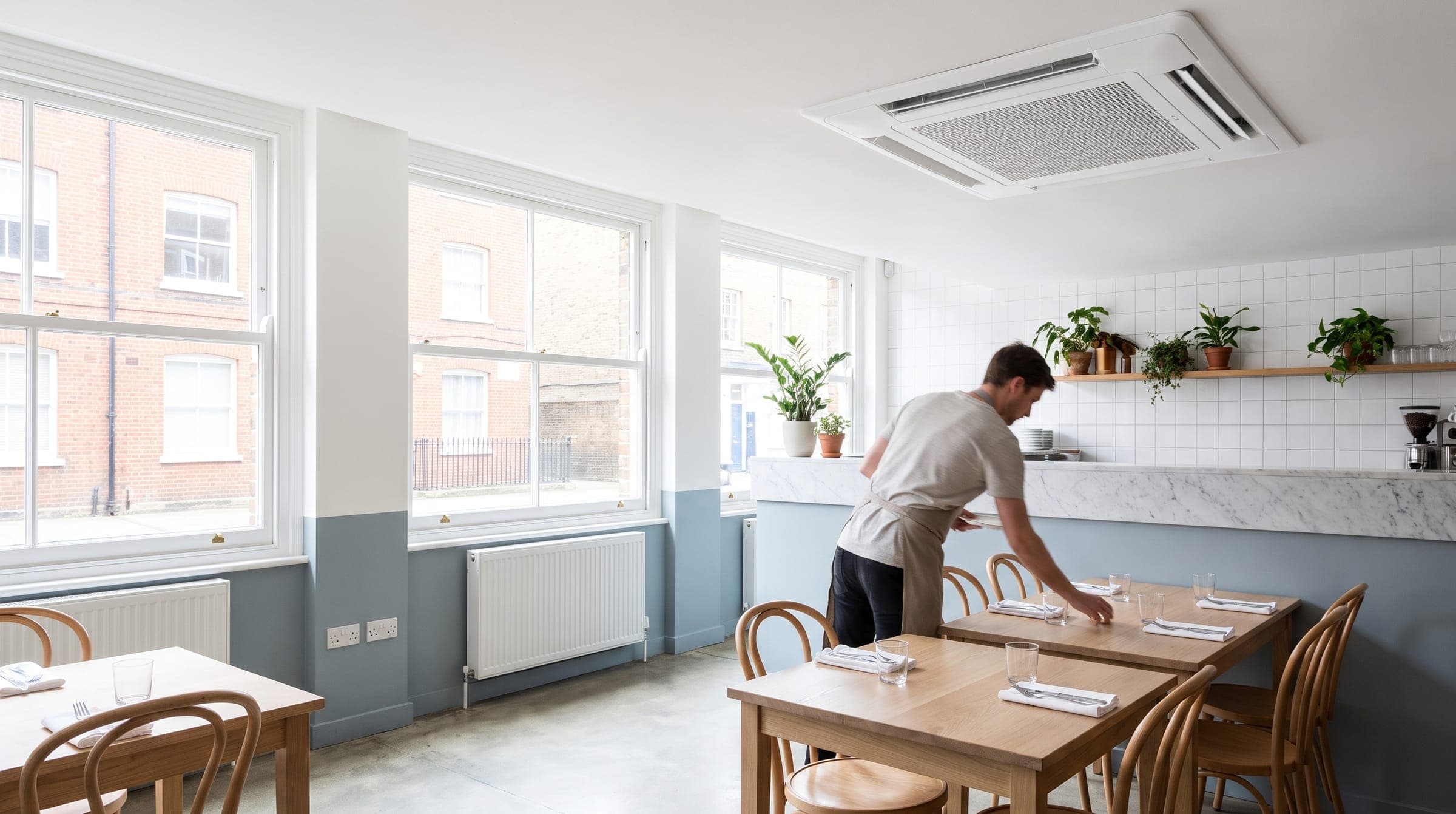
In the dining room, air conditioning does what it does anywhere else: it keeps people comfortable. The heat comes from diners, lighting, the pass, hot food and sunny front windows. Cassettes in a suspended ceiling spread the air evenly across the tables. Where there's no suitable ceiling, wall units work well in smaller rooms.
The kitchen is another matter. Most of its heat comes from cooking, and the extract canopy is already pulling hot, greasy air out. Ventilation in a commercial kitchen is designed by a ventilation specialist, usually to the BESA DW/172 specification, and that comes first. Air conditioning can't fix a kitchen with weak extraction or not enough replacement air.
Grease, heat and where units go
Grease in the air sticks to filters and coils. An indoor unit near the cooking line clogs quickly, loses cooling and becomes a hygiene problem. So we keep units away from the range and fryers, and put them where staff spend long stretches without cooking: prep rooms, pastry sections, the pass end of the kitchen and dry stores.
Watch the balance between the rooms too. If the kitchen extract pulls more air than is replaced, it draws air through from the dining room, dragging cooled air into the kitchen and warm air in through the front door. We look at this at the survey, and flag it if the ventilation needs attention first.
- Indoor units never above food preparation surfaces or open food
- Condensate piped to a proper drain, not left to drip
- Filters easy to reach, because they need cleaning more often than in an office
- Units sized for a full room on a hot evening, not an empty one at lunchtime
Noise and your neighbours
Restaurants often trade late, when streets are quiet and neighbours are trying to sleep. An outdoor unit that nobody hears at midday can be a nuisance at 11pm. Many restaurants also have flats above or behind them, which puts the plant close to bedroom windows.
Councils commonly assess plant noise using BS 4142, which compares the new noise with the existing background level. Some set the limit below that background level. Camden, for example, often sets it 10 dB below. Rear yards, flat roofs set back from the edge, quiet models and acoustic screens all help. We'll give you the manufacturer's sound data for your noise consultant.
Planning and landlord consent
The permitted development rights for heat pumps cover homes and blocks of flats, not restaurants. So an outdoor unit on a restaurant usually needs checking with the council, and often a planning application with a noise report. If the building is listed or in a conservation area, expect closer scrutiny of where the unit goes.
Your lease will almost certainly need the landlord's written consent as well. Apply early, and plan the air conditioning alongside any new kitchen extract, because both need outdoor space and both go to the council.
What we check at a restaurant survey
- Covers, opening hours and how full the room gets at peak
- Window orientation and any glazed frontage
- Ceiling type in the dining room, and the void above it
- Where the kitchen extract runs, and how air moves between kitchen and dining room
- Cool zones in the kitchen where a unit can sit safely away from grease
- Outdoor positions, distance to the nearest neighbouring windows, and access for servicing
- Electrical supply and spare capacity at the board
- Drain routes for condensate
Fitting around service
Survey
We visit at a quiet time, check the dining room and kitchen, and talk through your trading hours.
Quote and documents
You get a fixed written price plus VAT, and the spec sheets and noise data for your landlord and the council.
Plan the work
We agree which areas we work in and when. Our listed prices are for business hours, so tell us if you need anything different.
Install and commission
We fit, pressure test, vacuum and commission the system, leaving the dining room clean and ready for service.
Restaurant air conditioning prices
Starting prices plus VAT. Larger dining rooms and multi-room systems are quoted after a survey.
- from£1,795+ VAT
Commercial wall unit
Fitted in business hours
- from£2,750+ VAT
Ceiling cassette
In a suitable suspended ceiling
Keeping it clean and legal
A restaurant system needs more frequent filter cleaning than an office, especially anything in or near the kitchen. Regular servicing keeps it cooling well, keeps the air cleaner and keeps the manufacturer warranty valid.
If your system holds 5 tonnes CO2 equivalent of refrigerant or more, the F-Gas rules require leak checks at set intervals, and as the operator you must keep records. We combine the leak check with the service visit.
Restaurant air conditioning questions
Can you put air conditioning in a commercial kitchen?
Sometimes, in the right places. Units go in cooler zones away from cooking, such as prep rooms or the pass, and need more frequent cleaning. The main cooling in a kitchen comes from good extraction and replacement air, which a ventilation specialist designs.
Will the outdoor unit annoy my neighbours?
Not if it's chosen and placed with care. We look at the distance to neighbouring windows, use quiet models where needed and suggest screening. The council will often want a noise assessment, especially if you trade late.
Do I need planning permission for restaurant air conditioning?
Often. The permitted development rights for heat pumps don't cover business premises, so check with your council before fitting an outdoor unit. Many councils ask for a noise report with the application.
Cassettes or wall units for a dining room?
Cassettes suit larger dining rooms with a suspended ceiling, because they spread the air from the centre and keep walls clear. Wall units are cheaper to fit and work well in smaller rooms. We'll recommend one at the survey.
How much does restaurant air conditioning cost?
A commercial wall unit starts from £1,795 + VAT and a ceiling cassette from £2,750 + VAT. Larger dining rooms and multi-room systems are priced after a free survey.
How often should restaurant air conditioning be serviced?
At least once a year, and more often for busy sites or any unit in or near the kitchen, where grease builds up on filters and coils. We'll suggest a schedule based on how the system is used.