Air conditioning for flats in London
In a flat, the hard part is rarely the unit itself. It's getting consent, finding a place for the outdoor unit and keeping the neighbours happy. We help with all three, and we give you a consent pack to send to your freeholder or managing agent.
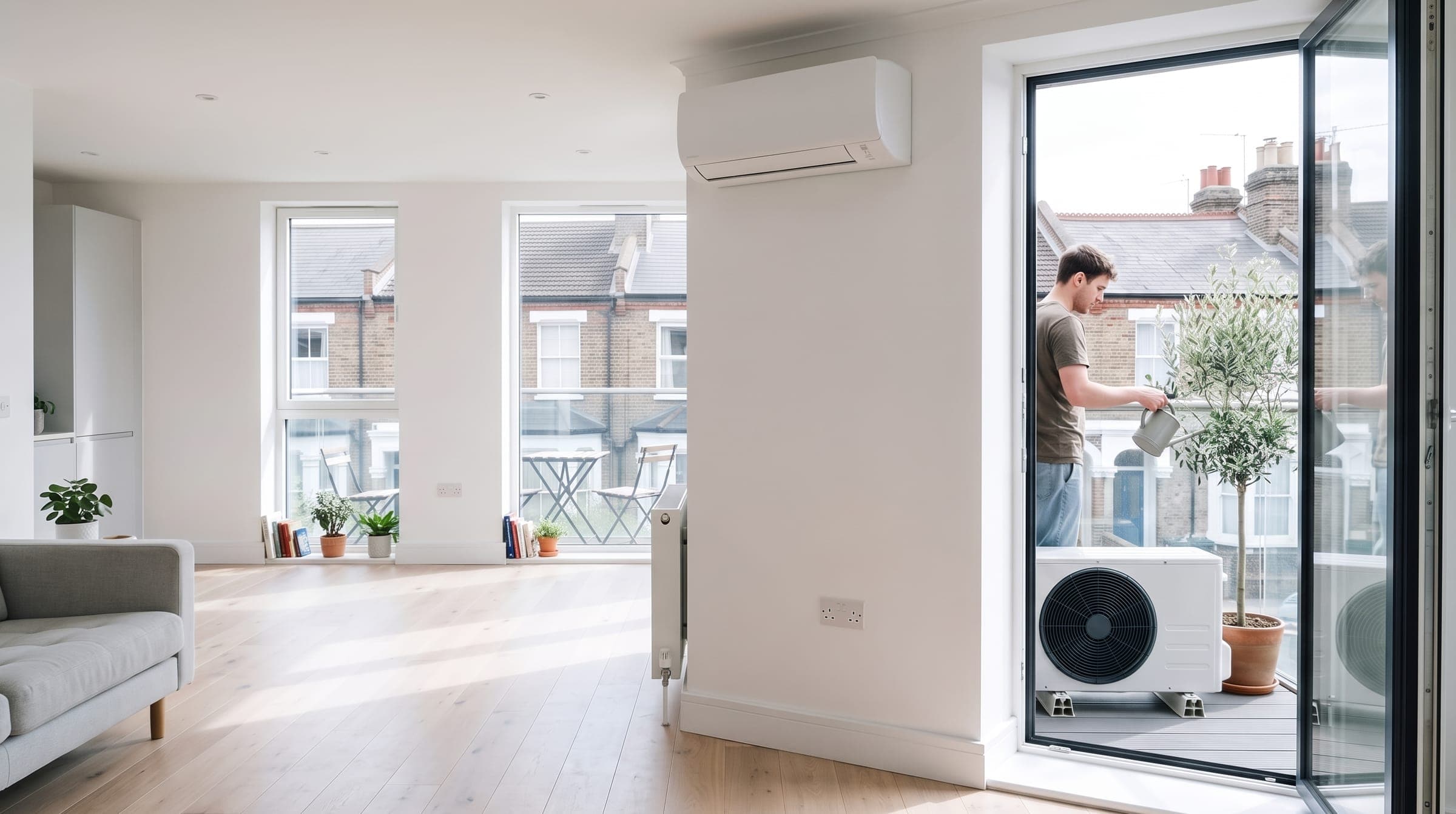
- one room, inc. VAT
- From £1,850
- for your freeholder or agent
- Consent pack
- quietest indoor setting
- 19 dB(A)
- workmanship guarantee
- 2 years
What works in each type of flat
London flats vary more than houses do. This is where we usually start for each type, before the survey confirms it.
| Flat type | The usual challenge | What usually works |
|---|---|---|
| Victorian or Edwardian conversion | A shared freehold or a freeholder upstairs, and other flats close by | Outdoor unit on a rear wall bracket or the flat roof of the back extension |
| Mansion block | Strict managing agents, uniform frontages and often a conservation area | Outdoor unit in a rear lightwell, on a back wall or on the roof, agreed in writing first |
| New-build high-rise | Leases that restrict anything on the outside, and concrete ceilings | Wall units inside, with the outdoor unit on the balcony floor if the lease allows it |
| Ex-council leasehold | The council is your freeholder and has its own alterations process | Apply early and expect a formal application. Rear walls and balconies are the usual positions |
| Top-floor flat | The hottest flat in the block, with heat coming through the roof | Often a 3.5 kW unit or larger, with the outdoor unit on a flat roof if the freeholder agrees |
| Studio | One room doing every job | A single 2.5 kW wall unit, placed so it doesn't blow on the bed or sofa |
Freeholder and managing agent consent
Most leases say you need written consent before altering the structure or the outside of the building. Air conditioning does both: there's a hole through an outside wall and an outdoor unit on the building. The formal consent is usually called a licence for alterations.
Read the alterations clause in your lease. Many say consent is 'not to be unreasonably withheld', which means the freeholder has to act reasonably. The freeholder can usually charge reasonable costs for dealing with your request, such as a surveyor's or solicitor's fee.
Lease consent and planning permission are separate. You may need one, both or neither, and getting one doesn't give you the other. If your freeholder is a council or housing association, it will have its own policy on alterations, and some list air conditioning units specifically.
Getting consent, step by step
Check your lease
Find the alterations clause, and the names of your freeholder and managing agent. If you rent, start with your landlord instead.
Survey and quote
We agree the indoor and outdoor unit positions and the pipe route with you, then send a fixed written quote.
Your consent pack
We give you the product spec sheets, the outdoor unit's noise figures, photos marked with the unit positions and pipe route, and a short method statement.
Send it to the agent
Ask what they need from you: a licence, a surveyor's visit, a fee, or conditions on noise, colour or screening.
Check planning
Flats, conservation areas and listed buildings usually need checks or consent. We check your address and tell you what applies.
Book the install
Once consent is in writing, we book your install date. Your 20% deposit is refunded in full if you cancel within the 14-day cancellation period.
Questions to ask your managing agent
Send these with the consent pack. Clear answers early save weeks later.
- Does my lease need a licence for alterations for air conditioning?
- Is there a fee, and will you need a surveyor or solicitor to review it?
- Where are outdoor units allowed: balcony, rear wall, roof or a plant area?
- Are there rules on noise, colour, screening or working hours?
- Do other flats in the block already have air conditioning?
- What documents do you need from the installer?
- How long does approval usually take?
- Does the building need planning permission, and who applies for it?
Where the outdoor unit can go
Every split system needs an outdoor unit with a clear flow of air. Our standard price includes up to 5 m of pipe, and longer runs are possible within the manufacturer's limits.
- Balcony: on a low stand with anti-vibration feet, if the lease allows it. We check the floor can drain the water the unit gives off
- Flat roof: on a frame or feet that protect the roof covering, with safe access for servicing
- Rear wall bracket: the most common option. High positions may need an access tower, which we quote for
- Lightwell or communal plant area: usually set by the managing agent, and often the neatest answer in mansion blocks
Noise and neighbours
Indoor units are very quiet. Daikin Perfera and Panasonic Etherea wall units run at 19 dB(A) on their quietest setting, about a whisper. Their outdoor units are rated at 46–48 dB(A) at full speed, and spend most of their time running slower than that.
In a block, the outdoor unit is what neighbours notice, so we plan around it. We keep it away from bedroom windows, yours and theirs, use anti-vibration mounts, and avoid fixing it to a wall that backs onto someone else's bedroom. Councils can also set noise conditions where planning permission is needed.
Renting a flat
If you rent, you need your landlord's written permission, and your landlord will usually need the freeholder's consent too. Agree in writing who owns the system, whether it stays at the end of the tenancy, and who pays for servicing.
If you're the landlord, the same consent steps apply. Keep the service records: manufacturers need a yearly service to keep their warranty valid, and any F-Gas certified engineer can do it.
Air conditioning prices for flats
A studio or one-bed usually needs one wall unit. A two-bed with a separate living room often suits a two-room multi-split. Access towers and managing agent fees are extra, and we list them in your quote.
- from£1,850inc. VAT
A bedroom or study
2.5 kW wall unit, 5 m pipe, fitted in a day
- from£2,050inc. VAT
A living room
3.5 kW wall unit
- from£2,450inc. VAT
Open plan or a loft
5 kW wall unit
- from£3,650inc. VAT
Two rooms, one outdoor unit
Multi-split
- from£5,100inc. VAT
Three rooms
Multi-split
Flat air conditioning questions
Do I need my freeholder's permission for air conditioning?
Almost always, if you're a leaseholder. Most leases need written consent for alterations to the structure or outside of the building, and air conditioning involves both. Check the alterations clause in your lease, then send your managing agent our consent pack.
Do I need planning permission for air conditioning in a flat?
Often you do, or at least a check first. The planning rules for flats are tighter than for houses, and conservation areas and listed buildings add more. Planning is separate from your lease consent. We check your address at the survey, and our planning guide explains the current rules.
What if my freeholder says no?
Ask for the reasons in writing. Many refusals are about the outdoor unit's position or noise, and a different position or a quieter model can solve it. If your lease says consent can't be unreasonably withheld, the freeholder has to act reasonably. For a dispute, take legal advice.
How much does air conditioning cost for a flat?
A single 2.5 kW wall unit for a studio or bedroom starts from £1,850, including VAT. A 3.5 kW unit for a living room starts from £2,050. A two-room multi-split starts from £3,650, and three rooms from £5,100. Access towers and managing agent fees are extra.
Will the outdoor unit disturb my neighbours?
It shouldn't, if it's in the right place. Outdoor units for one room are rated at around 46–48 dB(A) at full speed and usually run slower. We keep them away from bedroom windows, fit anti-vibration mounts and give you the noise figures for your freeholder.
Where does the water from the indoor unit go?
Cooling takes moisture out of the air, which drains through a small pipe that runs with the refrigerant pipes. Usually it falls naturally to a drain or gully outside. If it can't fall, a small condensate pump lifts it, which we'd tell you about at the survey.
Can I install air conditioning in a rented flat?
Only with your landlord's written permission, and they'll usually need the freeholder's consent too. Agree in writing who owns it, whether it stays when you move out, and who pays for servicing.
Can I have air conditioning without an outdoor unit?
Through-wall and water-cooled systems exist, but through-wall units are louder in the room and generally less efficient than a split system. The systems we fit all have an outdoor unit, so we'll tell you honestly if your flat suits one.