Quiet air conditioning for bedrooms
A bedroom unit has one job: keep the room cool without you noticing it. That means a quiet model, the right size, and a position where the air never lands on the bed. Most bedrooms are fitted in a day, so you can sleep cool the same night.
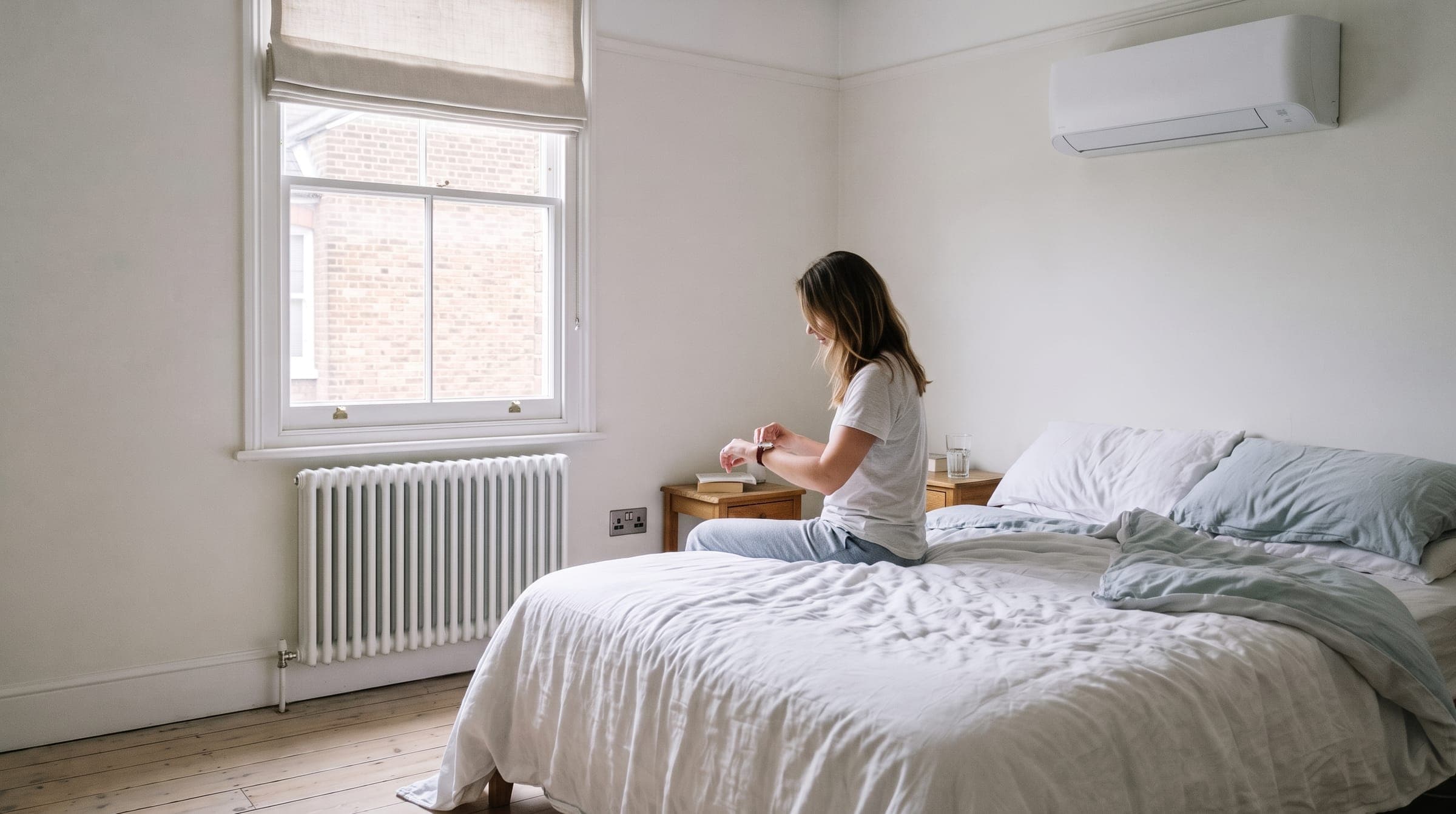
- quietest indoor setting
- 19 dB(A)
- 2.5 kW, inc. VAT
- From £1,850
- an hour to cool, 2.5 kW
- 7–13p
- most bedroom installs
- 1 day
How quiet are bedroom units?
Indoor sound levels in cooling mode, in dB(A), from the manufacturers' UK spec sheets. 19 dB(A) is about a whisper. Every 10 dB sounds roughly twice as loud.
| Model | Quietest | Low fan | High fan |
|---|---|---|---|
| Daikin Perfera 2.5 kW (FTXM25A) | 19 | 25 | 41 |
| Daikin Perfera 3.5 kW (FTXM35A) | 19 | 29 | 45 |
| Daikin Comfora 2.5 kW (FTXP25N) | 19 | 26 | 40 |
| Daikin Comfora 3.5 kW (FTXP35N) | 20 | 27 | 43 |
| Daikin Sensira 2.5 kW (FTXF25E) | 20 | 26 | 40 |
| Panasonic Etherea 2.5 kW (KIT-Z25-CKE) | 19 | 25 | 39 |
| Panasonic Etherea 3.5 kW (KIT-Z35-CKE) | 19 | 28 | 42 |
| Panasonic TZ 2.5 kW (TZ25) | 20 | 26 | 40 |
| Panasonic TZ 3.5 kW (TZ35) | 20 | 30 | 42 |
We also fit Mitsubishi Electric and LG. For any model we quote, we give you the manufacturer's own noise figures before you decide.
What temperature is best for sleep?
UK sleep charities suggest a cool bedroom, around 16–18°C for adults. For a baby's room, the Lullaby Trust advises 16–20°C. In a London heatwave, a top-floor bedroom can stay well above that long after bedtime.
You don't need to chase the lowest number. Bringing a hot room down to around 20°C makes a big difference to sleep, and a smaller gap between inside and outside costs less to run. On humid nights, the dry mode takes moisture out of the air, which makes the room feel cooler at the same temperature.
The easiest routine: close the door and switch on half an hour before bed, then let the sleep or night setting take over.
Where the unit goes
The aim is air that moves across the room above you, not down onto you. Wall units throw air forwards and outwards, so placement matters more than people expect.
- Above the headboard can work well, because the air shoots away from you towards the foot of the bed
- A side wall is often best, throwing air across the room above the bed
- Avoid the wall facing your pillow at close range, where the air lands on your face
- Keep clear space above the unit and away from tall wardrobes, so the air can flow
- Most remotes let you fix the louvre angle, so the air stays high once it's set
- An outside wall gives the shortest pipe run and the simplest drain
What size unit for your bedroom
Starting points for London bedrooms. Big south or west-facing windows, top-floor rooms and lofts need more, and we confirm the size at the survey.
| Room | Typical size | Unit |
|---|---|---|
| Box room or nursery | Up to about 10 m² | 2.5 kW |
| Double bedroom | About 10–20 m² | 2.5 kW |
| Main bedroom with a bay or en suite | About 20–30 m² | 3.5 kW |
| Loft bedroom, or a very sunny room | Any | Often 3.5 kW or 5 kW |
A bigger unit isn't better. An oversized unit switches on and off more, is louder and costs more to run.
Children's rooms
Children often struggle most in a hot summer, and a cool, quiet room helps the whole house sleep. For a nursery, we place the unit so the air never points at the cot, and we'll show you how to set it to the Lullaby Trust's 16–20°C range.
- Units sit high on the wall, out of reach, with no exposed wires or hot surfaces
- Many remotes have a child lock, and Wi-Fi control lets you check the room from your phone
- The display light can usually be dimmed or switched off for dark rooms
- Clean filters keep the air fresh. It takes a minute, and we show you how
Night and sleep settings
The names differ by brand, but most units we fit have the same useful settings. A quiet fan setting runs the indoor unit at its lowest sound level. A sleep or night setting eases the temperature up gradually overnight, so you're not too cold by morning. Many outdoor units have a quiet mode too, which helps when they're near bedroom windows.
Timers switch the unit off an hour or two after you fall asleep, or back on before you wake. With Wi-Fi control, you can cool the room on your way home.
What it costs to run at night
At the October to December 2026 price cap of 26.32p per kWh, a 2.5 kW unit typically costs 7–13p an hour to cool a bedroom, and a 3.5 kW unit 10–20p. An eight-hour night in a 2.5 kW room works out at about 56p to £1.04. Inverter units slow down once the room is cool, so most hours cost less than the top figure.
Bedroom air conditioning prices
One bedroom usually needs a 2.5 kW wall unit. Two or three bedrooms can share one outdoor unit on a multi-split. Premium ranges are quieter and more efficient.
- from£1,850inc. VAT
A bedroom or study
2.5 kW wall unit, 5 m pipe, fitted in a day
- from£2,050inc. VAT
A living room
3.5 kW wall unit
- from£250inc. VAT
Premium range upgrade
Quieter, more efficient unit
- from£550inc. VAT
Design range upgrade
Daikin Emura, Mitsubishi Electric Zen, LG Artcool
- from£3,650inc. VAT
Two rooms, one outdoor unit
Multi-split
- from£5,100inc. VAT
Three rooms
Multi-split
Bedroom air conditioning questions
How loud is bedroom air conditioning?
On the quietest setting, good wall units run at 19–20 dB(A), about a whisper. On high fan they reach around 39–45 dB(A), which you'll only need for a quick cool-down. Daikin Perfera and Panasonic Etherea units are rated at 19 dB(A) on their quietest setting.
What size air conditioner do I need for a bedroom?
Most double bedrooms up to about 20 m² need a 2.5 kW unit. A large main bedroom of 20–30 m² usually needs 3.5 kW. Loft bedrooms and very sunny rooms may need more. We confirm the size at the survey.
How much does it cost to run air conditioning all night?
About 56p to £1.04 for an eight-hour night with a 2.5 kW unit, at the October to December 2026 price cap of 26.32p per kWh. Inverter units slow down once the room is cool, so most nights cost nearer the lower figure.
Is it safe to sleep with air conditioning on?
Yes. Some people find cool, moving air dries their throat or nose. Keeping the filters clean, setting the louvre so the air doesn't blow on you and not over-cooling the room all help. The sleep setting also raises the temperature gently through the night.
Is air conditioning safe in a baby's room?
Yes, used sensibly. Fit it high on the wall, point the air away from the cot and keep the room within the Lullaby Trust's advised 16–20°C. A room thermometer near the cot is a good check. Keep the filters clean.
Can one outdoor unit serve all the bedrooms?
Yes. A multi-split runs two to four indoor units from one outdoor unit, with separate controls in each room. A two-room system starts from £3,650 and a three-room system from £5,100, including VAT.
How long does it take to fit air conditioning in a bedroom?
A single bedroom unit with a short pipe run usually takes four to eight hours, so it's working that evening. A multi-split for two to four bedrooms usually takes one to three days.
Will it heat the bedroom in winter as well?
Yes. The systems we fit are reversible heat pumps, so the same unit takes the chill off a cold bedroom quickly and efficiently.