Do you need planning permission for air conditioning?
Often not, for a heating-capable system on a house in England, as long as it meets every permitted development rule. The rules changed on 29 May 2025, and many guides still quote the old ones. This page sets out the current law, where each rule comes from, and when you do need to apply.
- when the current rules started
- 29 May 2025
- outdoor unit limit on a house
- 1.5 m³
- noise limit at the neighbour's window
- 37 dB(A)
- the unit must heat as well
- Not cooling-only
The short answer
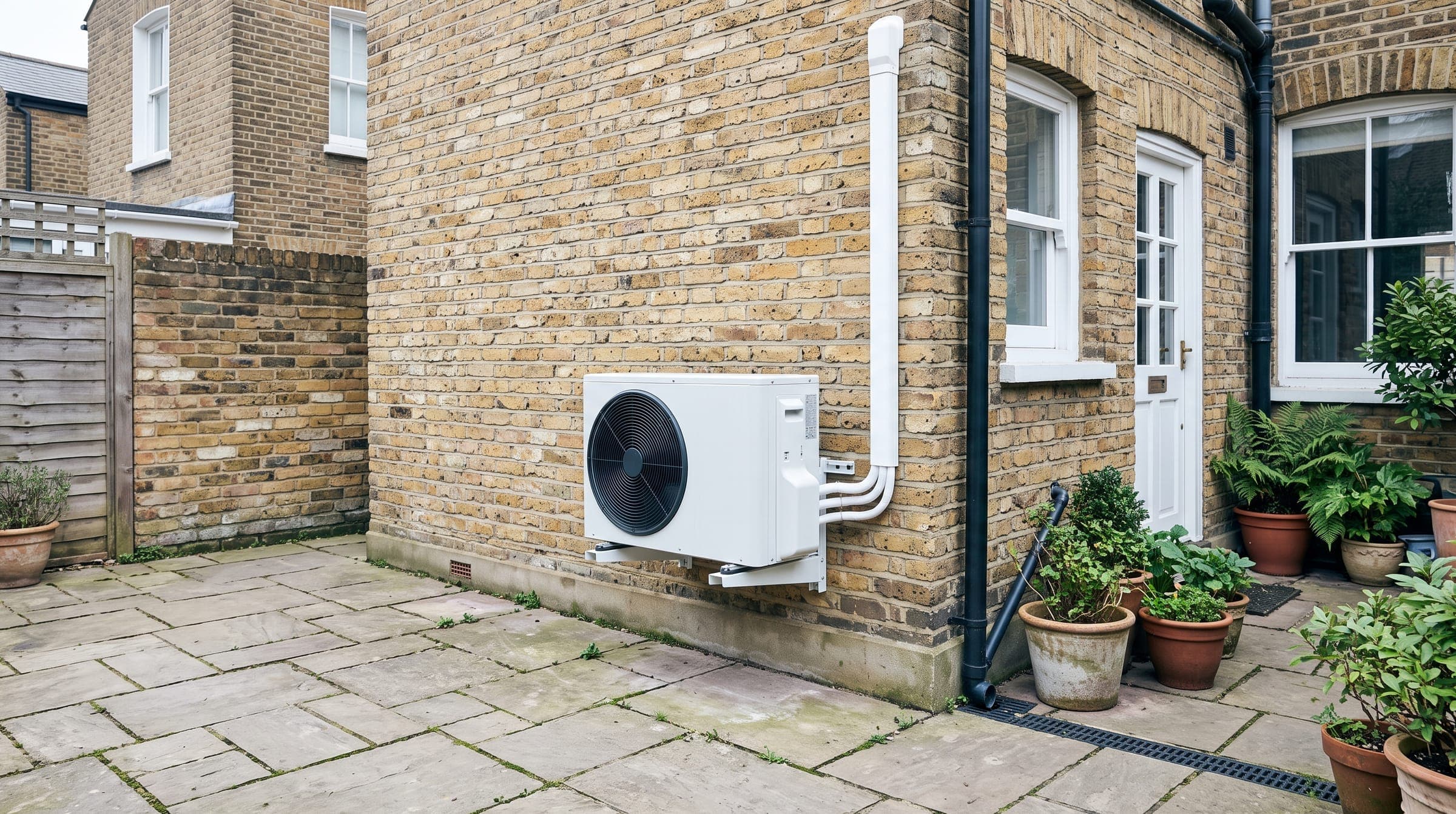
In planning law, air conditioning that can heat your home is an air source heat pump. Installing one on a house or a block of flats in England is permitted development under Class G of Part 14 of the General Permitted Development Order 2015. Permitted development means you don't need to apply for planning permission, as long as every limit and condition is met.
The Town and Country Planning (General Permitted Development) (England) (Amendment) Order 2025, SI 2025/560, rewrote those rules from 29 May 2025. Since then, a unit that heats and cools can qualify, but a cooling-only unit can't. If any rule below isn't met, you need full planning permission.
What changed on 29 May 2025
A guide that mentions a 1 metre boundary rule or a 0.6 m³ limit for houses is out of date. These are the changes, as the explanatory memorandum to SI 2025/560 describes them.
- The rule banning units within 1 metre of the property boundary was removed
- The outdoor unit limit for a house rose from 0.6 m³ to 1.5 m³. Blocks of flats stay at 0.6 m³
- A detached house can now have two heat pumps. Other houses and blocks of flats can have one
- The old condition that a heat pump be used solely for heating was replaced. Now it must not be used solely for cooling, which brings heating-capable air conditioning into the rules
- The noise standard is now MCS 020(a), with no option to use an equivalent standard
The permitted development rules for a house
From Class G as it stands today. Your installation must meet every one of these to avoid a planning application.
- The unit heats as well as cools. Class G condition G.3(aa): it must not be used solely for cooling
- It meets the MCS Planning Standards, now MCS 020(a), the noise calculation (G.1)
- No more than one heat pump on, or within the grounds of, a semi-detached or terraced house, or two on a detached house (G.2(a))
- The outdoor unit, including any housing, is no bigger than 1.5 m³ (G.2(d))
- It isn't on a pitched roof, or on a flat roof within 1 metre of the roof's edge (G.2(f) and (g))
- The house isn't a listed building, and the site isn't a scheduled monument (G.2(h) and (i))
- There's no wind turbine on the building or in the grounds (G.2(b) and (c))
- In a conservation area or World Heritage Site: not on a wall or roof that fronts a highway, and no nearer to a bordering highway than the house itself (G.2(j))
- Elsewhere: not on a wall that fronts a highway, above ground-floor level (G.2(k))
- Sited, so far as practicable, to minimise its effect on the look of the building and on the amenity of the area (G.3(b) and (c))
- Removed as soon as reasonably practicable when it's no longer needed (G.3(d))
The noise rule: MCS 020(a)
MCS 020(a), Air Source Heat Pump Sound Calculation (For Permitted Development Installations), has applied to permitted development installs since 20 September 2025. It sets a limit of 37 dB(A) at each assessment position. Many guides still quote 42 dB(A), a figure from the earlier version of the standard.
An assessment position is 1 metre outside the centre of a door or window to a habitable room of a neighbouring property. Habitable means rooms for living or sleeping, not bathrooms, hallways or utility rooms. On a block of flats, the other flats in the same block count as neighbours.
The calculation uses the unit's sound power level from the manufacturer, the distance to each neighbouring window, nearby walls that reflect sound and any solid barrier in between. Every neighbouring window that could be affected has to come out at 37.0 dB(A) or lower. If a position fails, moving the unit or adding a barrier can sometimes fix it. We give you the manufacturer's sound data for the model we quote.
Flats and leasehold homes
Class G does cover blocks of flats, despite what some guides say. The limits are tighter: one heat pump per block, on or within the grounds of the block, with an outdoor unit no bigger than 0.6 m³. If the block already has one, a second needs planning permission. Most outdoor units for one or two rooms are well under 0.6 m³, but always check the model's height, width and depth.
Planning is only half of it. Most leases need the freeholder's written consent for alterations, often called a licence for alterations, whatever the planning position. Apply early, because freeholders and managing agents can take weeks to reply and may charge a fee. Our flats page explains how to put the request together.
Conservation areas, listed buildings and Article 4 directions
In a conservation area, you can still use permitted development for a unit at the back or side of the house, as long as it isn't on a wall or roof facing a highway and isn't closer to a bordering highway than the house. Your council's website has a map of its conservation areas.
If your house or block is a listed building, Class G doesn't apply at all. You need planning permission, and usually listed building consent too. You can check whether a building is listed on Historic England's National Heritage List.
Councils can also remove permitted development rights in an area with an Article 4 direction, and some planning permissions, often on newer estates, include a condition that removes them. Check with your council if you're not sure.
Do I need to apply? A quick decision table
For a heating-capable split system on a home in England. Each row assumes every other rule is met.
| Your situation | Permitted development? | What to do |
|---|---|---|
| One unit on the back wall of a house, not listed | Usually yes | No application if the noise calculation passes |
| Second unit on a terraced or semi-detached house | No | Apply for planning, or use one multi-split outdoor unit |
| Two units on a detached house | Yes, if each meets the limits | Check the noise calculation covers both units |
| Cooling-only unit | No | Apply for planning permission |
| First unit on a block of flats, up to 0.6 m³ | Can be | Also get the freeholder's consent |
| Block of flats that already has a heat pump | No | Apply for planning permission |
| Conservation area, back wall away from the road | Can be | Check the highway rules carefully |
| Conservation area, front wall facing the street | No | Apply for planning permission |
| Front wall facing a highway, above ground floor | No | Apply for planning permission |
| Pitched roof | No | Apply for planning permission |
| Flat roof, at least 1 m from the edge | Can be | Check access and the noise calculation |
| Listed building | No | Planning permission and listed building consent |
| Article 4 direction or rights removed by condition | Check | Ask your council |
| Noise calculation over 37 dB(A) at any window | No | Move the unit, add a barrier, or apply |
This guide covers homes. Offices, shops and other business premises follow different rules, so ask the council.
When you need planning permission, and how to apply
If your installation falls outside Class G, you apply to your council, usually through the Planning Portal. A householder application normally needs drawings showing the unit's position, the manufacturer's details and often a noise report. Councils normally have 8 weeks to decide a householder application, and can attach conditions to an approval, such as a noise limit at the nearest neighbour.
Installing without permission when you needed it is a planning breach. The council can take enforcement action and require the unit to be removed. Checking first costs far less than moving a unit later.
Lawful Development Certificates
If you're confident your installation is permitted development but want it in writing, you can apply to the council for a Lawful Development Certificate for a proposed development, under section 192 of the Town and Country Planning Act 1990. There's a fee, so check your council's current charge.
It isn't compulsory, but it's useful when a case is borderline, such as a corner plot or a tight noise calculation, and when you come to sell.
Building Regulations and F-Gas
Planning isn't the only rule. Under Part P of the Building Regulations, adding a new electrical circuit in a home is notifiable work. It must be certified by an electrician registered with a competent person scheme, or approved by building control. Connecting to a suitable existing fused spur usually isn't notifiable.
Handling refrigerant is restricted to F-Gas certified engineers. Our engineers are F-Gas certified, and the refrigerant in your system is recorded when we commission it.
Planning permission questions
Do I need planning permission for air conditioning in London?
London follows the same rules as the rest of England. A heating-capable unit on a house is usually permitted development if it meets the Class G limits. Many London homes are in conservation areas, where units on walls facing the street need permission, so check your council's conservation area map first.
Why does a cooling-only unit need planning permission?
Because since 29 May 2025, Class G condition G.3(aa) says the heat pump must not be used solely for cooling. The rules exist to support low-carbon heating, so a unit that only cools falls outside them. All the home systems we fit heat as well as cool.
How big can the outdoor unit be?
Up to 1.5 m³, including any housing, on a house. Up to 0.6 m³ on a block of flats. A typical outdoor unit for a single room is much smaller than either limit, but check the actual model.
Can I put the outdoor unit on the front of my house?
Outside a conservation area, yes at ground-floor level, but not higher up on a wall facing a highway. In a conservation area or World Heritage Site, no unit can go on a wall or roof facing a highway under permitted development.
Can I fit air conditioning in a flat without planning permission?
Sometimes. Class G allows one heat pump per block of flats, with an outdoor unit up to 0.6 m³, if the other rules are met. If the block already has one, you need permission. You'll almost always need the freeholder's consent as well.
Do I need permission for a listed building?
Yes. Permitted development doesn't apply if the house or block of flats is listed. You'll need planning permission and usually listed building consent.
Will you check planning before installing?
Yes. At the survey we check the outdoor position against the Class G limits, look for conservation area and listed status, and tell you if we think you need an application or a Lawful Development Certificate. The decision is the council's, so ask them if there's any doubt.
Do the same rules apply in Wales or Scotland?
No. This guide covers England. Wales and Scotland set their own permitted development rules. We work in London and the Home Counties, all in England.