F-Gas leak checks for air conditioning and heat pumps
If your air conditioning holds 5 tonnes CO2 equivalent of refrigerant or more, the law says it must be checked for leaks at set intervals, and records kept. We work out whether your system is covered, carry out the checks with F-Gas certified engineers and keep the log for you.
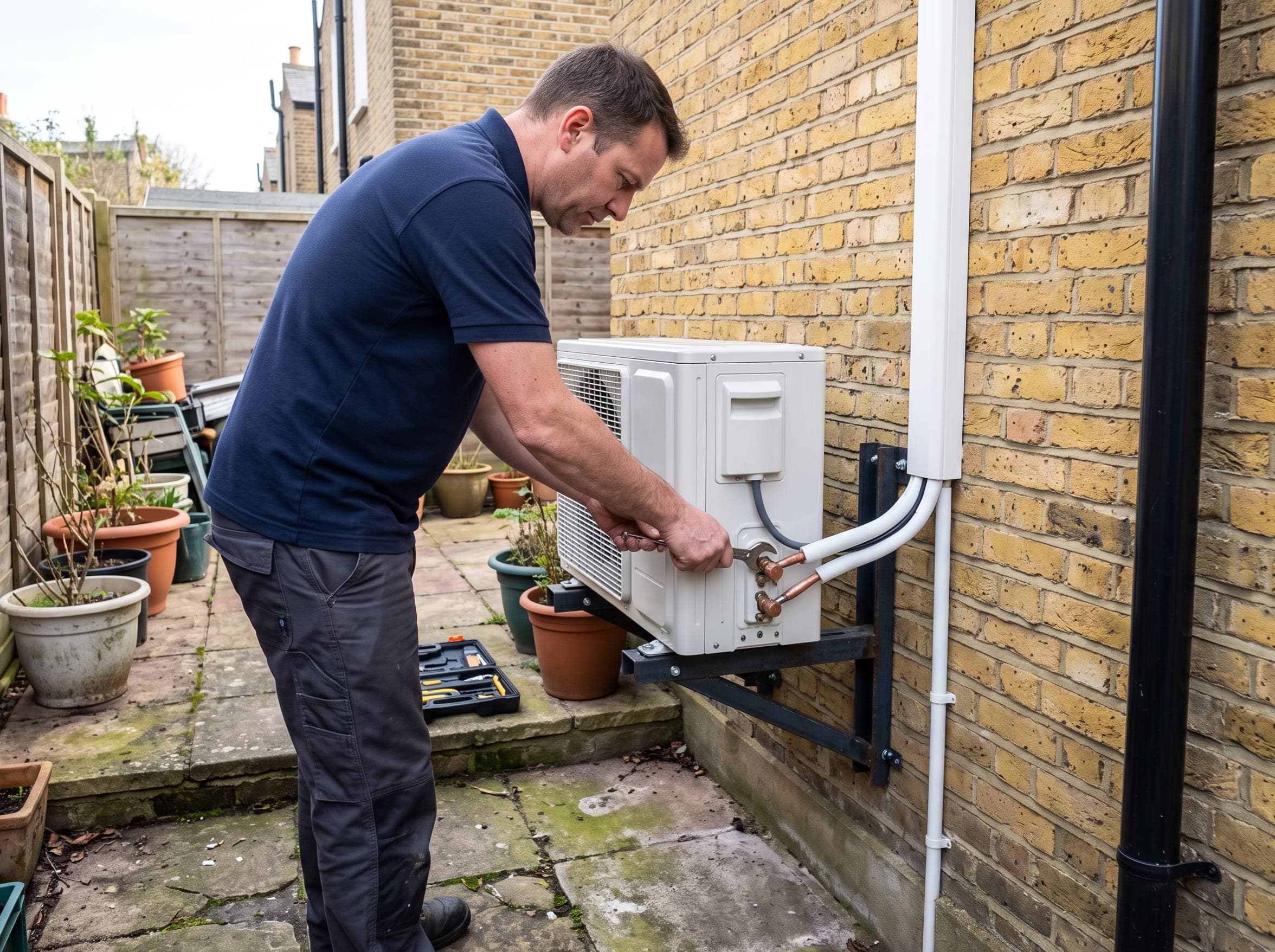
- the line where checks start
- 5 tCO2e
- longest gap from 5 to 50 tCO2e
- 12 months
- records must be kept
- 5 years
- certified engineers
- F-Gas
The law in Great Britain
Leak checks come from the F-Gas Regulation, Regulation (EU) No 517/2014 as it was kept in GB law after Brexit, together with the Fluorinated Greenhouse Gases Regulations 2015. The rules on this page are the ones in force in October 2026.
The duty falls on the operator: the person or business in actual control of how the equipment runs. For a home, that's the homeowner. For a business, it's usually the occupier. If you rent the equipment or the building, your agreement can decide who is responsible, so check it.
How often the law says to check
The interval depends on how much refrigerant the system holds, measured in tonnes of CO2 equivalent (tCO2e), not on its kW size. These are the maximum gaps between checks under Article 4.
| Refrigerant charge | Without leak detection | With automatic leak detection |
|---|---|---|
| Under 5 tCO2e | No legal leak check needed | No legal leak check needed |
| 5 to under 50 tCO2e | At least every 12 months | At least every 24 months |
| 50 to under 500 tCO2e | At least every 6 months | At least every 12 months |
| 500 tCO2e or more | Automatic leak detection is compulsory | At least every 6 months |
Hermetically sealed equipment, labelled as such, is exempt below 10 tCO2e. A split system joined with pipework on site doesn't usually qualify.
What that means in kilograms
To turn kilograms into tCO2e, multiply the charge in kg by the refrigerant's GWP and divide by 1,000. The charge is on the outdoor unit label, plus any gas added on site for long pipe runs.
| Threshold | R32 (GWP 675) | R410A (GWP 2,088) |
|---|---|---|
| 5 tCO2e | About 7.4 kg | About 2.4 kg |
| 50 tCO2e | About 74 kg | About 24 kg |
| 500 tCO2e | About 741 kg | About 240 kg |
Most single wall units hold well under 5 tCO2e. Larger multi-splits, ducted and commercial systems, and older R410A systems, are the ones most often over the line.
What a leak check involves
We follow the standard leak checking requirements kept in GB law from Regulation (EC) No 1516/2007.
- Read the equipment records first, looking for past leaks and problem areas
- Check pipe joints and connections
- Check valves, including their spindles
- Check seals, including those on driers and filters
- Check parts that vibrate, and the connections to safety and control devices
- Look for oil marks, corrosion, damage, ice or poor cooling, which all suggest a leak
- Measure pressures and temperatures and compare them with normal running
- Confirm any suspected leak with an electronic detector that picks up at least 5 grams a year, or bubble solution
- Write up the date and result in the F-Gas record
If we find a leak
The operator must have the leak repaired without undue delay. For equipment that needs leak checks, a certified engineer must check the repair within one month to make sure it has worked.
We give you a written price for the repair first. Once it's done, we refill the system to the right weight, record the gas added and book the follow-up check. Our regas page explains how a repair and refill works.
Records you must keep
For every system that needs leak checks, the operator must keep records for at least five years. The engineer who services the system must keep copies too. The Environment Agency can ask to see them.
- The type and amount of refrigerant in the system
- Any refrigerant added, during installation, servicing or after a leak
- Whether any gas used was recycled or reclaimed, and where it came from
- Any refrigerant recovered
- The company that installed, serviced or repaired it, with its certificate number
- The date and result of every legal leak check
- If the system was taken out, how the gas was recovered and disposed of
Who can carry out a leak check
Leak checks on air conditioning and heat pumps must be done by a person with the right F-Gas qualification. It's against the law to work on F-Gas equipment without one, and breaking the leak check or repair rules can lead to a civil penalty.
Our engineers are F-Gas and REFCOM certified. We combine the leak check with the service visit where we can, so you have one visit and one record.
What it costs
Every service we carry out includes a check of the pipe joints for signs of a leak. Where a system needs a legal leak check, we do it on the same visit and price it with the service. Business sites with several systems are quoted after a survey, plus VAT.
- from£119inc. VAT
An annual service
Keeps the manufacturer warranty valid
- from£59inc. VAT
Each extra indoor unit
Same visit
F-Gas leak check questions
Does my air conditioning need an F-Gas leak check?
Only if it holds 5 tonnes CO2 equivalent of refrigerant or more. That's about 7.4 kg of R32 or 2.4 kg of R410A. Look at the label on the outdoor unit for the refrigerant type and charge, or send us a photo and we'll work it out.
How often are F-Gas leak checks needed?
At least every 12 months from 5 to under 50 tCO2e, every 6 months from 50 to under 500, and every 3 months at 500 or more. Fitting automatic leak detection doubles each interval, and it's compulsory at 500 tCO2e or more.
Who is responsible for F-Gas leak checks?
The operator, meaning the person or business in actual control of how the system runs. For a business that's usually the occupier. If you lease the equipment or the building, your agreement may set out who is responsible.
How long must F-Gas records be kept?
At least five years. The records cover the refrigerant in the system, any gas added or recovered, who worked on it and the date and result of each leak check.
Is a leak check the same as a service?
No. A leak check looks for refrigerant leaks and is a legal duty for larger systems. A service cleans and tests the whole system for efficiency and your warranty. We usually do both on one visit.
What happens if a leak is found?
It must be repaired without undue delay, and the repair checked again by a certified engineer within one month. We price the repair in writing first and record everything in the F-Gas log.