Air conditioning regas, with the leak found and fixed first
If your air conditioning is low on refrigerant, it has a leak. A split system is sealed, so the gas doesn't get used up. We find the leak, repair it, test the repair and then refill to the right weight. A top-up on its own just lets the gas escape again.
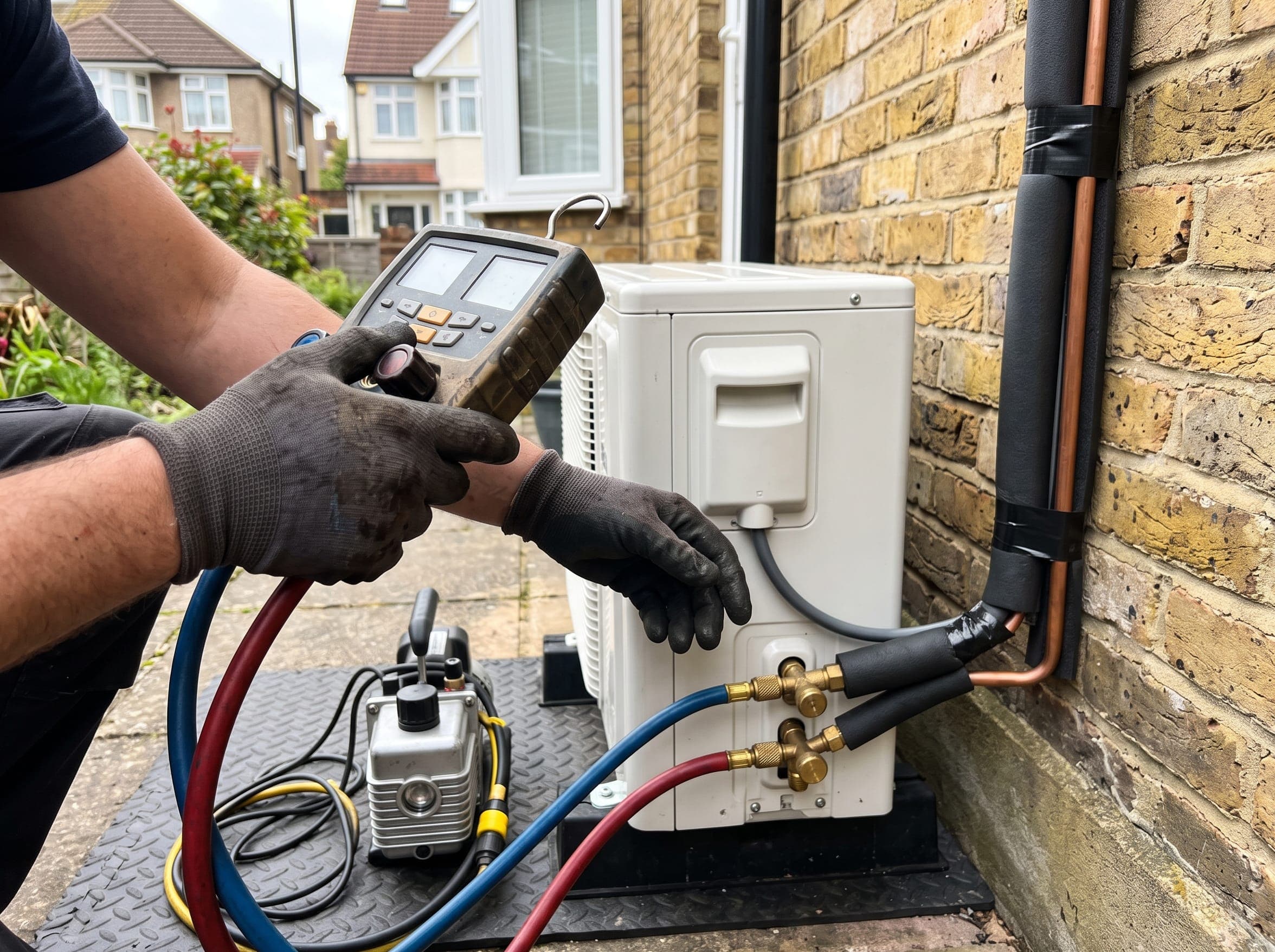
- diagnostic visit, deducted
- £125
- found and fixed before refilling
- Leak first
- refilled to the correct charge
- By weight
- certified engineers
- F-Gas
Why a regas on its own is the wrong fix
Air conditioning isn't like a car that burns fuel. The refrigerant goes round a closed circuit of pipes, coils and valves, over and over, for the life of the system. If the amount drops, it has escaped somewhere: a flare joint that has worked loose, a pinhole in a coil, a worn valve or a damaged pipe.
Topping up without finding that leak means paying for gas that will leak out again, sometimes within weeks. It also goes against the law. Under the F-Gas rules, operators must take precautions to prevent leaks and repair any leak found without undue delay. So we don't offer a top-up and go. Every regas starts with finding the leak.
Signs your system may be low on refrigerant
These can have other causes, such as dirty filters or a blocked outdoor coil, which is why we diagnose before quoting.
- It runs but blows cool, not cold, air, or struggles on hot days
- Ice or frost on the pipes, the indoor coil or the outdoor unit
- A hissing or bubbling sound from the pipes or the unit
- An error code that points to low refrigerant or high temperatures
- Oily marks on pipe joints, the outdoor unit or the trunking
- It takes much longer to reach the set temperature than it used to
How we find the leak and regas
Diagnose
We check the filters, coils and fans, then measure pressures and temperatures to confirm whether the charge is really low.
Find the leak
We check the joints, valves and coils with an electronic leak detector and bubble solution. Where needed, we recover the gas and pressure test the circuit with nitrogen.
Price
You get a written price for the repair and regas before any work starts.
Repair
We remake the faulty joint, or replace the leaking valve, pipe or coil, then pressure test to prove the repair holds.
Vacuum and refill
We pull a deep vacuum to clear air and moisture, then weigh in the correct charge of the right refrigerant.
Test and record
We run the system in cooling and heating, check the air temperatures and record the gas added, as the F-Gas rules require.
What a regas costs
Every regas starts with a diagnostic visit. It covers the first hour on site and comes off the bill if you go ahead. The repair and the refrigerant are priced in writing after diagnosis, because they depend on where the leak is and how much gas the system holds.
- from£125inc. VAT
Repair diagnostic visit
First hour on site, deducted if you go ahead
R32 and R410A: which gas is in your system?
The refrigerant type and the factory charge are printed on the label on the outdoor unit. A system must be refilled with the same refrigerant it was designed for.
| Refrigerant | R32 | R410A |
|---|---|---|
| Where you'll find it | Most new home split systems | Many older split systems |
| Global warming potential (GWP) | 675 | 2,088 |
| New single splits under 3 kg | Still allowed | Banned in Great Britain since 1 January 2025 |
| Can it still be regassed? | Yes, after the leak is repaired | Yes, after the leak is repaired |
| Gas weight for 5 tonnes CO2 equivalent | About 7.4 kg | About 2.4 kg |
GWP figures are from Annex I of the GB F-Gas Regulation. R410A is a 50/50 blend of R32 and R125, so its GWP is the average of the two.
Who can legally handle refrigerant
In Great Britain it's against the law to install, service, leak check, recover gas from or decommission air conditioning without the right F-Gas qualification. Releasing refrigerant into the air on purpose is banned. Breaking these rules can lead to a civil penalty.
Our engineers are F-Gas and REFCOM certified. We recover any gas we take out into proper recovery cylinders, never vent it, and keep a record of what was recovered and what was added.
When a regas isn't worth it
Most leaks are at a joint and are cheap to fix. A leak deep inside a corroded coil, or a system that has leaked several times, can cost more to repair than it's worth. If that's the case, we'll say so and give you the price of a repair and a replacement side by side, so you can choose.
If your system is still under the manufacturer's warranty, tell us when you book. A leak in a new system may be covered.
Regas questions
How much does an air conditioning regas cost?
It starts with a £125 diagnostic visit including VAT, which comes off the bill if you go ahead. The leak repair and the refrigerant are then priced in writing, because they depend on where the leak is, the type of gas and how much the system holds.
How often does air conditioning need regassing?
Never, if it's working properly. A split system is sealed, so the refrigerant should last its whole life. If it needs gas, it has a leak, and the leak has to be found and fixed first.
Can you just top up the gas?
No. Adding gas to a leaking system wastes your money, harms the environment and goes against the F-Gas duty to repair leaks without undue delay. We find and fix the leak, then refill by weight.
Can my R410A system still be regassed?
Yes. The ban that started on 1 January 2025 covers new single split systems under 3 kg using refrigerants with a GWP of 750 or more. It doesn't stop R410A being used to repair and refill existing systems.
Can I put R32 into an R410A system?
No. A system must be refilled with the refrigerant it was designed for, as shown on the outdoor unit label. The wrong gas changes the pressures the system runs at and can damage it.
Do I need to keep records after a regas?
If the system holds 5 tonnes CO2 equivalent or more, the operator must keep records of gas added and leak checks for at least five years. Below that, we still give you a written record of the work.
Can I regas my air conditioning myself?
No. Handling refrigerant without F-Gas qualifications is against the law in Great Britain. You can safely clean the filters and keep the outdoor unit clear, which solves some cooling problems that look like low gas.