Air conditioning in Bricket Wood, Park Street and How Wood
We install, service and repair air conditioning in Bricket Wood and its neighbours on the Abbey Line, Park Street and How Wood. Nearly half of Bricket Wood's homes are detached, many in a woodland setting near the Common, so here's how the woodland, the conservation areas and St Albans planning shape an install.
- Bricket Wood station opened
- 1861
- of Bricket Wood homes detached
- 47%
- Bricket Wood postcode
- AL2 3
- ducted, per zone, from
- £4,950
St Albans district in official figures
- households (2021 Census)
- 58,990
- live in a flat
- 23 in 100
- live in a house
- 76 in 100
- listed building entries
- 835
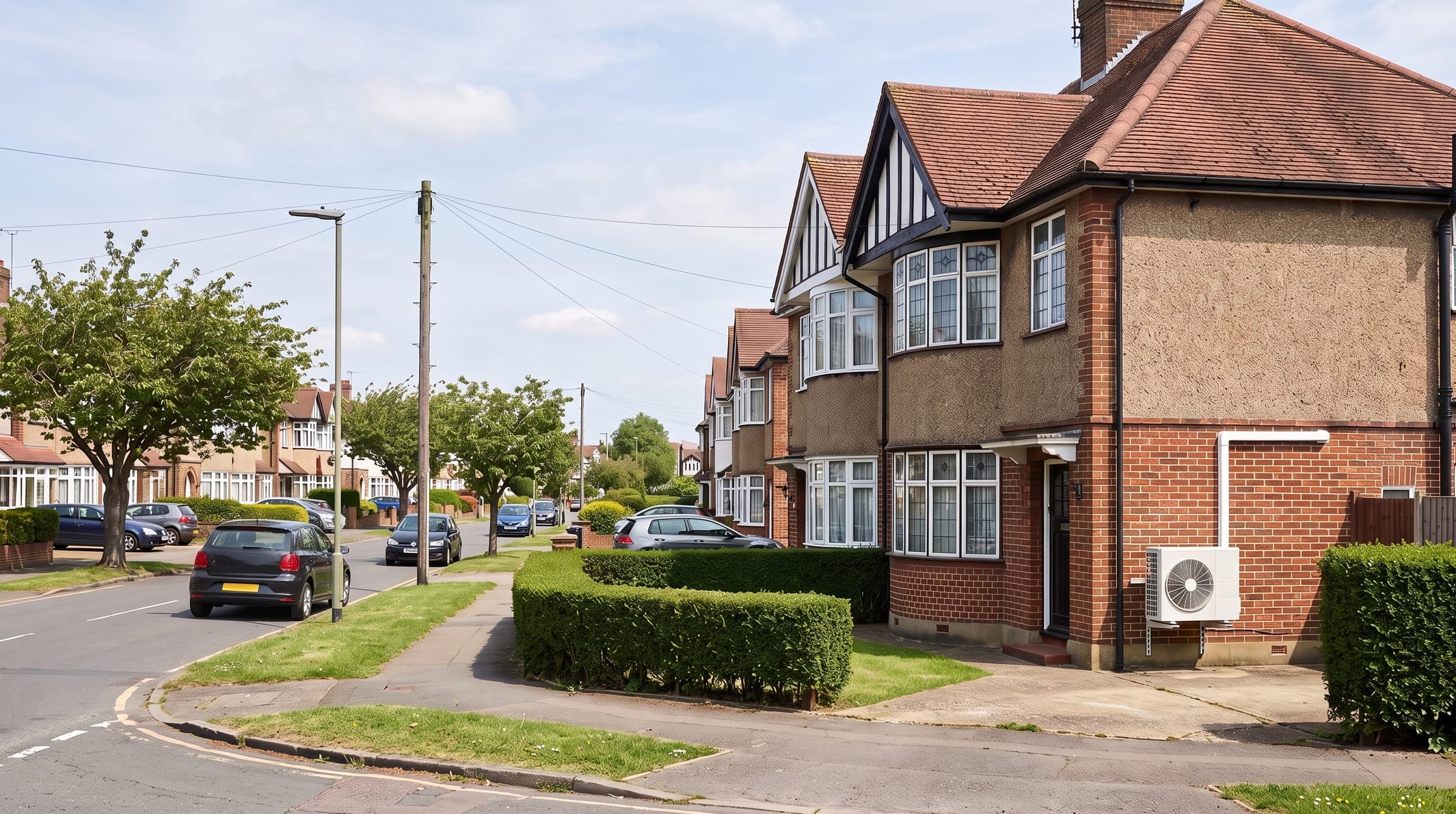
Of 58,990 households in the 2021 Census, 76 in 100 lived in a house (26 detached, 30 semi-detached, 20 terraced) and 23 in 100 in a flat. Most installs here are on houses, where a back or side wall is usually the simplest place for the outdoor unit.
In a conservation area an outdoor unit can't go on a wall or roof facing a road without planning permission, and an Article 4 direction can remove permitted development rights altogether. Check your postcode to see whether either applies to your street.
Figures for the whole St Albans district council area. Sources: ONS Census 2021, table TS044 (accommodation type); Historic England's National Heritage List entries within the council boundary, through planning.data.gov.uk (one entry can cover several buildings). Checked October 2026.
A village that grew around the railway and the Common
The council's conservation area statement traces the name Bricket Wood back to 1228. The area was under St Albans Abbey until 1539, and the Earls of Essex later used the Common as a hunting ground. The St Albans to Watford line, now the Abbey Line, opened in 1858, and Bricket Wood got its station in 1861.
In the early 1930s the aircraft maker Handley Page, at what became Radlett Aerodrome, built two small estates for its workers, one here and one in Park Street. The village grew most between the 1950s and the 1970s, and the St Stephen Neighbourhood Plan calls it the most rural of the parish's villages, with Smug Oak Green, Pound Green and patches of ancient woodland.
Bricket Wood homes and what they mean for an install
The ONS counts about 4,625 people in the Bricket Wood built-up area (Census 2021). Detached homes are the largest group.
| Type of home | Share of homes (2021) | What it means for the install |
|---|---|---|
| Detached houses and bungalows | About 47% | Two heat pumps are allowed under permitted development. Larger houses with loft space can take a ducted system. |
| Semi-detached houses, including the 1930s estate | About 26% | A side wall or a base in the back garden. A multi-split covers two or three bedrooms from one outdoor unit. |
| Flats, including Hanstead House and newer blocks | About 16% | Freeholder consent first. One heat pump per block under permitted development, up to 0.6 m³. |
| Terraced houses | About 10% | Outdoor unit on the back wall or a ground pad, with pipes straight through the wall behind the indoor unit. |
Old Bricket Wood conservation area
South of the village, the hamlet of Old Bricket sits down a winding lane deep in the Common, just east of the M1. Its conservation area was designated on 20 July 1983 and is drawn tightly around 24 homes, including cottages that probably date from the 17th century and listed buildings. The council's statement says any new work should keep to the hamlet's small scale.
Inside the conservation area, a unit can't go on a wall or roof facing the road, or in the garden closer to the road than the house, without permission. A listed building needs listed building consent for any outdoor unit. We look at the rear and side of the house first.
Planning: St Albans council and St Stephen parish
Bricket Wood is in St Stephen parish, whose council is based at the Parish Centre on Station Road. Planning applications go to St Albans City and District Council. Its Local Plan, adopted in September 2026, calls Bricket Wood, Chiswell Green, How Wood and Park Street medium-sized villages, and the St Stephen Neighbourhood Plan, made on 20 July 2022, sits alongside it.
A heating-capable outdoor unit on a house is often permitted development if it isn't cooling-only, is no bigger than 1.5 m³ and passes the MCS 020(a) noise check of 37 dB(A) at neighbours' windows. Outside a conservation area it can't go on a wall facing a road above the ground floor. The council's Article 4 list has no direction in Bricket Wood, Park Street or How Wood.
The BRE and the new homes
The Building Research Establishment, which Historic England places at Garston, is a protected employment area in the Local Plan. In its grounds is a replica of the Möhne Dam, a model built for experiments on breaching dams and scheduled as a monument in 2002. The Neighbourhood Plan counts about 100 new homes on former BRE land and about 138 at Hanstead Park, both reached from Mount Pleasant Lane.
The 2026 Local Plan adds more. If you buy a new home, ask whether its planning permission removes any permitted development rights, and send us the plot plan before you choose a spot for the outdoor unit.
- North of Oakwood Road (M4): about 74 homes
- Bucknalls Drive (M15): about 30 homes, next to the Common
- Ashdale, Lye Lane (M23): about 9 homes
- Land between the M25 and the A405 (OS1): kept for community use
Park Street and How Wood
Park Street is the oldest of the parish's villages. It grew on Watling Street, now the A5183, around Park Street Mill, first recorded in the 12th century and now Grade II listed. The Park Street and Frogmore conservation area, designated in 1994, runs along the old road and the River Ver, from the mill and the Victorian terraces of Branch Road to Frogmore House and the almshouses. A unit there can't face the road without permission.
How Wood grew west of Watling Street in the 20th century and has the main shops. Park Street station opened on its present site in 1890 and How Wood station in 1988. The Local Plan allocates about 95 homes west of Watling Street at Park Street and about 51 at Tippendell Lane and Orchard Drive in How Wood.
What air conditioning costs in Bricket Wood
Our starting prices are the same here as across Hertfordshire and London. Home prices include VAT. Business prices are plus VAT. The survey turns them into a fixed written price.
- from£1,850inc. VAT
A bedroom or study
2.5 kW wall unit, 5 m pipe, fitted in a day
- from£2,050inc. VAT
A living room
3.5 kW wall unit
- from£2,450inc. VAT
Open plan or a loft
5 kW wall unit
- from£5,100inc. VAT
Three rooms
Multi-split
- from£6,500inc. VAT
Four rooms
Multi-split
- from£4,950inc. VAT
Ducted, per zone
Hidden in the ceiling, survey needed
- from£550inc. VAT
Design range upgrade
Daikin Emura, Mitsubishi Electric Zen, LG Artcool
- from£119inc. VAT
An annual service
Keeps the manufacturer warranty valid
Areas and postcodes we cover
We cover the whole parish and the places around it, including:
- AL2 3: Bricket Wood, Mount Pleasant Lane, Oakwood Road, Bucknalls Drive, Lye Lane and Old Bricket
- AL2 2: Park Street, How Wood and Frogmore
- AL2 3: Chiswell Green
- Nearby: Watford, Abbots Langley, Radlett and St Albans
Bricket Wood questions
Do I need planning permission for air conditioning in Bricket Wood?
Usually not for a house, if the unit also heats and meets the size, position and noise limits. You need permission for a cooling-only unit, a listed building, or a unit facing the road in the Old Bricket Wood or Park Street and Frogmore conservation areas. Applications go to St Albans City and District Council.
My house backs onto the Common. Does that change anything?
Not for planning, unless you're in the Old Bricket Wood conservation area. It does change where we put the outdoor unit: away from overhanging branches and leaf fall, on a firm base clear of roots, with room for air to move around it. Trees in a conservation area or under a Tree Preservation Order are protected, so we never cut them back.
Can I have ducted air conditioning in a large detached house?
Often, if there's loft or ceiling space for the indoor unit and ducts. Only slim grilles show in the rooms. Ducted systems start from £4,950 per zone including VAT and always need a survey first. A multi-split is the simpler choice: three rooms from £5,100.
I live in a cottage on Park Street. Where would a unit go?
At the rear, out of sight of Watling Street. The cottages are in the Park Street and Frogmore conservation area and several are listed, so a unit on the front wall needs permission and a listed cottage needs consent for any unit. We check your address before we quote.
Do you cover How Wood and Chiswell Green too?
Yes. Both are in St Stephen parish with Bricket Wood, so the same council and Neighbourhood Plan apply. Most of How Wood is outside the conservation areas, so a heating-capable unit on a house there is usually permitted development.
Do you service and repair existing systems?
Yes. An annual service starts at £119 including VAT, plus £59 for each extra indoor unit on the same visit. We repair most brands, whoever fitted them, and confirm the cost of the repair visit when you book. Surveys and visits are booked at least a week ahead.