Air conditioning in Bedford
We install, service, repair and regas air conditioning for homes and businesses across Bedford, from the Embankment and De Parys to Brickhill, Putnoe, Kingsbrook and Elstow. Here's what the Bedford conservation area, the council's sound data rule, the station plans and the parking zones mean for your install.
single room, from £1,850
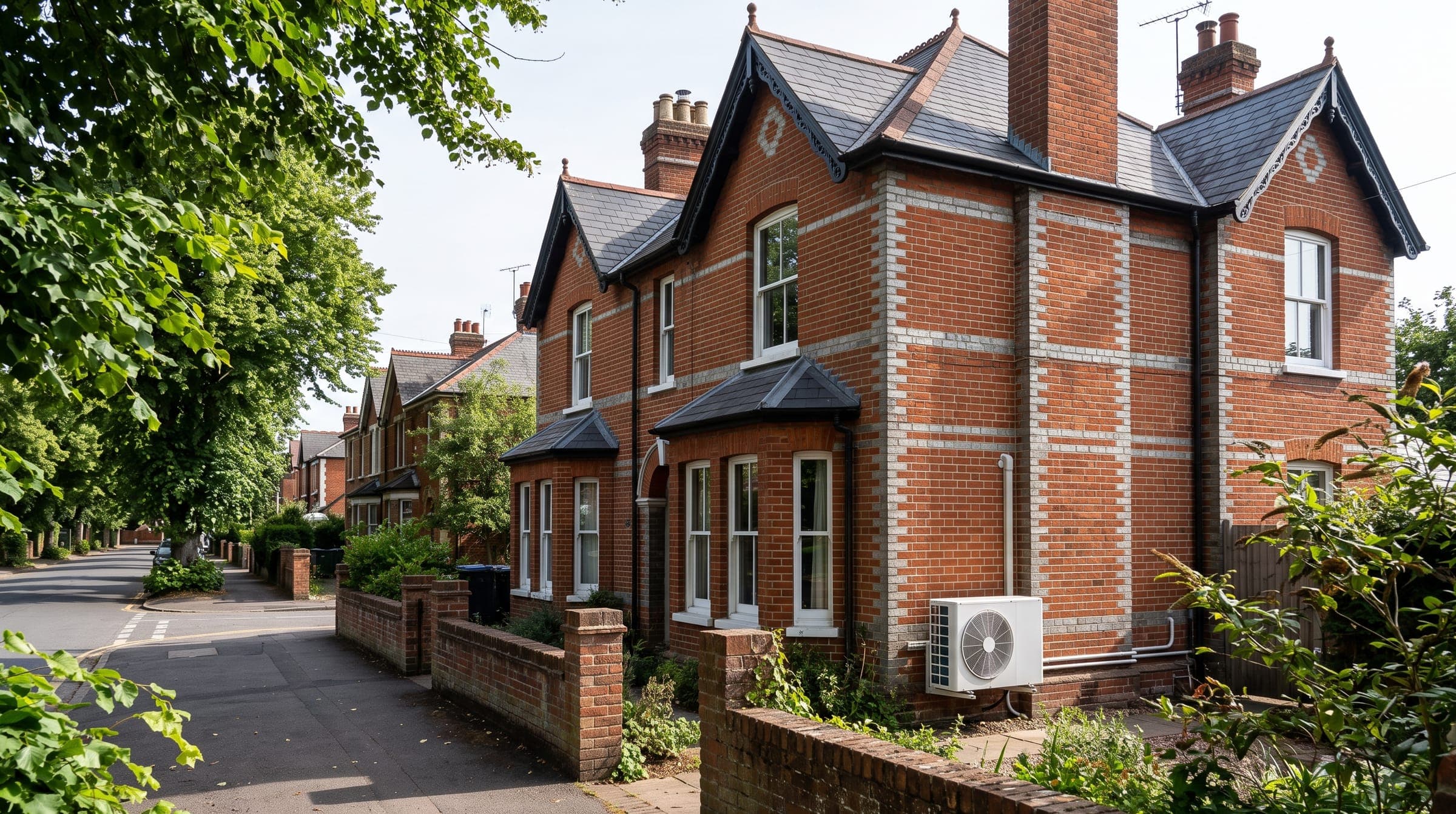
- single room, from
- £1,850
- conservation areas in the borough
- 29
- listed building entries
- 1,352
- one Bedford conservation area
- 1975
Air conditioning installation in Bedford
We fit air conditioning in Bedford homes, flats and businesses: wall-mounted units for a single room, multi-split systems for several rooms on one outdoor unit, and ducted systems where nothing should show. A single room starts from £1,850 fitted, two rooms on one outdoor unit from £3,650.
Every install starts with a free survey. Our engineer checks where the units and pipes can go and gives you a fixed price in writing, and most single rooms are fitted in a day. We install Daikin, Mitsubishi Electric, LG and more. See how installation works or get a free quote.
Servicing, repairs and regas
We service and repair split, multi-split and ducted systems across Bedford, whoever fitted them. An annual service starts at £149, plus £120 for each extra indoor unit on the same visit, and keeps the manufacturer's warranty valid. Visits are booked at least a week ahead so we arrive with the right parts, and we confirm the cost of a repair visit when you book.
A system that needs a regas has a leak, because refrigerant doesn't get used up. We find and fix the leak first, then regas and test the system, so you're not paying for gas that escapes again. We work on homes and business premises, not cars: car air conditioning is a job for a garage.
What air conditioning costs in Bedford
Our starting prices are the same here as across Bedfordshire and London. The survey turns them into a fixed written price, and planning or consent fees are separate.
- from£1,850
A bedroom or study
2.5 kW wall unit, 5 m pipe, fitted in a day
- from£2,050
A living room
3.5 kW wall unit
- from£3,650
Two rooms, one outdoor unit
Multi-split
- from£5,100
Three rooms
Multi-split
- from£2,350
Floor-standing unit
2.5 kW console
- from£1,795
Commercial wall unit
Fitted in business hours
- from£2,750
Ceiling cassette
In a suitable suspended ceiling
- from£149
An annual service
Keeps the manufacturer warranty valid
A river town, a school charity and a railway boom
Bedford grew up at a crossing of the Great Ouse. The council's conservation area appraisal traces the King's Ditch, dug around the southern half of the Saxon town in the time of Edward the Elder, and a Norman castle on the north bank that fell to a siege in 1224 and was pulled down on Henry III's orders. The mound survives as a small park and a scheduled monument behind the Embankment.
In 1552 Sir William Harpur endowed a free grammar school, and his gift became the Harpur Trust in 1764. Its schools drew families to the town, and the appraisal credits them with the early 19th-century villas of The Crescent and Adelaide Square, built for parents it calls 'educational squatters'. The river was made navigable to King's Lynn in 1689, John Bunyan preached here, and the Town Bridge went up in 1811 to 1813.
The big change came with the railway to London. Between 1851 and 1902 the population trebled, from 11,693 to 35,144, and estates of middle-class villas and workers' terraces ringed the old centre. By 1967 the town had reached 66,000, with council estates at Brickhill, Putnoe and Goldington. The 2021 Census counted about 185,200 people in the borough, up 17.6% in ten years, in 74,950 households: 33.0% semi-detached, 27.8% detached, 19.9% terraced and 14.2% in purpose-built flats. Private renting rose from 15.8% to 19.1%, so many installs here need a landlord's consent as well.
Bedford neighbourhoods and what they mean for an install
| Area | Homes and planning | What it means for the install |
|---|---|---|
| Town centre and St Paul's Square | The medieval core: the Grade I church of St Paul, Shire Hall, the High Street and Harpur Street. Shops and offices with flats above, in the conservation area. | Many buildings are listed. Rear walls, yards or flat roofs only, never the street front, with the paperwork done before we book. |
| The Embankment and Rothsay | Victorian villas on the Embankment, Rothsay Road, Bushmead Avenue and Newnham Road, by the riverside gardens. Some are listed; many are now flats. | The appraisal notes many houses lack rear access, so we plan to carry the outdoor unit through the house and site it in the back garden. |
| Castle Road and Albany Road | Smaller pairs and terraces on Castle Road, Waterloo Road and Albany Road, part of the Bower estate. Most are in the conservation area. | Narrow fronts on a strict building line: the unit goes at the back, with the pipes through the wall behind the indoor unit. |
| Russell Park | Late Victorian and Edwardian houses on Russell Avenue and Shaftesbury Avenue, built along one side of the street facing the park. | In the conservation area. Short front gardens face the road, so the unit stays on a rear wall or a pad in the back garden. |
| De Parys Avenue and Park Avenue | A wide tree-lined avenue laid out from the early 1880s between the town and Bedford Park, opened in 1888. Large villas, some now flats or hotels. | Plenty of room at the side and rear. Front walls need permission here. A detached villa can take two outdoor units under permitted development. |
| The Saints and Kimbolton Road | Late 19th-century streets north-east of the centre around Kimbolton Road and St Andrew's church, with Regency houses at the south end. | Mostly semis and villas in the conservation area. A multi-split serves several bedrooms from one unit at the back. |
| The Poets | Shakespeare Road, Milton Road, Lansdowne Road and Linden Road: large houses on big plots north of Bromham Road, with many flat conversions. | Inside the conservation area. Flats need the freeholder's consent; houses take a rear or side unit away from the road. |
| The Crescent and Adelaide Square | Early 19th-century houses around a square and a curving avenue near Bedford High School, many listed. | Check the listing first. A listed house needs listed building consent for the unit and the holes for its pipes. |
| Goldington Road, The Grove and Newnham Street | Three-storey Victorian villas on the south side of Goldington Road, and 18th and 19th-century houses on Newnham Street and The Grove. | Several are listed, and Goldington Road is busy. Rear positions, and a quieter unit where bedrooms face the traffic. |
| Queens Park | Terraced streets west of the railway, built mostly before 1918 after W.H. Allen opened its Queens Engineering Works in 1894. Outside the conservation area. | A heating-capable unit on the rear wall is usually permitted development. Back yards are tight, so we measure the space at the survey. |
| Cauldwell and Ampthill Road | 19th-century streets south of the river that grew around engineering works such as the Britannia Iron Works of 1859, whose gateway is listed. | Mostly outside the conservation area. Terraces take a rear unit; the St Johns station rebuild is planned nearby. |
| South of the bridge | St Mary's Street, Cauldwell Street, St John's Street and Cardington Road, in the old southern town, with the Grade II* College House. | In the conservation area, with listed buildings and a busy A6 frontage. Rear positions and early checks on listing. |
| Kingsbrook, Fenlake and Silver Jubilee | Silver Jubilee was built in the 1930s and named for George V's jubilee; Fenlake was settled by the 1970s. Priory Country Park lies to the north. | Semis and short terraces with side access. Usually permitted development, often one room fitted in a day. |
| Goldington | An old village swallowed by the town. The council bought Elms Farm in 1950 and built on it in the 1960s and 1970s; the power station site became homes by 1996. | Side or rear walls. Goldington Hall is listed, but the estates around it are not in a conservation area. |
| Putnoe | Council-built suburb: the first phase from 1953 to 1957, then the Elms Farm houses off Putnoe Lane from 1964 to 1966. Putnoe Wood is a nature reserve. | Semis and detached houses with gardens: a side wall or a pad by the back door, short pipe runs, usually permitted development. |
| Brickhill | The council bought Brickhill Farm in 1954 and planned 900 houses; Brickhill Drive went up from 1957, with bird-named streets in South Brickhill. | Straightforward 1960s houses. The newer homes at the north end may have planning conditions, so we check those first. |
| Elstow | A conservation area since October 1970: the abbey church, the 15th-century Moot Hall and timber-framed houses on the High Street, many listed. | Listed cottages need consent. Elsewhere, nothing on a wall facing the road without permission, so a rear position is the plan. |
| Renhold, Ravensden, Great Barford and Cople | Villages east and north-east of the town. Great Barford has its own conservation areas; Renhold, Ravensden and Cople are not on the council's list. | Room for a ground pad on most plots. We check the conservation area map and any listing on village-centre houses. |
| Flats near the station and the river | Converted villas, flats above shops and newer blocks, including the riverside and Greyfriars sites in the Local Plan. | Freeholder consent first. One heat pump per block up to 0.6 m³ can be permitted development; balconies and flat roofs suit most. |
Areas and dates come from the council's Bedford and Elstow conservation area appraisals, the Local Plan 2030 and Bedfordshire Archives. Some streets are only partly inside the conservation area, so we check your exact address.
Planning: Bedford Borough Council
Bedford Borough Council has decided all planning here since it became a unitary council in 2009, when Bedfordshire County Council was abolished. An air conditioner that also heats counts as an air source heat pump under Class G of the permitted development rules, so on a house it often needs no application if it isn't used only for cooling, the outdoor unit is no bigger than 1.5 m³, and it passes the MCS 020(a) noise check of 37 dB(A) at the nearest neighbour's habitable room window. A detached house can have two heat pumps, a semi or terrace one.
You need permission for a cooling-only unit, for a second unit on a non-detached house, for a unit on a road-facing wall above the ground floor, and in a conservation area for any unit on a wall or roof facing a road. A listed building, or anything in its curtilage, needs listed building consent. On a flat, one heat pump per block with an outdoor unit up to 0.6 m³ can be permitted development. Our planning guide covers every rule, and our planning checker gives an answer for your address.
For certainty, the council can issue a Lawful Development Certificate. It also gives paid advice before you apply: from 1 January 2026, written householder advice costs £393.60 and householder listed building advice £388.80, with a target reply of 56 days (read October 2026). We don't book the install until the planning position is clear.
The Bedford conservation area
Bedfordshire County Council designated a town centre conservation area in 1969, with two more next to it: one around St Peter's Green, The Grove and part of Kimbolton Road, the other around The Crescent and Adelaide Square. De Parys Avenue and the Embankment followed in 1970. North Bedfordshire Borough Council joined all five into one Bedford conservation area in 1975, and in 1992 it added St Michael's Road, St Augustine's Road and the playing fields north of Clapham Road.
The council's character appraisal splits it into 14 sub-areas: St Paul's Square, town centre west, town centre east, the riverside, South Burh, Bedford High, Borders, the Poets, De Parys, the Saints, Goldington Road, Grove, Rothsay and Russell Park. It holds 102 of the borough's 1,352 listed building entries, as well as the scheduled Castle mound and Town Bridge. The appraisal worries about lost sash windows, roof slates and front gardens turned into parking, so an outdoor unit on a front elevation would be a hard sell even where it is legal.
The borough's other 28 conservation areas are mostly villages: Biddenham, Bletsoe, Cardington, Carlton and Chellington, Elstow, Farndish, Felmersham, Great Barford (three areas), Harrold, Hinwick, Kempston, Little Barford, Odell, Pavenham, Podington, Riseley (two), Roxton, Sharnbrook, Stevington, Stewartby, Swineshead, Thurleigh, Turvey, Upper Dean and Wootton. Each has a boundary map on the council's website, and we check yours against it before we suggest a position.
Article 4 directions in Bedford Borough
An Article 4 direction takes away particular permitted development rights. The council lists two, and neither stops a heat pump on a Bedford home.
| Direction | Where | Heat pumps |
|---|---|---|
| Houses in multiple occupation (in force November 2020) | The urban areas of Bedford and Kempston | No effect. It only means turning a house into a small shared house of three to six people needs planning permission. |
| Stewartby conservation area (1987) | Parts of the Stewartby model village, south-west of the town | Made before the heat pump right began in December 2011, so it cannot have removed it. It does remove other rights, so check the boundary. |
With no heat pump direction anywhere in the borough, Class G applies to Bedford homes subject to the conservation area and listed building rules above. The council's Article 4 page and map show both directions.
The Local Plan, the withdrawn 2040 plan and the big sites
Applications are decided against the Local Plan 2030, adopted on 15 January 2020, and the Allocations and Designations Local Plan of 2013. Policy 41S asks anyone whose proposal affects a heritage asset to describe its significance and how the work keeps harm to a minimum, which is the heritage statement. Policy 47S asks development to avoid noise with significant adverse effects on health and quality of life, which is why the sound data matters.
The council's Local Plan 2040 was withdrawn from examination by full council on 8 October 2025, after it ran into difficulties at a late stage, and it carries no weight in decisions. Work has started on a Local Plan 2050: consultation on its priorities and a call for sites close at 11.59pm on 23 November 2026, and the council aims to adopt it in 2029.
The 2030 plan steers new homes into the town centre and the edges of the town, so many new Bedford homes are flats. Homes built under Part O of the Building Regulations, in force since June 2022, must limit overheating, but flats facing south over a busy road often still get hot because the windows can't stay open at night. The allocations include:
- The station area, Ashburnham Road (Policy 10): homes, offices and shops with a new station entrance and square
- Greyfriars (Policy 11): the former police station and land around it, about 200 homes with shops at street level
- Land at Ford End Road (Policy 12): about 24 hectares by the Eagle Brewery for around 700 homes, a primary school and riverside open space
- Borough Hall (Policy 13) and land south of the river along Kingsway (Policy 14): riverside flats and a new neighbourhood
- Mowbray Road in Kingsbrook (Policy 20), north of Beverley Crescent (Policy 21), Lodge Hill on Clapham Road (Policy 22) and Grazehill by Brickhill (Policy 24)
- The former Stewartby Brickworks (Policy 25): about 55 hectares for homes, jobs and community uses
- Universal's resort at Kempston Hardwick: permission granted by the government in December 2025 under a Special Development Order (SI 2025/1322)
Bedford Midland, East West Rail and the station quarter
East West Rail will link Oxford, Milton Keynes, Bedford and Cambridge, with Bedford Midland rebuilt as its hub. The council's summary of the November 2025 update describes a remodelled station with a pedestrian plaza at the front and its multi-storey car park reached from Ford End Road rather than Ashburnham Road. The same update added 53 homes and businesses on Ashburnham Road to the land needed, and could mean new cul-de-sacs on Chaucer, Spenser, Milton and Sidney Roads. Bedford St Johns would move to a new two-platform station.
The last route-wide consultation ran from 14 April to 9 June 2026. The application for the Development Consent Order is due in 2027, with the new Bedford station targeted for the mid-2030s, according to local reports of the consultation. Until then, homes in Queens Park, the Poets and along Ashburnham Road install air conditioning as normal; if you're near the line, we can choose a quiet unit and site it with future works in mind, and it can be moved if you ever sell to the railway.
Parking on install day
Bedford's controlled parking zone covers the streets around the centre in zones A, B, C, D, E, G, J, K, M and N. Most run from 8am to 6pm, Monday to Saturday; zone J runs 9.30am to 5.30pm on weekdays and zone K all day, every day. Permits are virtual. A first resident permit costs £35.90, and each resident gets free visitor hours (350 a year in most zones, with 350 more for £21.65). Homes built or converted after 1 April 2008 generally can't have resident permits, so a new flat may have no visitor hours at all.
For trades the council sells waivers to wait on a yellow line in the zone while loading bulky goods or working from the van: £8.10 for up to four hours and £16.15 for longer, per vehicle per day. A bay suspension costs £47.80 for the first day and £16 a bay for each extra day, with 14 days' notice (all read October 2026). We agree parking with you when we book: your visitor hours for the van, a waiver to unload the outdoor unit, or a suspension where the street is tight.
Air conditioning for Bedford businesses
We fit and service air conditioning in shops, restaurants, salons, clinics, offices and small server rooms: on the High Street, Midland Road and Harpur Street, by the river, around the station, and on the business estates south of the river such as Priory Business Park and the Cambridge Road industrial estate. Wall units suit small shops. Ceiling cassettes suit offices with suspended ceilings.
Commercial installs are done in business hours. Much of the centre is listed or in the conservation area, and every application with plant needs the sound data, so we agree the siting and the paperwork before we fix a date. We keep F-Gas records, carry out leak checks on systems that need them, and offer maintenance contracts for one site or several.
Shops, cafes and restaurants around the Harpur Centre and St Paul's Square
Bedford's shopping core runs along the High Street, Harpur Street and Midland Road, the walk in from the station. The Harpur Centre on Harpur Street sits behind the Grade II* listed front of the old Bedford Modern School, kept when the centre was built in the 1970s. The Charter Market runs on Wednesdays and Saturdays, with a general market on Fridays, and St Paul's Square has hosted markets since the 1500s.
Units inside the Harpur Centre follow the landlord's plant rules. High Street shops are mostly in the conservation area, often with flats or offices above, so outdoor units go on rear walls, yards and flat roofs. We fit shop air conditioning, cafe air conditioning and restaurant air conditioning here, sized for the heat from busy kitchens.
Towns and villages around Bedford
We cover the whole borough and the places around it. These have their own pages with their own planning details:
- Kempston (MK42): the town to the south-west, with its own conservation area and the HMO direction
- Bromham and Biddenham (MK43 and MK40): villages on the Great Ouse west of the town, with Great Denham between them
- Clapham (MK41) and Wootton (MK43): north and south-west, each with its own planning details
- Shortstown (MK42): the airship sheds and new homes by Cardington
- Wixams (MK45): the new town on the old depot, split between two councils
- Ampthill, Flitwick and Marston Moretaine: south, in Central Bedfordshire
Postcodes we cover
We cover every part of Bedford, including:
- MK40: the town centre, Castle, the Embankment, De Parys, the Poets, the Saints, Harpur, Queens Park, Russell Park and Biddenham
- MK41: Brickhill, Putnoe, Goldington, Newnham, Clapham and Renhold
- MK42: Cauldwell, Kingsbrook, Fenlake, Elstow, Kempston and Shortstown
- MK43: Bromham, Oakley, Wootton and Stewartby
- MK44: Great Barford, Ravensden, Cople, Willington and Cardington
- MK45: Wixams and the villages south of the town
Bedford borough in official figures
- households (2021 Census)
- 74,950
- live in a flat
- 18 in 100
- live in a house
- 81 in 100
- listed building entries
- 1,354
Of 74,950 households in the 2021 Census, 81 in 100 lived in a house (28 detached, 33 semi-detached, 20 terraced) and 18 in 100 in a flat. Most installs here are on houses, where a back or side wall is usually the simplest place for the outdoor unit.
In a conservation area an outdoor unit can't go on a wall or roof facing a road without planning permission, and an Article 4 direction can remove permitted development rights altogether. Check your postcode to see whether either applies to your street.
Figures for the whole Bedford borough council area. Sources: ONS Census 2021, table TS044 (accommodation type); Historic England's National Heritage List entries within the council boundary, through planning.data.gov.uk (one entry can cover several buildings). Checked October 2026.
Air conditioning for shops, cafes and restaurants in Bedford
- shops and other retail premises
- 670
- licensed restaurants
- 75
- cafes and unlicensed restaurants
- 90
- pubs and bars
- 85
The Bedford borough area has about 670 shops and other retail premises, 165 restaurants and cafes and 85 pubs and bars. Pubs and bars are a bigger share of food and drink here than in most of the areas we cover. A bar fills fast on a warm evening, so it is sized for a full room, and a beer cellar is a separate, colder job.
Permitted development for heat pumps covers homes, not shops, cafes or restaurants, so check with the council and your landlord before an outdoor unit goes up, and take extra care with a shopfront in a conservation area. Check your postcode.
- Shop air conditioning
- Cafe and coffee shop air conditioning
- Restaurant air conditioning
- Pub and bar air conditioning
- Salon and barber air conditioning
Business premises (local units) in the whole Bedford borough area, rounded by the ONS. Source: ONS UK Business Counts 2026, through Nomis.
Bedford questions
Do I need planning permission for air conditioning in Bedford?
Often not. A unit that also heats can be permitted development on a house if it meets the size, position and noise limits and is the only heat pump on the house (a detached house can have two). You need permission for a cooling-only unit, a listed building, a second unit on a semi or terrace, and a unit on a road-facing wall in one of the borough's 29 conservation areas. No Article 4 direction in the borough touches heat pumps. Applications go to Bedford Borough Council.
What does Bedford Borough Council need with an air conditioning application?
Since 29 September 2026 its validation list says every application involving air conditioning units or air-to-air heat pumps must include the unit's sound power level, or its sound pressure level at a stated distance. Where a listed building or conservation area is affected, it also needs a heritage statement. Our design pack gives the drawings, specification and manufacturer sound data; a full noise assessment, where needed, comes from an acoustician we can introduce.
I live on De Parys Avenue. Can I have an outdoor unit?
Usually, yes, if it's out of view from the road. De Parys is a sub-area of the Bedford conservation area, so a unit can't go on a wall facing the road under permitted development. These houses tend to have room at the side or rear, and a detached villa can have two outdoor units. If yours is listed, or it has been split into flats, you'll need listed building consent or the freeholder's agreement too.
My Embankment house has no rear access. How does the outdoor unit get in?
Through the house. An outdoor unit for one or two rooms is small enough for two engineers to carry through a hall, and we protect the floors on the way. We site it in the back garden or on a rear wall, out of view from the river, and run the pipes through the wall behind the indoor unit. We check the route at the survey so there are no surprises on the day.
How much does air conditioning installation cost in Bedford?
A bedroom or study starts from £1,850 with a 5 m pipe run, and a living room from £2,050. Two rooms on one outdoor unit start from £3,650 and three rooms from £5,100. Businesses start from £1,795 for a wall unit and £2,750 for a ceiling cassette. The survey gives you a fixed written price.
Can you cool the bedrooms in a Queens Park terrace?
Yes. A multi-split runs two to four indoor units from one outdoor unit at the back, from £3,650 for two rooms. Queens Park is outside the conservation area, so a heating-capable unit on the rear wall is usually permitted development. Back yards are small, so we measure the space and the distance to your neighbour's windows at the survey.
Will East West Rail affect air conditioning near Bedford station?
Not before the Development Consent Order, which is due to be applied for in 2027. Homes near Ashburnham Road, Ford End Road and the Poets can install as normal. If your home is near the line, we choose a quiet unit and a position that leaves room for future works, and an outdoor unit can be moved if it ever needs to be.
Where can the installer's van park in Bedford's parking zones?
Tell us when you book. In the controlled parking zone, the usual answer is your free visitor hours for the van, or a council waiver so we can wait on a yellow line while unloading (£8.10 for up to four hours, read October 2026). Where the street is tight we ask for a bay suspension with 14 days' notice. Outside the zone it's rarely a problem.
Can you regas or repair my air con in Bedford?
Yes, for most brands, whoever fitted them. A system that's short of refrigerant has a leak, so we find and fix it before we regas. We confirm the cost of the repair visit when you book, and price the repair in writing before any work starts. We work on air conditioning in homes and business premises, not in cars.
Will air conditioning heat my Bedford home in winter as well?
Yes. Every home system we fit heats as well as cools. It's an air-to-air heat pump, which is also why it can count as permitted development. It suits a loft room, an extension or a garden room that the central heating doesn't reach.