Air conditioning in Dunstable
We install, service and repair air conditioning for homes and businesses in Dunstable and the villages around it, from Toddington to Whipsnade. Here's how the old town at the crossroads, its conservation area and the Chilterns villages affect where an outdoor unit can go.
- conservation area designated
- 1976
- listed buildings in it (2010)
- 53
- single room, from
- £1,850
- annual service, from
- £119
Central Bedfordshire in official figures
- households (2021 Census)
- 120,755
- live in a flat
- 12 in 100
- live in a house
- 86 in 100
- listed building entries
- 1,936
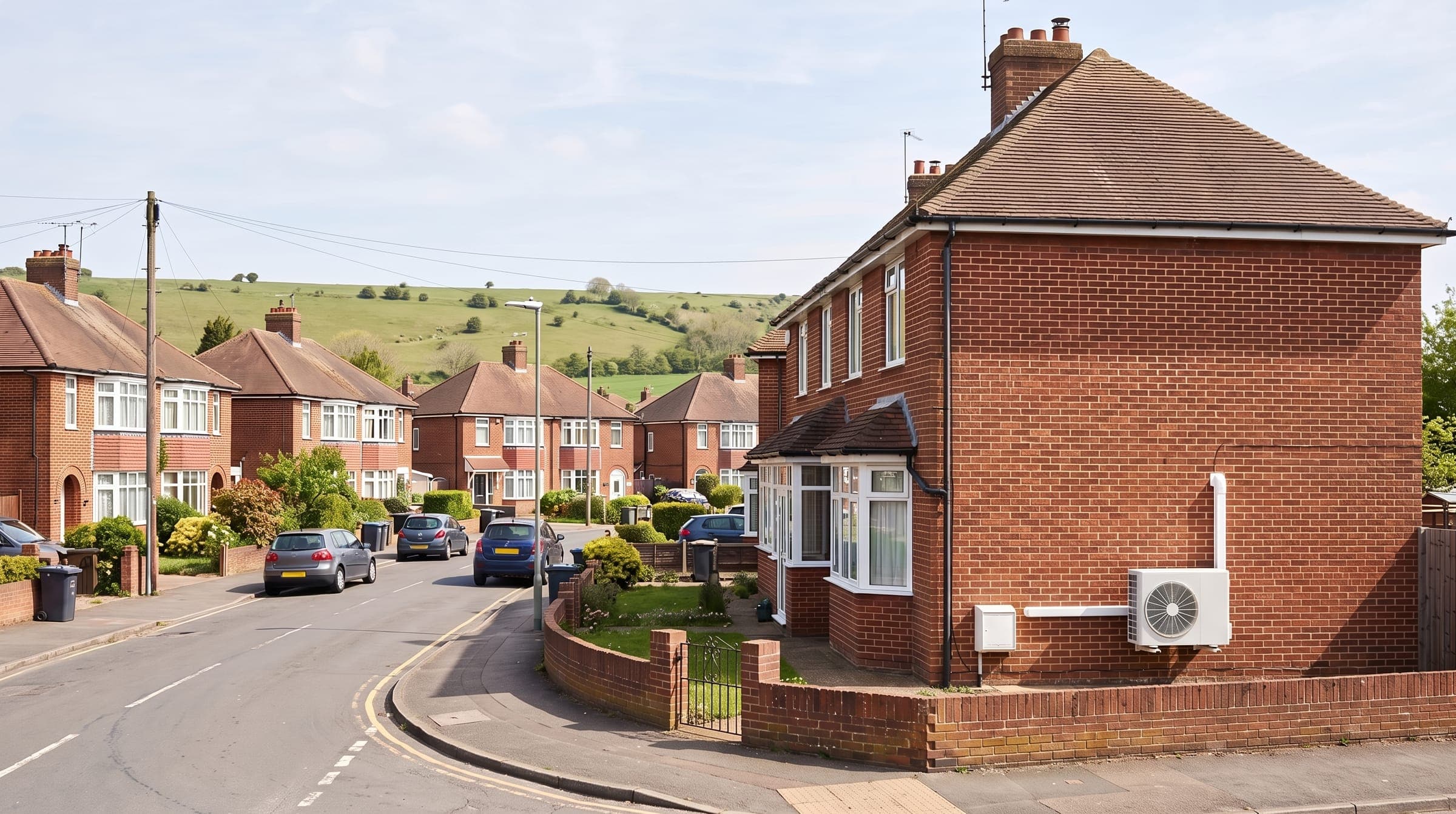
Of 120,755 households in the 2021 Census, 86 in 100 lived in a house (29 detached, 34 semi-detached, 23 terraced) and 12 in 100 in a flat. Most installs here are on houses, where a back or side wall is usually the simplest place for the outdoor unit.
In a conservation area an outdoor unit can't go on a wall or roof facing a road without planning permission, and an Article 4 direction can remove permitted development rights altogether. Check your postcode to see whether either applies to your street.
Figures for the whole Central Bedfordshire council area. Sources: ONS Census 2021, table TS044 (accommodation type); Historic England's National Heritage List entries within the council boundary, through planning.data.gov.uk (one entry can cover several buildings). Checked October 2026.
A town built on a crossroads
Dunstable grew where two ancient routes cross: the Icknield Way, running east to west, and the Roman Watling Street, running north to south. The council's conservation area appraisal traces the town from a Roman settlement, Durocobrivis, to a new town founded by Henry I in the early 12th century around a royal lodge and an Augustinian priory.
The Priory Church of St Peter still dominates the Church Street approach, and the churchyard over the old priory buildings is a scheduled monument. Coaching inns such as the Old Sugar Loaf on High Street North recall the town's years as a staging post on Watling Street. In the 19th century the railway and hat-making brought terraced streets behind the main roads, and in the 20th century Dunstable grew as an engineering town with large residential suburbs.
Dunstable homes and what they mean for an install
| Type of home | Typical areas | What it means for the install |
|---|---|---|
| Victorian terraces with no front gardens | Albion Street, Matthew Street and the streets behind High Street North | Outdoor unit at the rear. Many of these streets are in the conservation area, so a front wall is out without permission. |
| Late Victorian and Edwardian terraces and villas | West Street, Princes Street, Burr Street and the western suburbs | Rear or side positions work well. Check the council's map, as some streets are in or near the conservation area. |
| Interwar and post-war semis | The suburbs that spread out from the centre in the 20th century | Usually permitted development. A side wall or ground pad, and a multi-split for two or three bedrooms. |
| Newer houses and flats | Infill sites and redeveloped land across the town | Check planning conditions and covenants for new homes. Flats need the freeholder's consent first. |
| Shops and offices above shops | High Street North and South, West Street, Middle Row | Old, narrow buildings with listed neighbours. We agree a rear or roof position before booking. |
Planning: Central Bedfordshire Council
Dunstable was part of South Bedfordshire until 2009, when Central Bedfordshire Council took over. It now handles all planning in the town and the surrounding villages. A heating-capable unit on a house is often permitted development if it meets the limits on size, position and noise. Cooling-only units, listed buildings and units on road-facing walls in a conservation area need permission. Our planning guide explains each rule.
We found no Article 4 direction covering Dunstable itself on the council's list. Toddington is different, as explained below.
The Dunstable conservation area
The town has one conservation area, designated in 1976 and extended in 1995. It covers the historic centre on the four streets that meet at the crossroads: High Street North, High Street South, West Street and Church Street, with Middle Row, the Priory Church, Priory Gardens and Grove House Gardens. The council's 2010 draft appraisal counted 53 listed buildings inside it.
The appraisal singles out the local brickwork: plum-coloured local bricks, patterned headers and fine tuck pointing on Victorian terraces. We fix brackets and drill pipe holes with that in mind, and keep units and pipe runs on rear walls. The same draft suggested extending the boundary to parts of Princes Street, West Street, Burr Street and Britain Street, so check the council's map for your address before you plan anything at the front.
Villages around Dunstable
We cover the villages around the town too. Most have their own conservation area, and three sit in the Chilterns National Landscape, known until November 2023 as the Chilterns Area of Outstanding Natural Beauty. Class G doesn't set a separate heat pump limit for National Landscapes, so the conservation area and listed building rules usually decide whether you need to apply.
- Toddington (LU5): conservation area with an Article 4 direction from 1975 (see below)
- Caddington and Slip End (LU1): Caddington has a conservation area; Slip End has none on the council's list
- Kensworth (LU6): two conservation areas, Church End and Kensworth Lynch, and the village is in the Chilterns National Landscape
- Totternhoe and Eaton Bray (LU6): each has its own conservation area
- Studham and Whipsnade (LU6): each has a conservation area, and both villages are in the Chilterns National Landscape, as are Dunstable Downs
Air conditioning for Dunstable businesses
We fit and service systems in offices, shops, restaurants, clinics, salons and small server rooms, from the High Street to the retail and industrial estates. Ceiling cassettes suit offices with suspended ceilings. Wall units suit shops and smaller rooms. Commercial installs are done in business hours.
We take over servicing from other installers, carry out F-Gas leak checks on systems that need them, and regas a system once a leak has been found and fixed. A regas without a repair just leaks out again, so we always find the leak first.
Parking on install day
Central Bedfordshire runs five residents' parking zones in Dunstable: Prince Regent, Icknield Street, Stuart Street, Clifton Road and West Parade. Permits are virtual, and the council doesn't guarantee a space. If you live in one of these zones or on a busy town centre street, tell us when you book so we can plan where the van parks, because we need to unload the outdoor unit close to the house.
What air conditioning costs in Dunstable
Our starting prices are the same here as across Bedfordshire and London. Home prices include VAT; business prices are plus VAT. The survey gives you a fixed written price.
- from£1,850inc. VAT
A bedroom or study
2.5 kW wall unit, 5 m pipe, fitted in a day
- from£2,050inc. VAT
A living room
3.5 kW wall unit
- from£3,650inc. VAT
Two rooms, one outdoor unit
Multi-split
- from£5,100inc. VAT
Three rooms
Multi-split
- from£2,350inc. VAT
Floor-standing unit
2.5 kW console
- from£1,795+ VAT
Commercial wall unit
Fitted in business hours
- from£2,750+ VAT
Ceiling cassette
In a suitable suspended ceiling
- from£119inc. VAT
An annual service
Keeps the manufacturer warranty valid
Areas and postcodes we cover
We cover the whole town and the villages around it, including:
- LU5 and LU6: Dunstable town centre and every part of the town
- LU5: Toddington, and neighbouring Houghton Regis
- LU6: Totternhoe, Eaton Bray, Kensworth, Studham and Whipsnade
- LU1: Caddington and Slip End
- Markyate (Dacorum, Hertfordshire)
Dunstable questions
Do I need planning permission for air conditioning in Dunstable?
Often not. A heating-capable unit on a house can be permitted development if it meets the size, position and noise limits. You need permission for a listed building, a cooling-only unit, or a unit on a road-facing wall in the town's conservation area. Applications go to Central Bedfordshire Council.
I live in a Victorian terrace off High Street North. Where would the unit go?
At the rear, on the wall or a ground pad. These terraces open straight onto the pavement, and many are in the conservation area, where a unit on the front wall needs permission. We run the pipes through the back wall and take care with the old brickwork and pointing.
Do you install air con units in Dunstable semis and family homes?
Yes. A single bedroom starts from £1,850 including VAT, with a 5 m pipe run. Two rooms on one outdoor unit start from £3,650 and three rooms from £5,100. A side wall or ground pad usually works on a semi, and we size each room at the survey.
My air con needs a regas. Can you do that?
Yes, once we've found and fixed the leak. Refrigerant doesn't get used up, so a system that's short has a leak somewhere. We confirm the cost of the repair visit when you book, and the repair and regas are priced in writing before any work starts.
I live in Toddington. Is planning different there?
It can be. Toddington's conservation area has an Article 4 direction from 1975 that removes some permitted development rights. Heat pumps aren't named in it, but ask Central Bedfordshire Council before fitting a unit to a house in the conservation area. We check your address before we quote.
Do you service air conditioning for Dunstable businesses?
Yes. We service offices, shops and restaurants, keep F-Gas records for systems that need them, and offer maintenance contracts for one site or several. Commercial wall units start from £1,795 plus VAT, and ceiling cassettes from £2,750 plus VAT, if you need a new system.