Air conditioning installers in Luton
We're based in Luton, so this is our home patch. We install, service, repair and regas air conditioning in homes and businesses across all 20 wards, from the hat-trade terraces of High Town to the 1980s estates at Bramingham and the new flats at Napier Park. Here's how Luton's housing, its five conservation areas, its Local Plan and its parking zones affect an install.
single room, from £1,850
- single room, from
- £1,850
- where we're based
- LU4
- conservation areas
- 5
- council wards
- 20
Air conditioning installation in Luton
We fit air conditioning in Luton homes, flats and businesses: wall-mounted units for a single room, multi-split systems for several rooms on one outdoor unit, and ducted systems where nothing should show. A single room starts from £1,850 fitted, two rooms on one outdoor unit from £3,650.
Every install starts with a free survey. Our engineer checks where the units and pipes can go and gives you a fixed price in writing, and most single rooms are fitted in a day. We install Daikin, Mitsubishi Electric, LG and more. See how installation works or get a free quote.
Servicing, repairs and regas
We service and repair split, multi-split and ducted systems across Luton, whoever fitted them. An annual service starts at £149, plus £120 for each extra indoor unit on the same visit, and keeps the manufacturer's warranty valid. Being based here, a Luton service or repair is a short drive for us, though visits are still booked at least a week ahead so we arrive with the right parts. We confirm the cost of a repair visit when you book, and price the repair in writing before any work starts.
A system that needs a regas has a leak, because refrigerant doesn't get used up. We find and fix the leak first, then regas and test the system, so you're not paying for gas that escapes again. We work on homes and business premises, not cars: car air conditioning is a job for a garage.
What air conditioning costs in Luton
We're based in Luton, so there's no travel loading here: our starting prices are the same as across Bedfordshire and London. The survey turns them into a fixed written price, and planning or consent fees are separate.
- from£1,850
A bedroom or study
2.5 kW wall unit, 5 m pipe, fitted in a day
- from£2,050
A living room
3.5 kW wall unit
- from£2,450
Open plan or a loft
5 kW wall unit
- from£3,650
Two rooms, one outdoor unit
Multi-split
- from£5,100
Three rooms
Multi-split
- from£1,795
Commercial wall unit
Fitted in business hours
- from£2,750
Ceiling cassette
In a suitable suspended ceiling
- from£149
An annual service
Keeps the manufacturer warranty valid
A hat town that became a car town
Luton was the main centre of ladies' hat production in Britain for over 200 years, a trade that grew out of straw plaiting established here by the late 17th century. The railway reached Bute Street in 1858 and the Midland main line arrived in 1868, and the town grew faster than almost any other in southern England: 3,095 people in 1801, over 10,000 by 1850 and almost 39,000 by 1901. Luton became a borough in 1876. At the trade's peak in the 1930s the area made as many as 70 million hats a year.
Vauxhall moved its car works to Luton in 1905, built cars at Kimpton Road until 2002 and vans until 2025. Around the factories came the inter-war semis of Leagrave, Saints and Crawley Green, then the post-war council estates at Farley Hill, Stopsley, Limbury and Hockwell Ring, and Marsh Farm in the late 1960s, built largely for families moving out of London. Luton became a county borough in 1964 and has run all its own planning as a unitary council since 1997.
The 2021 Census counted about 225,300 people, up 10.9% in ten years, in 78,942 households. Semi-detached houses make up 40.3% of homes, well above the 31.5% across England, with 22.0% terraced, 20.5% in purpose-built blocks of flats and only 12.9% detached. Private renting rose from 22.6% to 29.0% of households between 2011 and 2021, so a fair share of the installs we quote in Luton need a landlord's consent as well as a survey.
Luton neighbourhoods and what they mean for an install
| Area | Homes and planning | What it means for the install |
|---|---|---|
| Town centre and the Hat District | Victorian hat factories and warehouses around Bute Street and Guildford Street, in the Plaiters' Lea and town centre conservation areas. Some are listed. | Mostly flats above shops and offices. The outdoor unit goes on a rear wall or flat roof, never a street frontage, and a listed building needs consent first. |
| High Town | Luton's earliest suburb, laid out from 1841 and complete by 1922: grey-brick terraces off High Town Road, plus 1970s council homes on the Paths estate. | High Town Road from Midland Road to Havelock Road is a conservation area. Rear wall or ground pad at the back, pipes through the back bedroom or kitchen wall. |
| Bury Park | An estate on the fields of Bury Farm, first occupied in 1882. Victorian houses off Dunstable Road, many now with shops built over the old front gardens. | Outdoor unit on the rear wall above the yard, or under a back window. Flats above the Dunstable Road shops need the freeholder's consent before anything else. |
| Dallow and Rothesay | Late Victorian to 1920s streets west of the centre, with Edwardian semis on Brantwood Road and Ashburnham Road. Rothesay was made a conservation area in 2003. | Outside Rothesay the usual permitted development rules apply. Inside it, nothing on a wall facing the road without permission, so we check your address first. |
| New Town, Park Town and South Luton | 19th-century streets between Castle Street, Park Street and Cutenhoe Road, plus 1960s blocks of flats. Luton South, designated 2010, is the conservation area. | Terraces take a rear unit on the wall or a pad, kept off road-facing walls in the conservation area. In the 1960s blocks, one heat pump per block is permitted. |
| Round Green and Hart Hill | An old hamlet, in the borough since 1933, with Edwardian and inter-war houses off Hitchin Road. Hart Hill mixes 19th-century houses with post-war estate homes. | Side or rear walls on the semis, a multi-split for two or three bedrooms. The Grade II water tower on Hart Lane is the only listing nearby to think about. |
| Stopsley and Putteridge | A hill-top village absorbed in 1933, with a post-war council estate and 1930s houses at Putteridge built by Janes of Luton. Butterfield business park is beyond. | Mostly semis and bungalows: outdoor unit on the side wall or a pad by the back door, short pipe runs, usually permitted development. |
| Wigmore, Crawley Green and Vauxhall Park | Crawley Green grew between the wars and after 1945, Vauxhall Park in the 1950s, and Wigmore from the 1970s and 1980s on farmland beside the airport. | Low-density houses with side access, so the unit sits on a side wall out of sight. Many are three and four-bedroom homes that suit a multi-split. |
| Napier Park and Power Court | Napier Park is the former Vauxhall plant off Kimpton Road, allocated for around 25 hectares of mixed use. Power Court holds the stadium and around 600 homes. | New flats: management company and planning conditions first, then a balcony or flat-roof position. One heat pump per block can be permitted development. |
| Biscot and Saints | A hamlet swallowed by Luton in the early 1900s, then inter-war suburbs: the Saints streets off Montrose Avenue and the roads off Biscot Road by Wardown Park. | Bay-fronted semis with side passages. The outdoor unit goes on the side or rear wall, and a bedroom unit is usually a short run through the back wall. |
| Barnfield, Old Bedford Road and Warden Hill | Mature semis and detached houses around Old Bedford Road, with Warden Hill's 1960s and 1970s houses and the late-1980s and 1990s streets that grew around them. | A detached house can have two heat pumps under permitted development, so two outdoor units for a larger house are usually fine. Side walls suit well. |
| Leagrave and Limbury | Villages absorbed in 1928, with 1920s and 1930s bay-fronted semis and terraces, extended over Limbury Mead in the 1950s. Leagrave station opened in 1868. | Side wall or rear ground pad. Where the side passage is shared, we keep the condensate drain off the neighbour's side and agree the position before the day. |
| Marsh Farm and Hockwell Ring | Post-war council estates: Hockwell Ring's four 14-storey towers went up in 1965 and 1966, Marsh Farm's flats and houses in the late 1960s, new homes since 2017. | Houses are straightforward. In the towers and low-rise blocks the landlord or housing association decides, so we help you with that request first. |
| Sundon Park | Built for workers at the SKF ball-bearing factory: the Avenues from the 1920s and 1930s, and the hill-named roads north of Hill Rise from the 1950s and 1960s. | Long straight streets of semis with gardens. Rear or side wall, pipes through the kitchen or back bedroom wall, usually permitted development. |
| Bramingham | Low-density 1980s and 1990s suburban houses that grew out to meet Warden Hill and Marsh Farm, with a few 19th-century cottages left on Great Bramingham Lane. | Side walls behind the gate are the usual spot. Check your deeds for estate covenants on external equipment before we fix anything. |
| Lewsey Farm and Lewsey Park | Lewsey Farm's 1960s and 1970s terraces in yellow and grey brick, much of it social housing, and Lewsey Park's larger 1980s and 1990s detached houses and semis. | Terraces take a rear wall unit above the garden. Lewsey Park's cul-de-sacs give easy side access, and a detached house can have two outdoor units. |
| Challney, Chaul End and the Poets | Suburban streets between Dunstable Road and the M1, with the poet-named roads between Lewsey Road and Poynters Road. The motorway arrived in the early 1960s. | Semis and short terraces: side or rear wall. Near the M1 we pick a quieter unit and site it on the side of the house away from the carriageway. |
| Farley Hill | A council estate built after the Second World War to replace bombed homes, between Stockwood Park and the M1, with its shops inside a roundabout. | Houses take a rear unit. Tenants of the council or a housing association need the landlord's written consent before anything is fixed to the wall. |
| Flats near the station and the centre | Converted houses, flats above shops and newer blocks such as Gillam Court in High Town, with the Napier Gateway towers planned on the Vauxhall site. | Freeholder consent first. One heat pump per block up to 0.6 m³ can be permitted development; a second needs permission. Balconies and flat roofs suit most. |
Dates and descriptions come from the council's conservation area documents, the Local Plan, Historic England and local histories. Some streets are only partly inside a conservation area, so we check your exact address.
Planning: Luton Borough Council
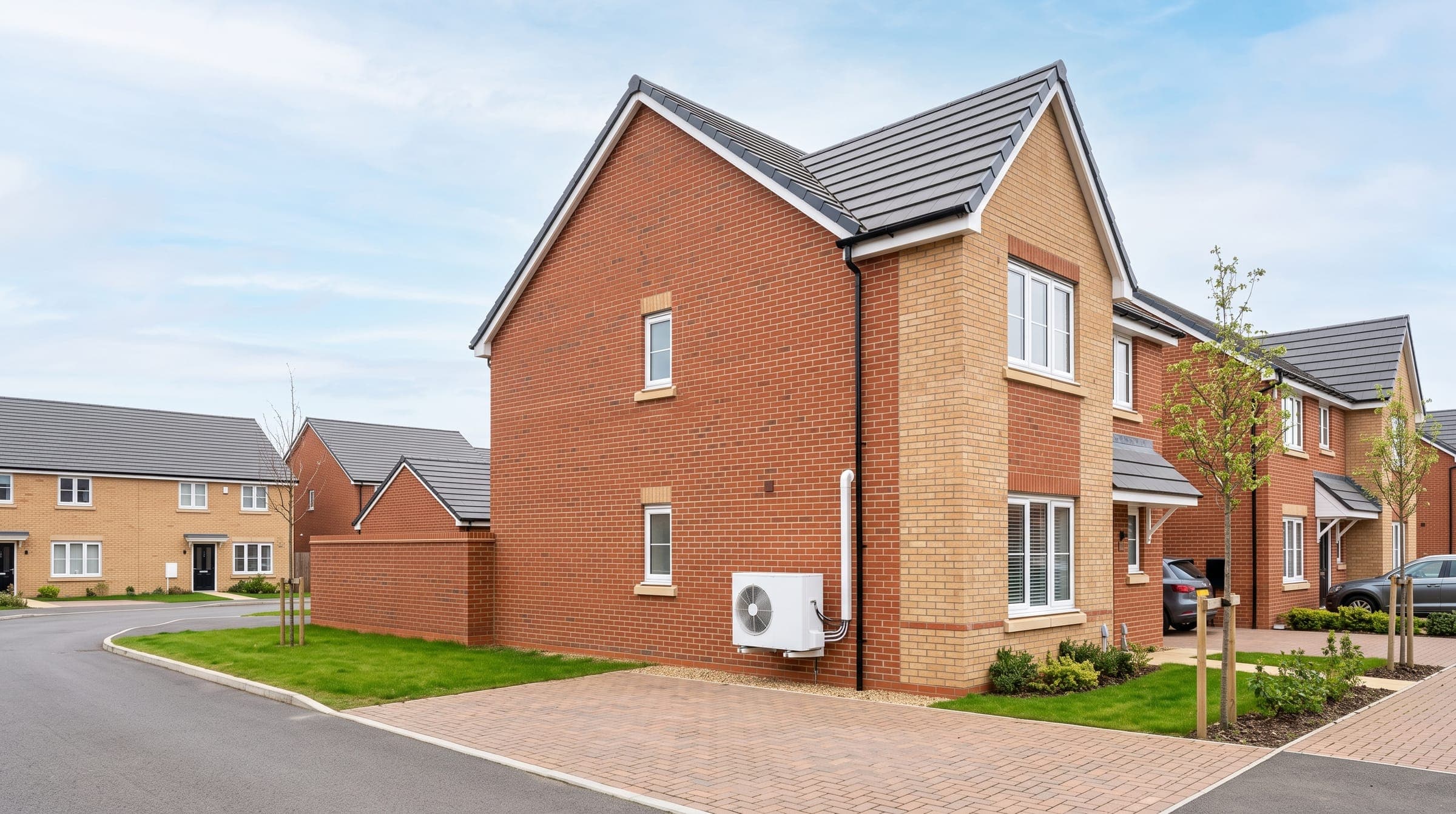
Luton Borough Council has decided all its own planning applications since it became a unitary council in 1997. An air conditioning unit that also heats counts as an air source heat pump under Class G of the permitted development rules, so on a house it often needs no application if it isn't used only for cooling, the outdoor unit is no bigger than 1.5 m³, it passes the MCS 020(a) noise check of 37 dB(A) at the nearest neighbour's window, and it is the first heat pump on the house. A detached house can have two, a semi or a terrace one.
You need permission for a cooling-only unit, for a second unit on a non-detached house, and in a conservation area for a unit on a wall or roof that faces a road. A listed building needs listed building consent as well. On a flat, one heat pump per block with an outdoor unit up to 0.6 m³ can be permitted development. Our planning permission guide explains every rule and our planning checker gives an answer for your own address; both are linked at the foot of this page.
If you want certainty in writing, the council can issue a Lawful Development Certificate. We give you the unit's dimensions, its noise data and a siting plan for either route, and we don't book the install until the planning position is clear.
Luton's five conservation areas
Luton has five conservation areas. Three are mainly commercial: the town centre around George Street and St Mary's Church, Plaiters' Lea (now named Plaiters' Lea: The Hat District) and High Town Road, the core of Luton's earliest suburb. Two are mainly residential: Rothesay, designated in 2003 on the west side of the centre by Winsdon Hill, and Luton South, designated in 2010.
Plaiters' Lea is the one with a published appraisal and management plan, both approved on 17 August 2020, when its boundary was extended. Historic England's 2011 assessment describes just under 4.5 hectares of hat factories, warehouses and workshops centred on the Guildford Street and Bute Street crossroads, and the area is on the Heritage at Risk Register. Power Court's redevelopment next door has to preserve its character and the setting of the Grade I listed St Mary's Church.
The council's guidance says that inside a conservation area some changes that are normally permitted need permission, that a satellite dish on a roof slope or wall fronting the road needs consent, and that some areas have extra controls. An outdoor unit facing the street is treated the same way, so in all five areas we plan a rear, courtyard or roof position and keep the pipework off the frontage.
Article 4 directions in Luton
An Article 4 direction takes away particular permitted development rights. These are the six on the council's current list.
| Direction | Where | What it removes |
|---|---|---|
| Luton Town Centre and surrounds (6 October 2023) | The town centre and the streets around it | Class MA: offices and shops can't become homes without permission. Nothing about heat pumps or air conditioning. |
| Butterfield Green and Business Park (1 August 2022) | Butterfield business park, off the A505 beyond Stopsley | Class MA only. It replaced an earlier direction that expired on 31 July 2022. |
| Capability Green (1 August 2022) | Capability Green business park, by the airport | Class MA only, on the same date and for the same reason as Butterfield. |
| Wolston Close (10 July 2002) | Wolston Close | A telecommunications mast. No effect on heat pumps at homes. |
| Land adjoining Hayling Drive (9 July 1975) | Land off Wigmore Lane | Enclosure and access on that land only. |
| Hayhurst Road and Stanton Road (11 January 1960) | Land at the south end of both roads | Enclosure of that land only. |
None of the six removes the right to install a heat pump, so Class G applies to homes across Luton, subject to the conservation area and listed building rules above.
The Luton Local Plan and the big sites
Applications are decided against the Luton Local Plan 2011 to 2031, adopted with main modifications on 7 November 2017. It plans for 8,500 new homes over the period against an assessed need of 17,800, which is why the big brownfield sites matter so much, and why so many Luton households now live in flats and recent conversions. Policy LLP30 covers the historic environment, so an application in a conservation area or on a listed building has to show how it preserves the building's character.
The council has restarted its Local Plan under the 2026 plan-making regulations. Its timetable, published on 28 May 2026, runs a scoping consultation from 28 May to 23 July 2026, a first gateway on 22 October 2026, consultation on the plan's proposed content from 13 May to 24 June 2027, consultation on the proposed plan from 18 November 2027 to 20 January 2028, submission on 15 June 2028 and adoption planned for 22 December 2028. Until then the 2017 plan stands.
The 2017 plan's strategic sites are where most of Luton's new flats and workplaces are being built:
- Napier Park (Policy LLP8): about 25 hectares of the former Vauxhall plant off Kimpton Road, with outline permission since 2014 for 625 homes, a supermarket, a hotel and workspace; the Napier Gateway towers are still to come
- Power Court (Policy LLP9): about 7 hectares by St Mary's Road for around 600 homes and town centre uses; the 25,000-seat stadium got detailed approval on 16 December 2024 and rose above ground from June 2026
- Butterfield Green Technology Park (Policy LLP7): 23 hectares of undeveloped land allocated for business and light industry beside the existing park, where The Quad 2 units were finished in June 2022
- Century Park: outline permission on 29 June 2021 for a business park and a 2 km access road off the A1081 at Airport Way, since renamed Green Horizons Park by the airport's owner
- London Luton Airport: development consent granted on 3 April 2025 to grow from 18 million to 32 million passengers a year with a second terminal; it handled 16.9 million passengers in 2024
- High Town (LLP10), the Creative Quarter (LLP11) and Marsh Farm (LLP12) are the plan's other named regeneration areas
Parking on install day
Luton runs resident permit zones and controlled parking zones. Entry signs mark where a zone starts, the time plates on each bay say when the restriction applies, and outside those hours anyone can use the bays. Permits are virtual and only work in their own zone: a first resident permit costs £71 and visitor vouchers £29 for ten. Not every address in a zone qualifies, and the council generally excludes new-build homes from older schemes, so a new flat may have no permit at all.
In a controlled parking zone, parking is only allowed in marked bays and the rest of the kerb is yellow lines, which the council enforces: it issued over 93,000 penalty charge notices in 2024 to 2025 and 40% were for yellow line offences. Its parking pages publish no dispensation for tradespeople, so we plan it with you when we book: a visitor voucher for a resident's bay, a nearby car park for the day, or unloading the outdoor unit at the kerb and moving the van. There are also 11 numbered on-street pay zones, with charges set on 1 April 2026.
Air conditioning for Luton businesses
We fit and service air conditioning in shops, restaurants, salons, clinics, offices and small server rooms across Luton: on George Street and in The Mall, along Dunstable Road in Bury Park, in the restored hat factories of the Hat District (Hat House at 32 Guildford Street and Hat Works at 47 Guildford Street, built between 1840 and 1850 and reopened in April 2021), and on the business parks at Butterfield, Capability Green and around the airport, where the hotels and the offices off Airport Way run their plant all year.
Wall units suit small shops. Ceiling cassettes suit offices with suspended ceilings. Commercial installs are done in business hours, and in the Hat District and the town centre conservation area we start with the siting and the paperwork, because the frontages are protected and many of the buildings are listed. We keep F-Gas records, carry out leak checks on systems that need them, and offer maintenance contracts for one site or several.
Shops and restaurants from George Street to Dunstable Road
George Street is Luton's main shopping street, in the town centre conservation area by St Mary's Church. Beside it is the covered centre that opened in 1972 as the Arndale, now owned by Frasers Group, with Luton Indoor Market's 127-unit market hall inside. In Bury Park, Dunstable Road is the town's food street: grocers, restaurants and takeaways, many in houses turned into shops after the trams arrived in 1908. High Town Road is a commercial conservation area of its own.
Units in the shopping centre follow the landlord's plant rules. On Dunstable Road, kitchen cooling has to cope with the extract, and outdoor units go at the rear, clear of the windows upstairs. We fit shop air conditioning, cafe air conditioning and restaurant air conditioning across the town.
Villages and towns around Luton
Being based in Luton, we cover the towns and villages around it as closely as the borough itself. Each has its own page with its own planning details:
- Dunstable (LU5 and LU6): the next town west along the A505, in Central Bedfordshire
- Houghton Regis (LU5): north of Dunstable, also in Central Bedfordshire
- Caddington and Slip End (LU1): villages on the hill south-west of Luton, in Central Bedfordshire despite the Luton postcode
- Toddington (LU5) and Barton-le-Clay (MK45): villages north of the town, off the M1 and the A6
- Eaton Bray (LU6) and Leighton Buzzard (LU7): west, towards the Buckinghamshire border
- Flitwick (MK45): north up the Midland main line, in Central Bedfordshire
- Harpenden (AL5) and Redbourn (AL3): over the county line in Hertfordshire, with a different council and their own conservation areas
- Hitchin (SG4 and SG5), in North Hertfordshire, and Stevenage beyond it
Postcodes we cover
We cover every street in LU1 to LU4 and the LU postcodes around them. Broadly:
- LU1: the town centre, New Town, Park Town, South Luton, Farley Hill, Dallow, Bury Park, Caddington and Slip End
- LU2: High Town, Round Green, Hart Hill, Stopsley, Putteridge, Wigmore, Crawley Green, Vauxhall Park, Napier Park, the airport, Lilley and Cockernhoe
- LU3: Biscot, Saints, Barnfield, Limbury, Marsh Farm, Bramingham, Warden Hill, Sundon Park, Streatley and Sundon
- LU4: Leagrave, Hockwell Ring, Lewsey Farm, Lewsey Park, Challney, Chaul End and Chalton
- LU5 and LU6: Dunstable, Houghton Regis, Toddington, Eaton Bray and the villages between them
- LU7: Leighton Buzzard and its villages
Luton in official figures
- households (2021 Census)
- 78,942
- live in a flat
- 25 in 100
- live in a house
- 75 in 100
- listed building entries
- 85
Of 78,942 households in the 2021 Census, 75 in 100 lived in a house (13 detached, 40 semi-detached, 22 terraced) and 25 in 100 in a flat. Most installs here are on houses, where a back or side wall is usually the simplest place for the outdoor unit.
In a conservation area an outdoor unit can't go on a wall or roof facing a road without planning permission, and an Article 4 direction can remove permitted development rights altogether. Check your postcode to see whether either applies to your street.
Figures for the whole Luton council area. Sources: ONS Census 2021, table TS044 (accommodation type); Historic England's National Heritage List entries within the council boundary, through planning.data.gov.uk (one entry can cover several buildings). Checked October 2026.
Air conditioning for shops, cafes and restaurants in Luton
- shops and other retail premises
- 1,010
- licensed restaurants
- 90
- cafes and unlicensed restaurants
- 115
- pubs and bars
- 40
The Luton area has about 1,010 shops and other retail premises, 205 restaurants and cafes and 40 pubs and bars. Cafes outnumber restaurants here by more than in most of the areas we cover. A small room with an espresso machine, a chilled counter and a door that opens all day needs more cooling than its size suggests.
Permitted development for heat pumps covers homes, not shops, cafes or restaurants, so check with the council and your landlord before an outdoor unit goes up, and take extra care with a shopfront in a conservation area. Check your postcode.
- Shop air conditioning
- Cafe and coffee shop air conditioning
- Restaurant air conditioning
- Pub and bar air conditioning
- Salon and barber air conditioning
Business premises (local units) in the whole Luton area, rounded by the ONS. Source: ONS UK Business Counts 2026, through Nomis.
Luton questions
Do I need planning permission for air conditioning in Luton?
Often not. A unit that also heats can be permitted development on a house if it meets the size, position and noise limits and is the only heat pump on the house (a detached house can have two). You need permission for a cooling-only unit, a listed building, a second unit on a semi or terrace, and a unit on a road-facing wall in one of the five conservation areas. Luton has no Article 4 direction that touches heat pumps. Applications go to Luton Borough Council, and our planning checker gives you an answer for your address.
Are you really based in Luton?
Yes. Our registered office is in Luton, in LU4, so Luton, Dunstable and Houghton Regis are the shortest trips we make. It doesn't change the price: our starting prices are the same across Bedfordshire, Hertfordshire and London. Surveys and visits are booked at least a week ahead wherever you are.
I live in a High Town terrace. Where does the outdoor unit go?
At the back, on the rear wall or a ground pad in the yard, with the pipes run through the wall behind the indoor unit. High Town Road between Midland Road and Havelock Road is a conservation area, so a unit on a wall facing the road needs permission there; the side streets of grey-brick terraces are mostly outside it, but we check your address against the council's map before we quote.
Can I have air conditioning in a flat at Napier Park or in the town centre?
Usually, once the freeholder or management company agrees, so we start there. New blocks often have planning conditions or estate rules about external equipment, and older flats above shops need the landlord's consent. Permitted development allows one heat pump per block with an outdoor unit up to 0.6 m³; a balcony, flat roof or rear wall is the normal spot. In the town centre or Plaiters' Lea conservation areas the unit can't face the street without permission.
How much does air conditioning installation cost in Luton?
A bedroom or study starts from £1,850 with a 5 m pipe run, a living room from £2,050 and an open-plan room or loft from £2,450. Two rooms on one outdoor unit start from £3,650 and three rooms from £5,100. Businesses start from £1,795 for a wall unit and £2,750 for a ceiling cassette. We're based in Luton, so there's no travel loading, and the survey gives you a fixed written price.
Can you regas my air conditioning in Luton?
Yes, once we've found and fixed the leak, because a system that's short of refrigerant has one. We confirm the cost of the repair visit when you book, and price the repair and regas in writing before any work starts. We work on air conditioning in homes and business premises, not in cars.
My street is in a resident permit zone. Is that a problem on install day?
No, but tell us when you book. Luton's permits are virtual and only work in their own zone, and the council publishes no dispensation for tradespeople. The usual answer is a visitor voucher for a resident's bay (£29 for ten), or we unload the outdoor unit at the kerb, park in a nearby car park and walk back. The time plates on the bays show when the restriction applies, and outside those hours anyone can park.
Do you fit air conditioning in Luton shops, offices and hotels?
Yes, in business hours. Commercial wall units start from £1,795 and ceiling cassettes from £2,750, and we cover the town centre, Bury Park, the Hat District, Butterfield, Capability Green and the hotels and offices around the airport. In the two town centre conservation areas we agree the siting first, because frontages are protected and many buildings are listed. We keep F-Gas records for systems that need them and offer maintenance contracts.