VRF air conditioning for offices, hotels and larger buildings
VRF air conditioning runs many indoor units from one outdoor system, with each room controlled on its own. We design, install and service VRF and VRV systems across London and the Home Counties, and quote every one after a survey.
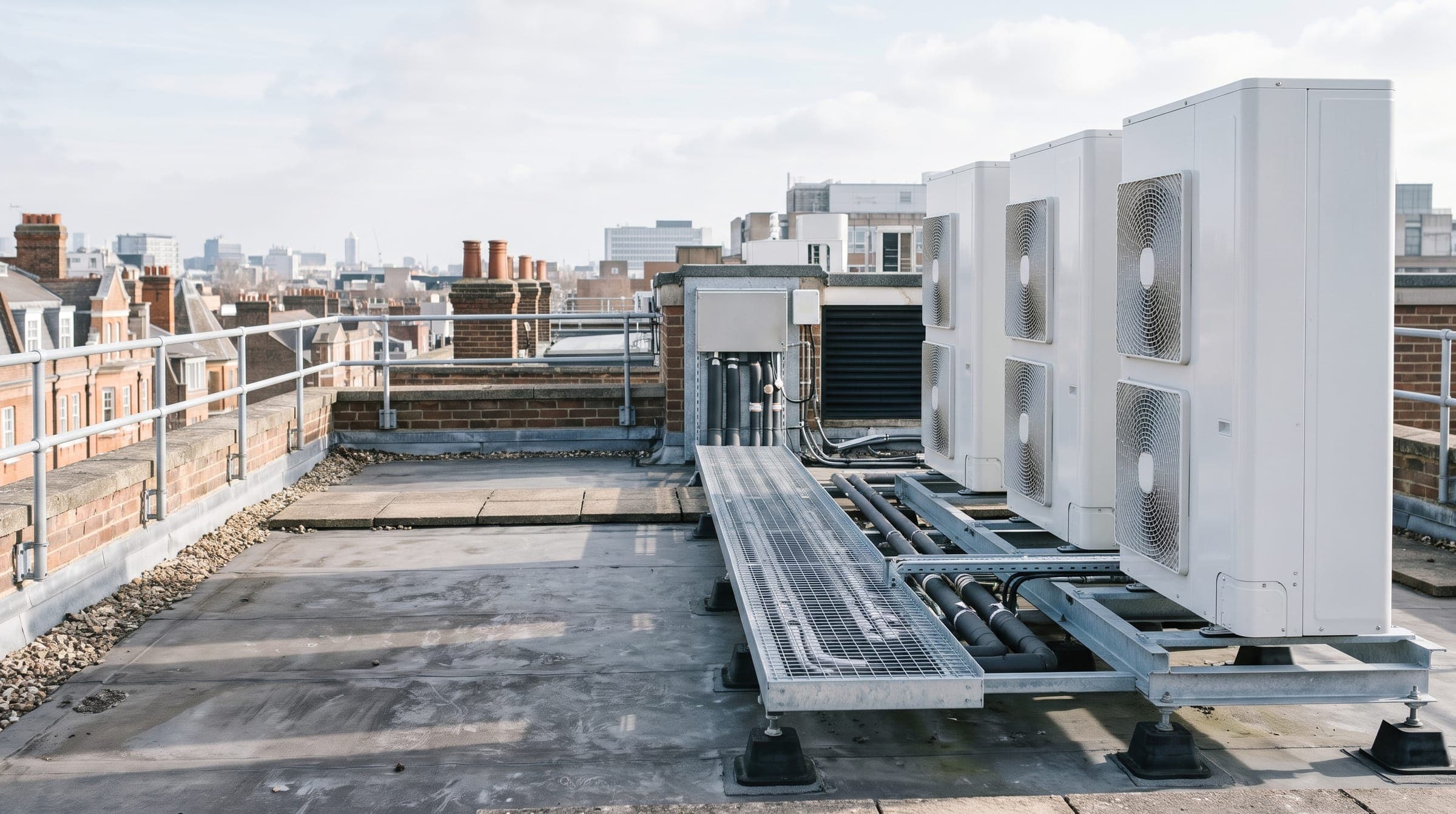
- every VRF system is quoted
- Survey first
- heat and cool at once
- Heat recovery
- where F-Gas checks start
- 5 tCO2e
- TM44 inspection needed
- Over 12 kW
What is a VRF system?
VRF stands for variable refrigerant flow. A VRF system cycles refrigerant between an outdoor unit and each indoor unit (LG), and varies the flow to match what each room needs. One set of pipes serves a whole floor or building, and every zone has its own control.
VRV, or variable refrigerant volume, is Daikin's name for the same idea. Daikin says it invented it (Daikin). So "VRV air conditioning" and "VRF air conditioning" describe the same type of system.
VRF or several split systems?
| Feature | Separate splits | Multi-split | VRF system |
|---|---|---|---|
| Typical size | One room each | A few rooms | A floor or a whole building |
| Outdoor units | One per room | One for several rooms | One system, often on the roof |
| Heat some rooms, cool others | Yes, each is separate | No | Yes, with heat recovery |
| Central control | Limited | Limited | Yes, one controller for the building |
| Price | From £1,795 per room | Quoted after survey | Quoted after survey |
When VRF beats several splits
VRF earns its cost in larger offices, hotels, multi-floor buildings and anywhere a row of outdoor units would crowd the roof or the wall. One system replaces many, and long pipe runs reach rooms far from the plant. Daikin's REYQ-U heat recovery range, for example, allows 190 m of piping to the furthest unit and 1,000 m in total (Daikin).
For a small office with three or four rooms, separate splits or a multi-split are usually simpler and cheaper.
Two-pipe heat pump or heat recovery VRF
A heat pump VRF system heats or cools. A heat recovery VRF system can do both at once, moving heat out of a sunny south office and into a cold north one.
The brands do this differently. Daikin uses a three-pipe heat recovery design (Daikin). Mitsubishi Electric's City Multi R2 does it with two pipes, and Mitsubishi says it's the only two-pipe heat recovery system on the market (Mitsubishi Electric). Hotels and buildings with lots of glass on different sides gain the most.
The main VRF brands
- Daikin VRV, including VRV 5 heat pump and heat recovery on R-32 (Daikin)
- Mitsubishi Electric City Multi, including R2 heat recovery on R32 (Mitsubishi Electric)
- LG Multi V (LG)
- Panasonic ECOi, including the compact Mini ECOi in 4, 5 and 6 HP sizes (BSEE)
- Fujitsu Airstage, from 12 to 135 kW in the Generation IV range (BSEE)
- Samsung DVM S2, which detects refrigerant leaks and alerts users (ACR Journal)
Refrigerant, small rooms and BS EN 378
Because one VRF system links many rooms, it holds more refrigerant than a single split. If it all leaked into one small room, the concentration could become harmful to the people in it (Toshiba). The safety standard BS EN 378 sets limits for this, so we check the smallest room on each system at the design stage.
Where a room is too small, the usual fixes are an opening to a neighbouring room, mechanical ventilation, or a leak detector that triggers when the level passes the EN 378 limit. Toshiba's detector, for example, trips at 0.39 kg per cubic metre and pumps the refrigerant back to the outdoor unit (Toshiba).
Controls, F-Gas leak checks and TM44
Each zone has its own controller, and a central controller lets a building manager set times and limits for the whole system. Daikin says zone control keeps VRV running costs down (Daikin).
Many VRF systems are big enough to need F-Gas leak checks. The line is 5 tonnes CO2 equivalent: about 7.41 kg of R32 (GWP 675) or 2.39 kg of R410A (GWP 2,088) (Mitsubishi Electric). Above it, checks are needed at least every 12 months, more often for bigger charges, and a leak detection system is compulsory at 500 tonnes (GOV.UK).
A VRF system is almost always over 12 kW, so it needs a TM44 inspection by an accredited energy assessor at least every 5 years (GOV.UK).
VRF air conditioning cost
VRF systems are always quoted after a survey and design. For comparison, these are our starting prices for single systems and servicing.
- from£1,795
Commercial wall unit
Fitted in business hours
- from£2,750
Ceiling cassette
In a suitable suspended ceiling
- from£4,950
Ducted, per zone
Hidden in the ceiling, survey needed
- from£149
An annual service
Keeps the manufacturer warranty valid
VRF air conditioning questions
What is the difference between VRF and VRV?
None in practice. VRV, variable refrigerant volume, is Daikin's name. VRF, variable refrigerant flow, is the general term other makers use.
How much does VRF air conditioning cost?
It depends on the number of zones, the pipe runs, the controls and whether you need heat recovery, so we quote every VRF system after a survey and design. For comparison, a single commercial wall unit starts from £1,795.
What is heat recovery VRF?
A system that can heat some rooms and cool others at the same time, moving heat from where it isn't wanted to where it is. Daikin uses three pipes to do it, and Mitsubishi Electric's City Multi R2 uses two.
Does a VRF system need F-Gas leak checks?
If it holds 5 tonnes CO2 equivalent or more, yes: at least every 12 months, or more often for larger charges. That's about 7.41 kg of R32 or 2.39 kg of R410A. Fitting a leak detection system doubles the interval.
Can VRF work with ducted units and cassettes?
Yes. One VRF system can run a mix of wall units, ceiling cassettes and ducted units, so each room gets the indoor unit that suits it.
Sources
11
- Daikin UK: VRV product group
- Daikin UK: REYQ-U heat recovery outdoor unit
- Mitsubishi Electric UK: City Multi R2 heat recovery
- Mitsubishi Electric UK: PLA-ZM R32 sheet (GWP values)
- LG UK: VRF systems
- BSEE: Panasonic Mini ECOi VRF launch
- BSEE: Fujitsu Generation IV Airstage VRF launch
- ACR Journal: Samsung DVM S2
- Toshiba UK: TCB-LD2UK refrigerant leak detection
- GOV.UK: Checking F gas equipment for leaks
- GOV.UK: A guide to air conditioning inspections in buildings