Warehouse and workshop air conditioning
A big shed with a high roof is expensive to cool from end to end, and usually it doesn't need to be. We fit warehouse air conditioning, workshop air conditioning and factory air conditioning across London and the Home Counties, cooling the places where people and stock actually sit.
commercial wall unit, from £1,795
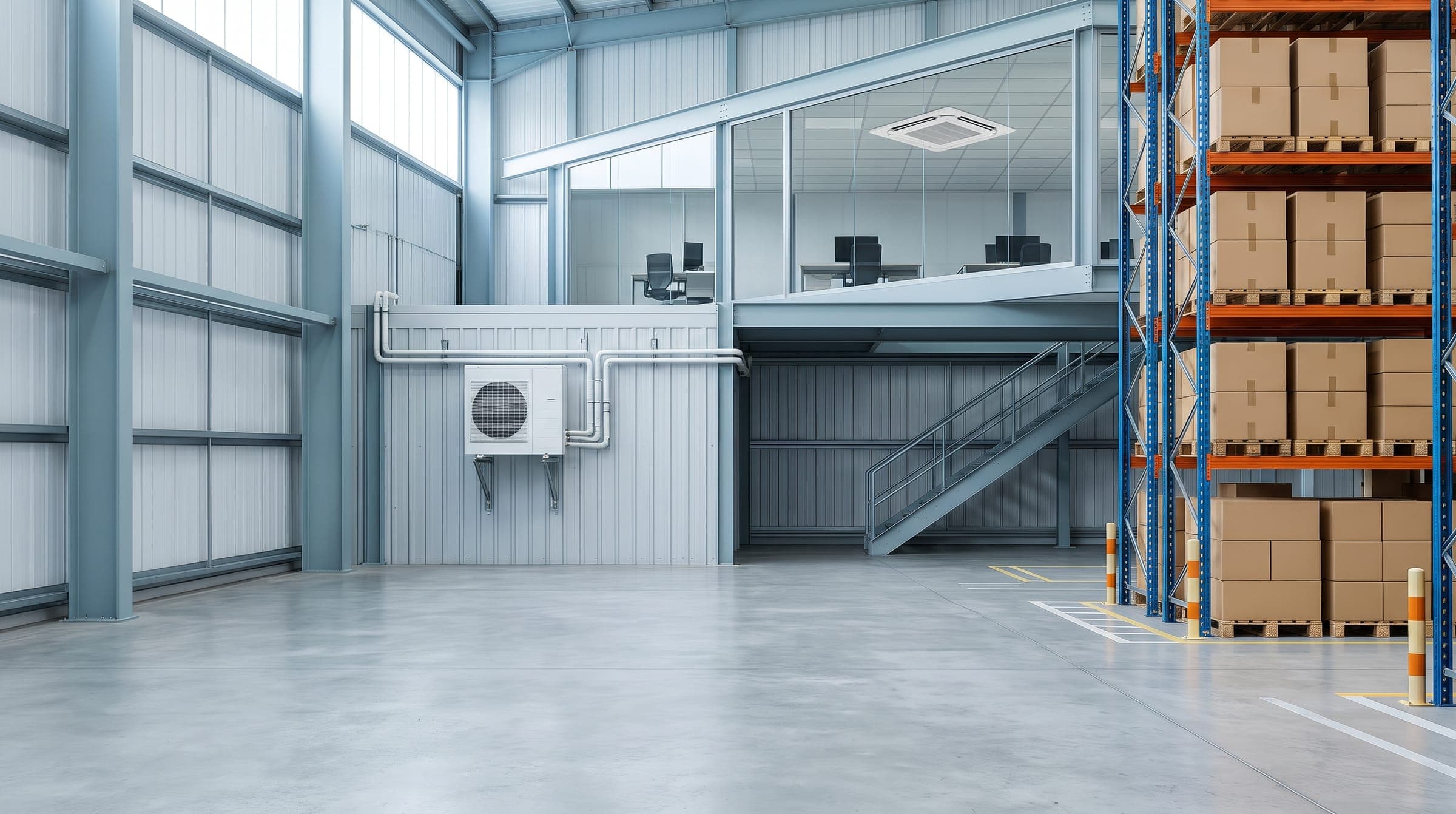
- commercial wall unit, from
- £1,795
- ceiling cassette, from
- £2,750
- HSE suggested indoor minimum
- 16°C
- TM44 inspection needed
- Over 12 kW
Spot cooling or cooling the whole shed?
Warm air rises, so in a tall building much of the cooling you pay for ends up under the roof, far above anyone's head. For most sites we cool zones instead: the office, the mezzanine, the pick and pack area, the workshop bench or the canteen.
Whole-building warehouse cooling makes sense when the stock itself needs a set temperature. Then it's a design job, sized from a survey of the roof, the walls, the doors and how often they open.
- Offices and mezzanines: wall units or ceiling cassettes, the same as any office
- Pick, pack and dispatch areas: units aimed at where people stand
- Workshops: cooling near benches and machines that give off heat
- Loading bays: hard to cool while the doors are open, so we usually leave them out
Which system suits which part of the building
| Area | Usual choice | Worth knowing |
|---|---|---|
| Office or mezzanine with a suspended ceiling | Ceiling cassette | Spreads air four ways and keeps walls free for racking or desks |
| Small office, canteen or break room | Wall unit | Cheapest to fit and quick to install |
| Larger rooms where you want nothing on show | Ducted | Hidden above the ceiling with grilles only. Needs void depth and access |
| Open floor or workshop with no ceiling | Wall units or exposed cassettes, after a survey | Unit height and throw decide what works under a high roof |
| Stock held at a set temperature | Designed system, quoted after survey | Sized for the whole space, the doors and the season |
Workplace temperature: what the HSE says
The Workplace Regulations require a reasonable indoor temperature. The HSE's guidance suggests a minimum of 16°C, or 13°C where much of the work involves rigorous physical effort. HSE also says there is no maximum temperature, but heat is a hazard and must be covered by your risk assessment.
Among the measures the HSE lists for hot workplaces are fans, air cooling or air conditioning with adequate ventilation, shading, and moving workstations away from heat sources (HSE). Spot cooling the busiest areas is often the practical answer in a large building. Our maximum working temperature guide covers the rules in more detail.
Stock that needs a set temperature
Some goods have their own storage limits, such as medicines, cosmetics, electronics or some foods. For medicines, the European Commission's question and answer note on Good Distribution Practice says temperature mapping places sensors at the critical points, for example at different heights, near a sunny window and next to the doors, and should be done in the seasons with the highest and lowest temperatures (European Commission).
That's why a single thermostat on one wall isn't enough for regulated stock. Some cassettes can hold low settings too. Mitsubishi Electric's PLA-ZM range offers a 14°C set point option with the right controller (Mitsubishi Electric). Chilled and frozen storage is refrigeration, not air conditioning, and needs a specialist.
Roof and wall outdoor units
Industrial buildings usually have room for outdoor units on a flat roof, a side wall or the yard. We check the roof structure and access, keep units clear of vehicle routes and away from neighbours' windows, and plan safe access for servicing.
Your landlord's written consent is usually needed, and the council may need to approve plant on a business building. We give you spec sheets and noise data to send with the request.
Warehouse air conditioning cost
Starting prices for offices and smaller zones. Whole-building cooling and larger systems are quoted after a survey.
- from£1,795
Commercial wall unit
Fitted in business hours
- from£2,750
Ceiling cassette
In a suitable suspended ceiling
- from£4,950
Ducted, per zone
Hidden in the ceiling, survey needed
Servicing, F-Gas leak checks and TM44
Dust, cardboard fibres and workshop grime clog filters quickly, so plan regular servicing. If a system holds 5 tonnes CO2 equivalent of refrigerant or more, it needs a leak check at least every 12 months, more often for bigger systems, and a repaired leak must be re-tested within a month (GOV.UK).
If the systems you control add up to more than 12 kW of cooling, you need a TM44 inspection by an accredited energy assessor at least every 5 years (GOV.UK). Several small units count together.
Warehouse and workshop air conditioning questions
Can you air condition a whole warehouse?
Yes, but it's rarely the best value. With a high roof and loading doors, most of the cooling is wasted. We usually cool the zones where people work, and design whole-building cooling only when the stock needs a set temperature.
What is the maximum temperature in a warehouse or workshop?
There's no legal maximum. The HSE says employers must provide a reasonable temperature and treat heat as a hazard in their risk assessment. Its guidance suggests a minimum of 16°C, or 13°C for rigorous physical work.
How much does warehouse air conditioning cost?
A commercial wall unit starts from £1,795 and a ceiling cassette from £2,750. Ducted zones, open workshops and whole-building systems are priced after a free survey.
Do warehouse units need F-Gas leak checks?
Only systems holding 5 tonnes CO2 equivalent of refrigerant or more. Then it's at least every 12 months, or more often for larger systems. We tell you which of your systems are covered and keep the records.
Can the same units heat the workshop in winter?
Yes. The systems we fit are reversible heat pumps, so the units that cool the office in summer can heat it in winter too.
Sources
6
- HSE: Temperature in the workplace, the law
- HSE: Managing workplace temperature
- GOV.UK: Checking F gas equipment for leaks
- GOV.UK: A guide to air conditioning inspections in buildings
- European Commission: Good Distribution Practice questions and answers (2014)
- Mitsubishi Electric UK: PLA-ZM R32 product information sheet