School, classroom and nursery air conditioning
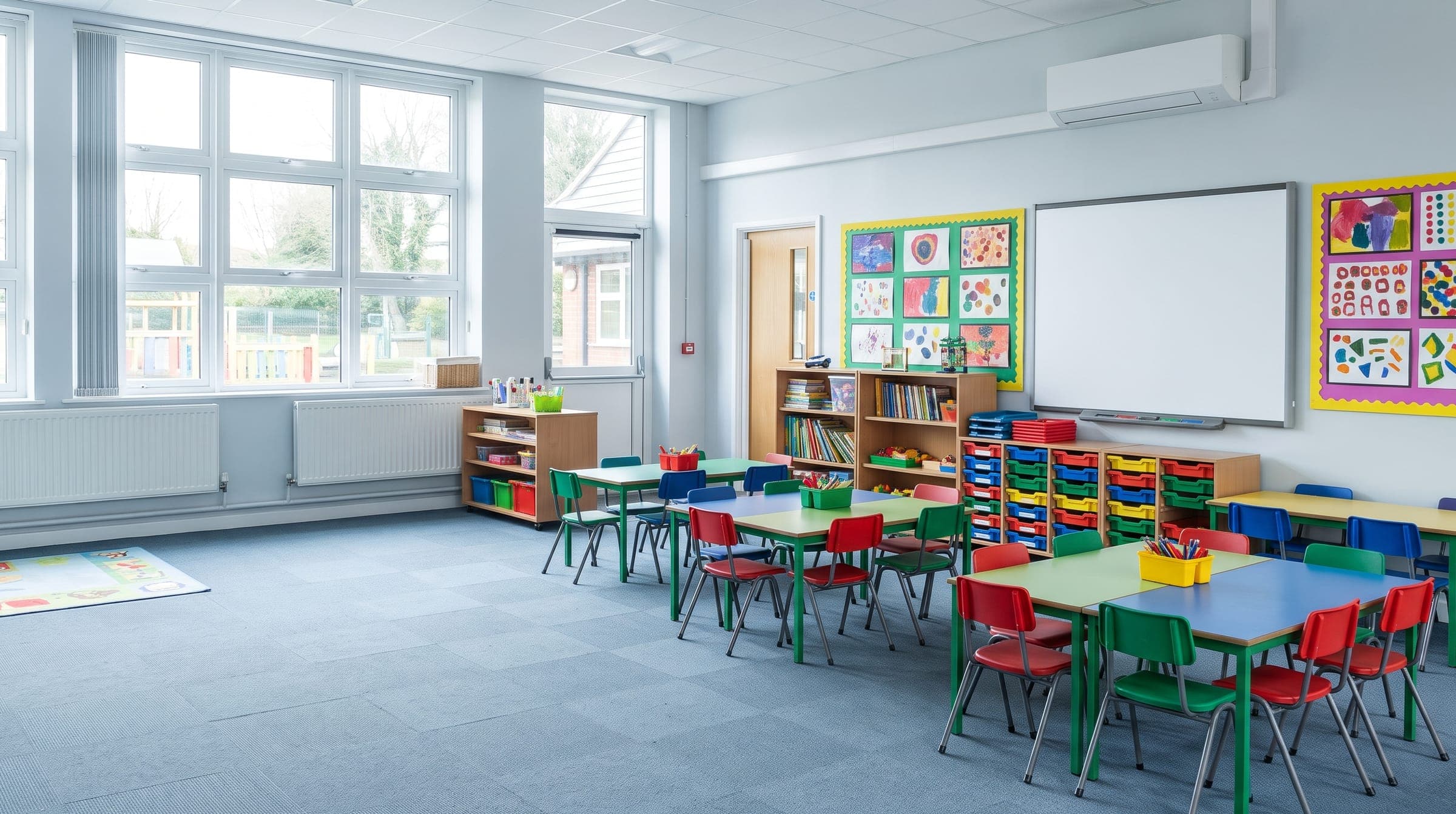
A south-facing classroom with 30 pupils and a bank of screens can be stifling by June, and a nursery baby room has to stay comfortable for naps. We fit school and nursery air conditioning across London and the Home Counties, planned around term dates and the guidance schools work to.
commercial wall unit, from £1,795
- commercial wall unit, from
- £1,795
- ceiling cassette, from
- £2,750
- DfE ventilation and comfort guide
- BB101
- baby sleep room, EYFS
- 16 to 20°C
What the Department for Education says about classroom temperatures
The Department for Education's Building Bulletin 101 (BB101) sets the standards for ventilation, thermal comfort and air quality in schools. It doesn't set one maximum classroom temperature. Instead, it tests overheating against a comfort limit that rises with the outdoor temperature, between 1 May and 30 September in school hours.
BB101 aims to avoid unnecessary air conditioning through passive measures such as limiting solar gain, night cooling and thermal mass. But it accepts mechanical cooling where the heat load justifies it.
- In the heating season, teaching spaces should be kept at 20°C, with a maximum of 25°C at full occupancy
- In most schools, general classrooms with computer heat gains under 15 W/m² shouldn't need mechanical cooling
- Where heat gains in a teaching space pass 25 W/m², mechanical cooling may be considered
- ICT-rich classrooms may need comfort cooling for the hottest summer days
- Server rooms should not go above 28°C, measured above the racks
Classroom air conditioning: which rooms first?
| Room | Typical approach | Why |
|---|---|---|
| Computer suites and ICT-rich classrooms | Wall units or ceiling cassettes | BB101 names them as rooms that may need comfort cooling |
| South and west-facing classrooms | Wall unit, after shading is tried | The rooms most likely to overheat in summer term |
| Nursery baby and sleep rooms | Quiet wall unit with a locked controller | EYFS gives a 16 to 20°C room temperature for babies |
| Server and comms rooms | A dedicated unit | Runs all year. BB101 says units shouldn't sit above the racks |
Nursery air conditioning and baby rooms
The EYFS statutory framework says children should not get too hot or cold when sleeping, and gives a recommended room temperature for babies of 16 to 20°C. The Lullaby Trust gives the same range. On a summer afternoon, a sleep room with a window in the sun can be well above that.
UKHSA also notes that children under 5 are at greater risk in hot weather. A quiet wall unit, set and locked by staff, holds a sleep room steady. Place it so the air doesn't blow onto cots.
Cooling is not ventilation
A split unit cools the air already in the room. It doesn't bring in fresh air or lower CO2. BB101 asks for enough outdoor air to keep the daily average CO2 below 1000 ppm in mechanically ventilated classrooms, or 1500 ppm with natural ventilation. Keep the ventilation working alongside any air conditioning.
School air conditioning installation in the holidays
We plan school installs for half term and the summer holidays, so no teaching time is lost. Book the survey in spring for a summer install. Because the systems we fit are reversible heat pumps, the same units can also heat a cold classroom or a mobile in winter.
A good question for any contractor working on a school site: how do they meet your safeguarding policy, and what checks do their engineers hold? Ask before you book, whoever you use.
School and nursery air conditioning cost
Starting prices. Several classrooms are quoted after a free survey.
- from£1,795
Commercial wall unit
Fitted in business hours
- from£2,750
Ceiling cassette
In a suitable suspended ceiling
- from£149
An annual service
Keeps the manufacturer warranty valid
- from£120
Each extra indoor unit
Same visit
Servicing, maintenance and inspections
BB101 says any air conditioning should be regularly maintained to keep noise down and keep it hygienic. Service in the Easter holidays so it's ready for summer term. A system holding 5 tonnes CO2 equivalent of refrigerant or more needs a leak check at least every 12 months, and if your units add up to more than 12 kW, you need a TM44 inspection at least every five years.
School and nursery air conditioning questions
Is there a maximum temperature for a classroom?
There's no single legal maximum. BB101 tests overheating against a comfort limit that rises with the outdoor temperature, and in the heating season recommends 20°C, up to 25°C at full occupancy. See BB101.
What temperature should a nursery baby room be?
The EYFS framework gives a recommended room temperature for babies of 16 to 20°C, the same range the Lullaby Trust gives for safe sleep.
How much does classroom air conditioning cost?
A commercial wall unit starts from £1,795 and a ceiling cassette from £2,750. Several classrooms or a whole block are quoted after a free survey.
Can you install during the school holidays?
Yes. We plan school and nursery installs for half term and the summer holidays. Book the survey in spring for a summer install.
Can school air conditioning heat classrooms too?
Yes. The systems we fit are reversible heat pumps, so the same units can heat a classroom in winter. That suits mobiles, extensions and rooms the main heating doesn't reach well.
Sources for this page
7
- DfE: ventilation, thermal comfort and indoor air quality, BB101
- DfE: BB101 guidelines document (2018)
- UKHSA: looking after children and those in early years settings in hot weather
- DfE: early years foundation stage (EYFS) statutory framework
- The Lullaby Trust: room temperature
- GOV.UK: checking F gas equipment for leaks
- GOV.UK: a guide to air conditioning inspections in buildings