Air conditioning for server and comms rooms
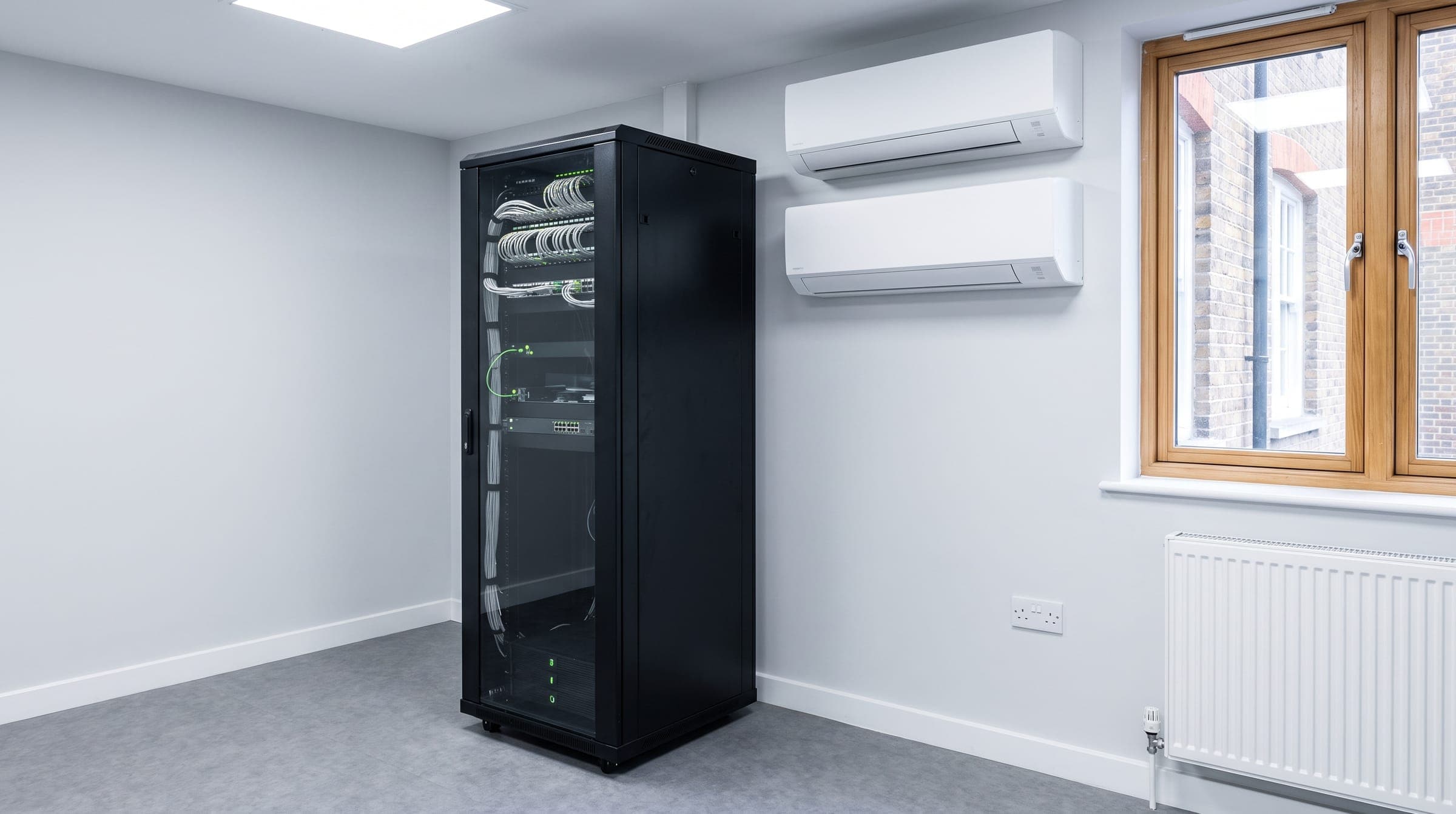
A server room makes heat every hour of every day, including Christmas and the coldest night in January. We design and fit dedicated cooling for small server rooms and comms cupboards in offices and businesses across London and the Home Counties, with standby units and alarms where the risk calls for them.
- ASHRAE recommended inlet range
- 18 to 27°C
- one standby unit beyond need
- N+1
- commercial wall unit, from
- £1,795 + VAT
- and REFCOM certified
- F-Gas
Why a server room needs its own cooling
Almost all the electricity your servers, switches and UPS use ends up as heat in the room. That heat doesn't stop at 6pm or at the weekend, and it doesn't drop much in winter. The office air conditioning, which switches off when everyone goes home, can't look after it.
So a server room needs a system that runs all the time, on its own controls and its own electrical supply. It also needs an outdoor unit that can keep cooling in winter, because a server room needs cooling even on a frosty night. Not every model is rated for that, so we check the manufacturer's cooling operating range before we specify one.
How cool is cool enough?
Equipment cares about the temperature of the air going into it, not the temperature by the door. ASHRAE, the industry body whose thermal guidelines the IT world uses, recommends an inlet air range of 18 to 27°C for most server equipment. Your hardware maker's own limits always come first.
Many rooms are run far colder than they need to be, which wastes energy. A steady temperature within the recommended range, with good airflow to the front of the racks, matters more than a very low set point.
Comfort units or close control?
Two different kinds of equipment. The honest answer depends on the size and importance of the room.
| Feature | Comfort split system | Close control unit |
|---|---|---|
| Designed for | People in offices and homes | Rooms full of equipment, such as data centres |
| Controls | Temperature, with humidity as a side effect | Temperature and humidity, held within tight limits |
| Typical job | Comfort cooling for rooms people use | Continuous cooling of equipment at a steady load |
| Suits | Small server rooms and comms cupboards | Larger rooms and critical, high-density installations |
| Cost | Lower to buy and fit | Much higher, and specialist to design |
We fit split systems for small server and comms rooms. If your room needs full close control, we'll say so at the survey and suggest you use a specialist.
Standby units and N+1
If one air conditioner is all that stands between your servers and a shutdown, a single fault becomes an outage. N+1 means fitting one more unit than you need: if the room needs one unit, you fit two, and either can carry the load alone.
Manufacturers including Daikin and LG make controllers for exactly this. Duty rotation swaps the running unit and the standby unit at set intervals, so both wear evenly and you know the standby works. If the running unit fails, the controller brings the standby in automatically.
For the best protection, give each unit its own electrical supply and, where possible, its own outdoor unit, so one fault can't take out both.
Alarms and good practice
Cooling is only half of it. You need to know quickly when something goes wrong.
- A high-temperature alarm that's independent of the air conditioning, so it still works if the units fail
- Alerts sent to someone who can act, by email, text or your monitoring system, not just a local beep
- Use the fault output on the air conditioning controller where your monitoring can read it
- Indoor units never directly above racks, and condensate piped away from equipment
- Blanking panels in empty rack spaces so hot exhaust air doesn't loop back to the front
- No portable air conditioners as the long-term answer: they need a vent and a water bucket emptying
- Plan for growth: new kit adds heat, so leave headroom in the sizing
How we size and fit server room cooling
Measure the load
We look at the IT equipment's power draw, the UPS, lighting and any heat coming in through walls and windows.
Agree the risk
We talk through how critical the room is, and whether you need N+1, duty rotation and remote alarms.
Written quote
You get a fixed price plus VAT, with each option shown clearly so you can choose the level of resilience.
Install without downtime
We plan the work with your IT team so the equipment keeps running. Temporary cooling can be discussed if the room is already hot.
Commission and test
We commission the system, test the changeover between units and confirm the alarms reach the right people.
Server room cooling prices
Server rooms are quoted after a survey, because resilience options change the price. As a guide, a commercial wall unit starts from:
- from£1,795+ VAT
Commercial wall unit
Fitted in business hours
Server room air conditioning questions
What temperature should a server room be?
ASHRAE recommends 18 to 27°C for the air going into most server equipment. Check your hardware maker's limits as well. A steady temperature in that range matters more than running the room very cold.
Can I use a normal split air conditioner for a server room?
For a small server room or comms cupboard, a split system chosen and set up for the job is common. It must be able to cool all year, including in winter. Larger or critical rooms may need close control units, which are specialist equipment.
What does N+1 mean for air conditioning?
It means fitting one more unit than the room needs. If one unit can cool the room, you fit two. When the running unit fails, the standby takes over, so the room stays cool while it's repaired.
What is duty rotation?
A controller that swaps the running and standby units at set intervals. Both units wear evenly, and you know the standby works because it runs regularly. Controllers like these also switch to the standby automatically if the running unit fails.
Do I need a temperature alarm as well?
Yes, ideally one that's independent of the air conditioning and sends alerts to someone who can act. If cooling fails, the alarm gives you warning before the equipment overheats.
How often should server room air conditioning be serviced?
Because it runs all year, it works far harder than an office system. We recommend servicing at least twice a year, and we test the changeover between units at each visit.