Air conditioning in a National Park or National Landscape (AONB)
Plenty of guides say there is no permitted development in a National Park or an Area of Outstanding Natural Beauty. For house extensions that is partly true. For a heat pump that also cools, it isn't: the national rules add no extra limit for either. Here is what the law says, why the myth exists, what the Chilterns, Surrey Hills and Kent Downs ask for, and what does make you apply.
- in Class G for these areas
- No extra limit
- Chilterns National Landscape
- 838 km²
- Surrey Hills designated
- 1958
- Kent Downs National Landscape
- 878 km²
On this page13 sections
The short answer
In planning law, air conditioning that also heats is an air source heat pump. On a house or a block of flats in England it can be permitted development under Class G, so no planning application, if every limit is met.
- Class G names only two kinds of area for extra rules: conservation areas and World Heritage Sites. A National Park, a National Landscape and the Broads are not among them
- So a heating-capable unit on an unlisted house in the Chilterns or the Surrey Hills follows exactly the same rules as one in Luton
- One unit on a terraced or semi-detached house, two on a detached house, an outdoor unit no bigger than 1.5 m³, and not on a pitched roof
- The MCS 020(a) noise calculation passed, and no wall facing a road above the ground floor. Our planning permission guide sets out every rule
- What makes you apply is the same as in town: a listed building, a conservation area with a street-facing position, a scheduled monument, an Article 4 direction, a planning condition, or a cooling-only unit
- Countryside homes have more of all of these than you might think, which is why the answer has to be checked address by address
Why people think permitted development doesn't apply
Many householder rights are cut back on what the Order calls article 2(3) land, so guides written about extensions say permitted development is restricted in these areas, and the line gets repeated for everything.
- Article 2(3) land is defined in Schedule 1 Part 1: conservation areas, Areas of Outstanding Natural Beauty, the Broads, National Parks, World Heritage Sites and certain land under the Wildlife and Countryside Act 1981
- Class G for heat pumps doesn't use the term at all. Its only area rule, G.2(j), names land within a conservation area or which is a World Heritage Site
- Some older case studies say a National Park property had no permitted development rights. That may have been true of that house through a condition or listing, but isn't a general rule
- Even Historic England's Advice Note 18 says permitted development rights carry additional restrictions in places such as conservation areas, World Heritage Sites and National Parks
- That is right for some rights. For a heat pump on a house, only the first two change anything
What being in a National Landscape or National Park changes
For a house on article 2(3) land, from the current text of the Order. National Landscapes are still legally Areas of Outstanding Natural Beauty.
| Work | Rule on article 2(3) land | Where it comes from |
|---|---|---|
| Air source heat pump, including heat-and-cool air conditioning | No extra limit, unless also in a conservation area | Part 14 Class G |
| Cooling-only air conditioning | No permitted development anywhere | Part 14 Class G, condition G.3(aa) |
| Cladding the outside of the house | Not permitted development | Part 1 Class A, paragraph A.2 |
| Side extension, or a rear extension of more than one storey | Not permitted development | Part 1 Class A, paragraph A.2 |
| Roof extension, such as a dormer | Not permitted development | Part 1 Class B |
| Outbuilding more than 20 m from the house | Total capped at 10 m² in a National Park or National Landscape | Part 1 Class E, paragraph E.2 |
| Outbuilding between a side wall and the boundary | Not permitted development | Part 1 Class E, paragraph E.3 |
| Chimney or flue on a wall or roof facing a road | Not permitted development on the front or side | Part 1 Class G (flues, not heat pumps) |
| Some solar and wind installations | Tighter limits | Part 14 Classes A, B, H and I |
The duty councils have had since December 2023
If you do apply, the council has a stronger duty than it used to. It doesn't create a new consent or ban anything.
- Since 26 December 2023, section 85 of the Countryside and Rights of Way Act 2000, as amended by the Levelling-up and Regeneration Act 2023, sets the duty
- A relevant authority in England must seek to further the purpose of conserving and enhancing the natural beauty of an Area of Outstanding Natural Beauty. Before that it only had to have regard to it
- The same change applies to National Parks under section 11A of the National Parks and Access to the Countryside Act 1949
- When your application is decided, the unit's effect on the landscape gets more weight, so a low, screened position and a colour that sits into its background matter more
- The Kent Downs team has published advice to councils on the new duty, and the Surrey Hills management plan for 2025 to 2030 sets out how authorities should meet it
- AONBs in England and Wales were renamed National Landscapes on 22 November 2023
- The legal designation is still Area of Outstanding Natural Beauty, which is why the Order and older council documents use that name
The Chilterns
The Chilterns National Landscape covers about 838 square kilometres (324 square miles) across Bedfordshire, Buckinghamshire, Hertfordshire and Oxfordshire, and it reaches right into our patch.
- Designated in 1965 and extended in 1990, it is looked after by the Chilterns Conservation Board, a public body set up under the Countryside and Rights of Way Act 2000
- A boundary review that might have enlarged it was stopped by Natural England in June 2025, after its funding was cut, so the boundary is unchanged
- In it: Dunstable Downs, Whipsnade, Kensworth, Studham and the Barton Hills, close to our base in Luton
- Also Wigginton, Aldbury and Tring Park around Tring, Potten End and Berkhamsted Common in Dacorum, the countryside around Amersham and Chesham, and Marlow Bottom
- Just outside it: Tring town, Berkhamsted town centre and Beaconsfield
- The Board's Chilterns Buildings Design Guide (2010) is the local design reference and encourages sensitively sited and designed renewable energy
- It asks for utility boxes and similar fittings to go on less prominent facades and be coloured or painted to match the wall
- It recommends black painted cast metal rather than uPVC for external gutters and pipework
- It also points to tree planting and building orientation for summer cooling, the passive steps a council will want to see before cooling
The Surrey Hills
The Surrey Hills was one of the first landscapes designated an Area of Outstanding Natural Beauty, in 1958, and covers about a quarter of Surrey from Farnham in the west to Oxted in the east.
- In it: Box Hill, Ranmore, Leith Hill, Westcott and Mickleham near Dorking, and Shere, Albury and Peaslake near Guildford
- Also Reigate Hill and Gatton, and Haslemere and the Devil's Punch Bowl in the south-west
- It may grow: Natural England's variation order would add about 129 square kilometres in Surrey, Hampshire and Greater London
- That includes land around Farnham, Dorking, Leatherhead, Reigate and the Hog's Back
- Natural England sent it to the Secretary of State in September 2026 for confirmation, and no decision had been made when we checked
- If your home is near the current edge, check the latest map before you plan an outdoor unit
- The Board's Environmental Design Guidance sets principles for all development, and its management plan for 2025 to 2030 calls for strict control of development
- Neither sets a rule written for heat pumps
- In practice the Surrey councils look closely at anything visible from the hills or the lanes, so a unit that sits low, at the back or side, screened by a hedge, is what works
The Kent Downs
The Kent Downs National Landscape was designated in July 1968 and covers 878 square kilometres, running from the white cliffs of Dover to the Surrey and London border.
- About 74,000 people live in it, and together with the High Weald it covers about a third of Kent
- The team publishes guidance on the selection and use of colour in development (2020), a Landscape Design Handbook and farmstead guidance
- It also publishes a renewable energy position statement (June 2026) and advice to councils on the 2023 duty
- None of them sets a rule for domestic heat pumps or air conditioning: the 2026 position statement deals mainly with solar, wind, biomass and battery storage
- The colour guidance is the useful one for a home: it is about choosing colours that sit into the landscape, and the same thinking applies to an outdoor unit and its pipework
Protected landscapes in and around our area
| Landscape | Where it reaches | What to know |
|---|---|---|
| Chilterns National Landscape | South Bedfordshire, west Hertfordshire, the Buckinghamshire Chilterns | Design guide asks for less prominent facades, matching colours, black metal pipework |
| Surrey Hills National Landscape | About a quarter of Surrey, Farnham to Oxted | Extension of about 129 km² awaiting a decision; strict control of visible development |
| Kent Downs National Landscape | Dover to the Surrey and London border | Colour guidance for development; advice to councils on the 2023 duty |
| High Weald National Landscape | West Kent, East and West Sussex, a small part of Surrey | Over 70% of Tunbridge Wells borough, its council says |
| North Wessex Downs National Landscape | West Berkshire and beyond | Much of West Berkshire's countryside |
| Dedham Vale National Landscape | The Essex and Suffolk border | Constable country around Dedham, itself a conservation area |
| South Downs National Park | Hampshire, West Sussex and East Sussex, not Surrey | Starts just south of Haslemere; the park authority is the planning authority |
England has 34 National Landscapes and 10 National Parks, counting the Broads, in the government's planning data. No National Park lies inside the counties we cover.
What does make you apply in the countryside
The landscape itself doesn't make you apply, but the things that do are common in the countryside.
- Conservation areas: most villages in these landscapes have one at their centre, and the rule applies in full: no unit on a wall or roof fronting a highway, or nearer a bordering road than the house
- Listed buildings: farmhouses, cottages and barns are often listed, and a listed house loses Class G altogether, so you need planning permission and usually listed building consent
- Scheduled monuments: such as the castle earthworks on Totternhoe Knolls, have no Class G right either
- Planning conditions: converted barns and newer houses often come with one removing permitted development rights, so read your decision notices
- Article 4 directions: the rural ones we found near Amersham and Chesham cover farmland and woodland, not homes, but check yours
- In a National Park the park authority is the planning authority, even where a district council handles the paperwork for it
- Rural homes tend to sit further from roads and closer to open views, so the G.3 conditions matter
- The unit must be sited, so far as practicable, to minimise its effect on the look of the building and on the amenity of the area. That is a condition of permitted development, not just good manners
Siting an outdoor unit in a protected landscape
From the Chilterns, Kent Downs and Surrey Hills guidance and the councils that cover them. We plan every survey around these.
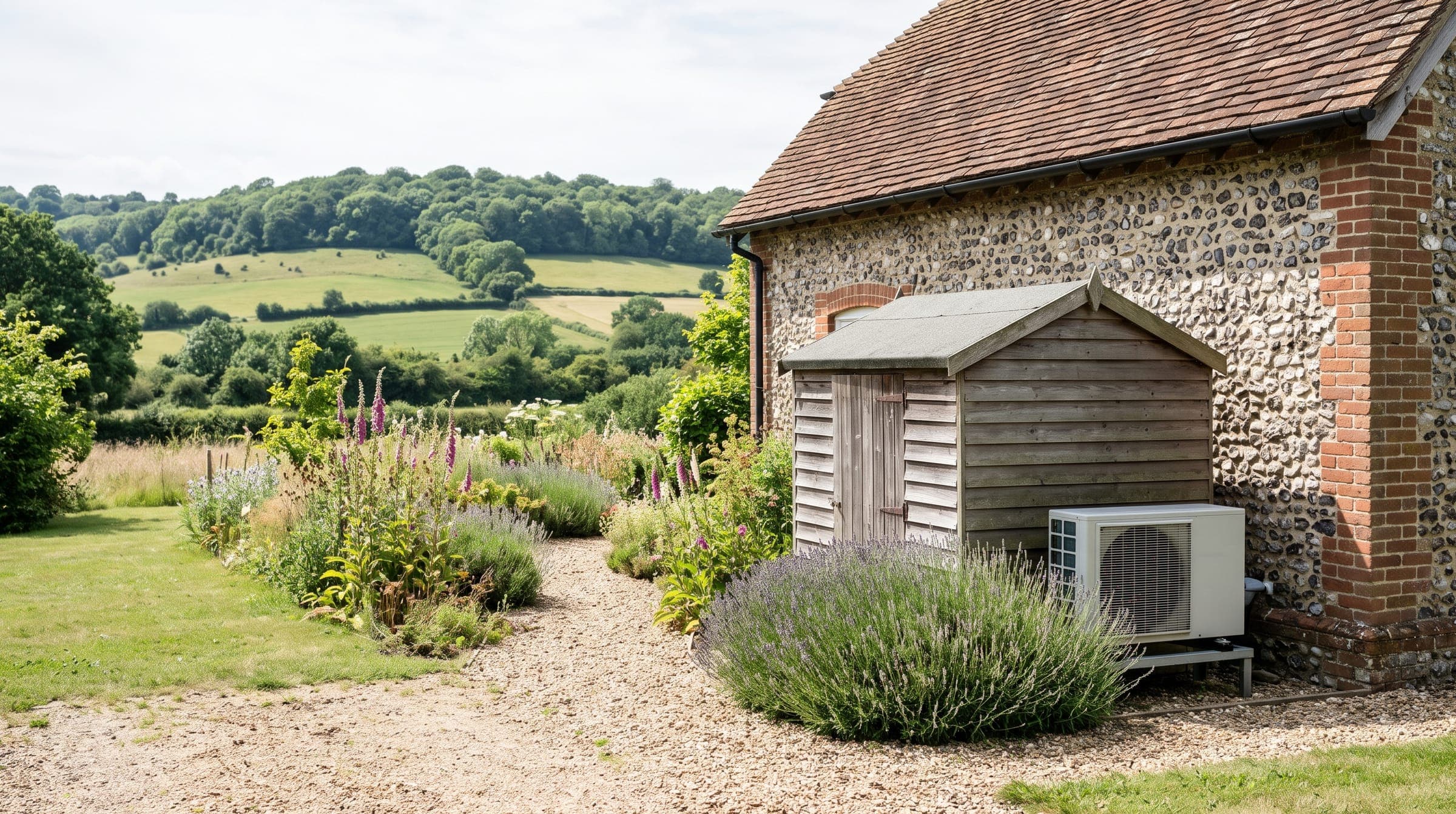
- At the rear or a side away from the lane, at ground level, below the line of a hedge or wall
- Out of the long views from footpaths, commons and hilltops, not just from the road
- On a pad or stand rather than a bracket on flint, clunch or old brick
- A unit and any visible pipework coloured to match the wall, after checking the maker's warranty
- Pipework through the wall straight behind the unit, with black painted metal where any shows on a historic house
- No external lighting on the unit or its enclosure, in a landscape that guards its dark skies
- Condensate to a drain or a gravel soakaway, never across a path where it can freeze
- One outdoor unit for several rooms rather than a row of single units
- The MCS 020(a) noise calculation run to every neighbouring window, which matters more in quiet countryside
- Old oil tanks or redundant plant removed at the same time, which Historic England says can offset any harm
When you need an application, and how we help
If the house is listed, in a conservation area with no hidden position, under an Article 4 direction or condition, or the system only cools, you apply.
- A householder application costs £548 in England from 1 April 2026, listed building consent has no fee, and councils have 8 weeks to decide once it is valid
- A Lawful Development Certificate, which costs half the planning fee, confirms in writing that a unit is permitted development if you want certainty
- Councils and park authorities decide from drawings, and our design pack provides them
- It covers scaled plans and elevations, the outdoor unit position and screen, pipe routes, the equipment specification, the maker's sound data and our MCS 020 calculation
- It costs from £795, can be more for a larger house or a listed building, and is a fixed fee agreed in writing first
- It comes off your installation if you go ahead with us. Where a specialist report is needed, we say so at the free survey
National Park and National Landscape questions
Is permitted development allowed in an AONB?
Yes, with limits. Many householder rights are restricted on article 2(3) land, which includes AONBs, now called National Landscapes: cladding, side extensions, two-storey rear extensions, dormers and some outbuildings need permission. But the heat pump right in Class G adds no AONB limit. A heating-capable unit on an unlisted house follows the same rules as anywhere else in England.
Are permitted development rights removed in an AONB?
Not by the designation itself. Some rights are narrower, as above. Rights are removed only by an Article 4 direction or a planning condition on a particular property, and those can happen anywhere. Check your planning history and the council's Article 4 list, and whether the house is listed or in a conservation area.
Can I install a heat pump in a National Park without planning permission?
Often yes, on an unlisted house outside a conservation area, if it meets the Class G limits on size, number, position and noise. The National Park adds no extra heat pump rule. In a park the park authority decides any application, and many park villages are conservation areas with listed cottages, so check the address first.
Does the Chilterns National Landscape stop me fitting air conditioning?
No. It adds no limit to the heat pump rules, so a heating-capable unit on an unlisted house in Dunstable, Tring or the Chilterns villages can often go in without an application. The Chilterns Buildings Design Guide asks for fittings on less prominent walls in matching colours, which is how we plan every unit there anyway.
I live in the Surrey Hills. Do I need permission for an outdoor unit?
Not because of the Surrey Hills. You need permission if the house is listed, the unit faces a road in a conservation area, an Article 4 direction or condition applies, or it only cools. Councils look closely at anything visible from the hills and lanes, so a low, screened rear position is what works, whether or not you apply.
Will the Surrey Hills extension change the rules for my house?
Not for a heat pump. Being added to the National Landscape doesn't create a heat pump limit. It narrows other householder rights, such as side extensions and dormers, and it brings in the council's duty to further the landscape's purpose if you ever apply. Natural England sent the order to the Secretary of State in September 2026.
Why do some websites say there is no permitted development in a National Park?
Because many householder rights are restricted on article 2(3) land, and older guidance repeated that for everything. Class G, the heat pump right, names only conservation areas and World Heritage Sites for its extra rule. Individual houses can have rights removed by a condition, which is where some of those stories come from.
Does a cooling-only unit need planning permission in a National Landscape?
Yes, as it would anywhere in England. Since 29 May 2025, Class G only covers a heat pump that is not used solely for cooling. A split system that heats your home as well qualifies, and in a home off the gas grid it can heat the rooms it serves in place of oil or electric heaters.