Air conditioning in a conservation area: what you can and can't do
A conservation area doesn't stop you fitting air conditioning. A unit that heats as well as cools can often go at the back of an unlisted house with no application. What changes is where the outdoor unit can sit, and in a few streets an Article 4 direction takes the right away. Here's the rule in plain words, the directions near us that matter, and what councils accept.
householder fee, from 1 April 2026 £548
- householder fee, from 1 April 2026
- £548
- conservation areas in England
- About 10,000
- homes in conservation areas
- 2.8 million
- air source heat pump right began
- 1 Dec 2011
On this page14 sections
The short answer
In planning law, air conditioning that can heat your home is an air source heat pump. On a house in England it can be permitted development under Class G: you don't need to apply, as long as every limit is met.
- A conservation area keeps that right but adds one rule, paragraph G.2(j)
- The unit can't go on a wall or roof that fronts a highway, and it can't sit nearer to a bordering highway than the house
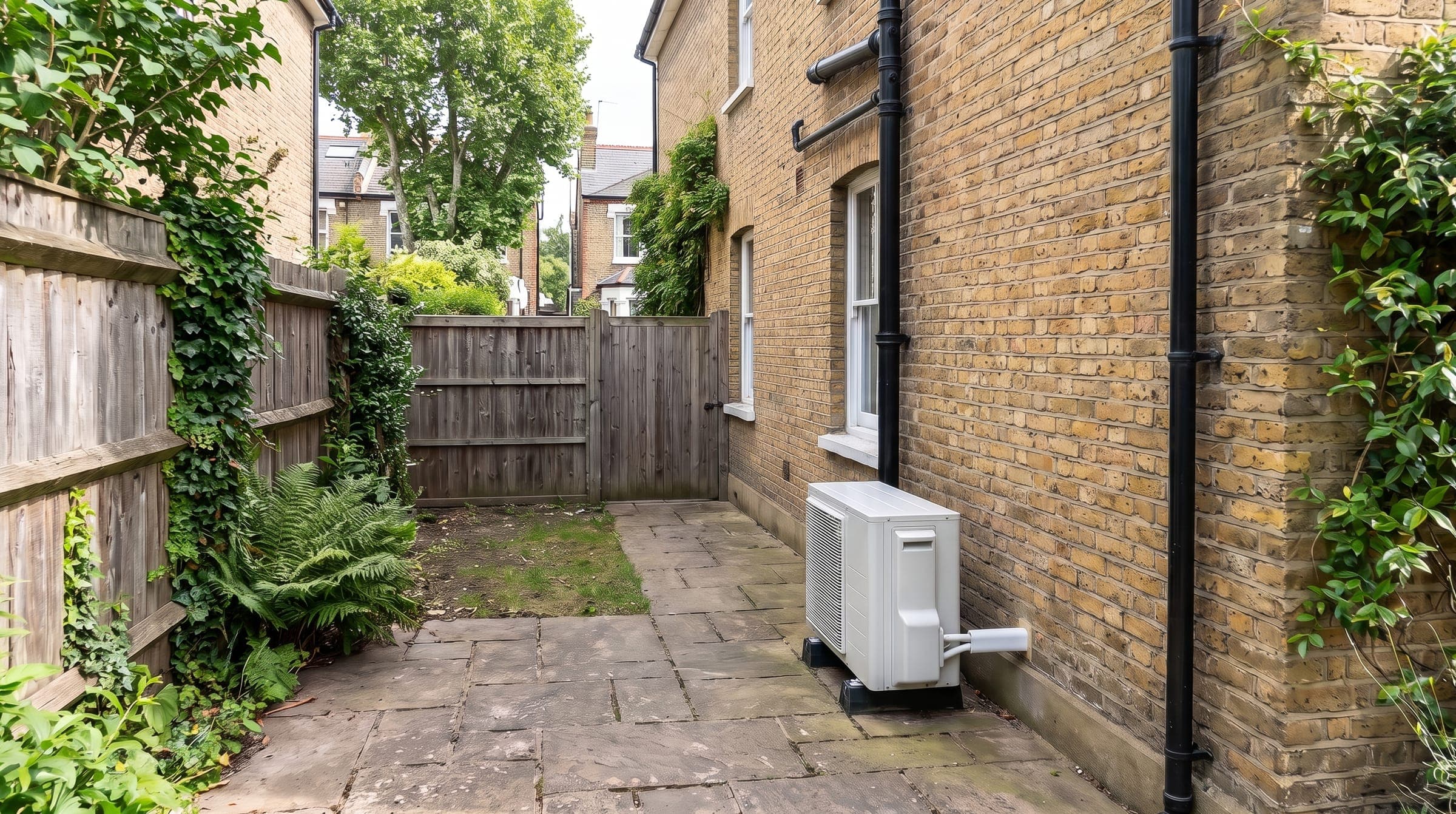
- So a heating-capable unit on the back wall, or on a side wall that doesn't face a road, can still go in without permission on an unlisted house
- It must also meet the size, number and noise rules. Our planning permission guide has the full Class G checklist
- Three things take the right away: listing, an Article 4 direction and a planning condition
- Cooling-only units are different: since 29 May 2025, Class G only covers a heat pump that is not used solely for cooling
- A unit that only cools needs planning permission wherever it goes, in a conservation area or not
How many homes this affects
Historic England counts around 10,000 conservation areas in England. Its Advice Note 18 puts the number of homes in them at around 2.8 million.
- The national planning data register holds 10,786 records, covering about 2.2% of the country
- Councils designate them for special architectural or historic interest. They range from a single village green to most of a town: Bath's covers two thirds of the city
- In our area they are everywhere: St Albans, Hertford, Hitchin, Berkhamsted, Amersham, Marlow, Ampthill and Woburn all have historic centres in conservation areas
- London boroughs have dozens each: Westminster lists 56 and Richmond upon Thames 85
- Your council's website has a map, and our planning checker looks your postcode up in the government's planning data
The street-facing rule in plain words
G.2(j) keeps the unit behind the building line on every side that touches a road. It has two parts.
- First: the outdoor unit can't be fixed to a wall or a roof that fronts a highway
- Second: wherever it is, it can't be nearer to a highway that bounds your property than the nearest part of the house
- The Order doesn't define fronting a highway for heat pumps. The government's householder technical guidance, written for extensions, fills the gap
- It says a highway is a public right of way such as a road, footpath or bridleway, and for the Order includes unadopted streets and private ways
- A wall at more than 45 degrees to the highway won't normally count as fronting it, and a wall a long way from the road, or separated by land in other ownership, may not either
- Councils often use the same reasoning, but they decide
- Corner plots are where most mistakes happen: a side wall facing a second road fronts a highway, and a garden pad beside it may be nearer that road than the house
- A rear lane or a public footpath behind the garden can be a highway too. If your plot touches a road or path on more than one side, check each one
Where the outdoor unit can go in a conservation area
For a heating-capable unit on an unlisted house with no Article 4 direction or condition. Every row assumes the size, number and MCS 020(a) noise rules are met.
| Position | Permitted development? | Notes |
|---|---|---|
| Rear wall, garden behind the house | Usually yes | The standard position, and the one councils prefer anyway |
| Ground pad in the back garden | Usually yes | Check no rear lane or footpath bounds the garden |
| Side wall that doesn't face a road | Can be | Not if it would sit forward of the house towards a road |
| Side passage, set back behind the front wall | Can be | Not if the side wall faces a road; a gate or wall helps the look |
| Side wall facing a second road on a corner plot | No | Apply for planning permission |
| Front wall facing the street, any height | No | Apply, and expect refusal in most places |
| Front garden or forecourt | No | Nearer the road than the house |
| Pitched roof | No | Not permitted anywhere under Class G |
| Flat roof at the rear, at least 1 m from the edge | Can be | Not if the roof fronts a highway |
| Any position, cooling-only unit | No | Class G doesn't cover cooling-only units |
| Any position, listed building | No | Planning permission and listed building consent |
Article 4 directions, explained
An Article 4 direction lets a council, or the Secretary of State, withdraw specified permitted development rights in a defined area. What matters for you is the class a direction names.
- Government guidance says directions should be used in a measured and targeted way, applied to the smallest area possible and based on robust evidence
- Most cover a conservation area or part of one, and most deal with windows, doors, roofs, front walls and painting, not heat pumps
- Non-immediate directions take effect after notice and consultation
- Immediate directions remove rights straight away and must be confirmed by the council within 6 months to stay in force
- A direction can't undo work already carried out
- If a council removes a right and then refuses permission, it can be liable for compensation, limited to abortive spending or loss directly caused by the withdrawal
- The heat pump right is Class G of Part 14 in the 2015 Order. Before April 2015 it was Class G of Part 40 in the 1995 Order, added on 1 December 2011
- So no direction made before December 2011 can have removed the air source heat pump right, however wide its wording sounds
- Class G of Part 1 is a different right altogether: chimneys, flues and soil and vent pipes. Directions that remove it are often misread as covering heat pumps
Article 4 directions near us that do remove the heat pump right
Confirmed from the council's own direction or schedule. In these places an outdoor unit needs planning permission wherever it goes, even at the back.
| Place | Council | Direction | What it removes |
|---|---|---|---|
| Bishop's Stortford Conservation Area (the whole area) | East Hertfordshire | Confirmed 15 November 2017 | Part 14 Class G on houses, flats and their grounds |
| Cunningham Avenue Conservation Area, St Albans | St Albans City and District | In effect 3 November 2014 (ref Ar4.20) | Microgeneration including air source heat pumps, on houses and flats |
| Finchley Garden Village Conservation Area (Village Road, Cyprus Avenue) | Barnet | Sealed 2 December 2013 (ref FGV 13) | Part 40 Classes A to I, including the air source heat pump class |
| Moss Hall Crescent Conservation Area, North Finchley | Barnet | In force 21 October 2015 (ref MHC 15) | Part 14 Classes A to I, including Class G, for every property |
Our planning checker flags all four. Councils add and change directions, so always check the current list for your address.
Directions that sound relevant but don't touch heat pumps
We read these because they are often quoted. None of them removes the air source heat pump right, so Class G still applies, subject to the conservation area rule.
| Place | Council | What the direction actually covers |
|---|---|---|
| Hampstead Garden Suburb (2010) | Barnet | Part 40 Classes A to F: solar, ground and water source heat pumps, flues. The Trust's own consent still applies |
| Hendon The Burroughs (2012) | Barnet | Part 40 Classes A to F, not air source |
| Queen's Park (2021), Mapesbury (2025) and others | Brent | Part 14 Classes A, D and H: solar, water source heat pumps and wind. Class G is not removed |
| Brownswood (2026) | Hackney | Part 14 Classes A and J: solar |
| Noel Park (2020) | Haringey | Part 14 Class A: solar |
| Chatsworth Road (2016) | Croydon | Part 14 Class A: solar |
| Hampstead, Belsize, South Hampstead (2010) | Camden | Solar and flues only; the replacements keep only flues |
| Stockens Green, Knebworth and Hitchin (2013) | North Hertfordshire | Part 1 Class G: chimneys, flues, soil and vent pipes |
| The Royds and Elstree Hill North (2015) | Hertsmere | Part 1 Class G: chimneys and flues |
| Moor Park (2007) | Three Rivers | Too early to cover heat pumps; the estate's own covenant does |
| All directions in the borough | Richmond upon Thames | The council says none of them removes heat pump rights |
| All directions in the borough | Islington | Windows and external insulation only |
How to check your address
Run the planning checker
Our planning checker looks your postcode up in the government's planning data and shows conservation areas, World Heritage Sites and Article 4 directions at that point, and flags the ones known to cover heat pumps.
Read the direction itself
If an Article 4 direction appears, open the council's copy and look for Part 14 Class G, Part 40 Class G or the words air source heat pump. Note the date: anything before December 2011 can't cover it. Part 1 Class G means chimneys and flues, not heat pumps.
Check whether the building is listed
Search the National Heritage List for England by address or map. If the house or block is listed, Class G doesn't apply at all, and you need planning permission and usually listed building consent.
Look for a planning condition
Find your home's planning history on the council's website and read the decision notices, especially for a newer house, a conversion or an extension. A condition can remove permitted development rights for that one property, whatever the area rules say.
Check for an estate scheme or covenant
In places such as Hampstead Garden Suburb, Letchworth, Welwyn Garden City, Dulwich and Moor Park, an estate body has its own consent on top of planning. Your deeds and a local land charges search will show it.
Ask the council if it's close
For a borderline case, such as a corner plot, ask the council or apply for a Lawful Development Certificate, which costs half the planning fee. It gives you a written answer you can show a buyer later.
What councils near us accept, and what they refuse
Very few councils publish a rule written for air conditioning. Their views sit in conservation area appraisals, heat pump guidance and noise policy, and they agree on the basics: rear, low, out of sight from the street and from neighbours' gardens, with as little pipework on show as possible.
- Southwark (2025 householder guidance): heat pumps won't be acceptable in a front garden or on a street-facing roof in a conservation area, or in any other publicly visible spot
- Westminster: avoid the front and anywhere facing the highway; it prefers rear yards, gardens and rear lightwells
- Camden: a heat pump on the front of a property is unlikely to be acceptable
- St Albans: its householder guide, written for satellite dishes, says rear, low, dark and never the front facade
- Dacorum: asks for rear positions away from neighbours, with details of any screen, the noise and the unit's efficiency
- Conservation area appraisals now name air conditioning outright. North Herts' 2023 Pirton appraisal lists air conditioning units among additions that harm historic character
- Buckinghamshire's Buckingham appraisal (April 2026) says units in visually prominent locations detract from the area, and the county's guidance asks you to record the options you considered
- Welwyn Village's 2024 appraisal says the same of prominent units
- A screen doesn't rescue a visible spot: Welwyn Garden City's estate scheme refused a heat pump and its screening in a street-visible position in 2022
Present it as a heat pump that also cools
Councils are much warmer towards heat pumps than towards air conditioning. An air-to-air heat pump is the same kit as a split air conditioner, sized and set up for heating.
- Historic England's Advice Note 18 says low-carbon heating such as heat pumps will generally be acceptable
- Camden discourages air conditioning and asks for proof of need
- Islington counts the cooling from an air-to-air unit as active cooling and wants the cooling hierarchy of shading and ventilation shown first
- Southwark discourages air conditioning because of its energy use
- If you apply, lead with the heating: what it replaces, its efficiency and its refrigerant
- Treat cooling as the second benefit, with the shading and ventilation you already use set out
- That framing is also the only route to permitted development, because a cooling-only unit has no Class G right
What a conservation area application should show
Councils decide from drawings. This is what their validation lists and guidance ask for, and what our design pack is built around.
- A location plan at 1:1250 edged in red, and a block plan showing boundaries, neighbours' windows and the unit position
- Existing and proposed elevations at 1:50 or 1:100 of every wall that changes, with the unit's exact dimensions
- The pipe, cable and condensate routes, inside and out, and any wall openings
- Any screen or enclosure drawn in full, with the maker's airflow clearances kept clear
- Photos of the house and the view from the street, with the proposed position marked
- The maker's data sheet: size, colour, sound power, efficiency and refrigerant
- A noise calculation at the nearest neighbouring window, plus a report by an acoustician where the council asks for one
- A short statement of the alternative positions you considered and why the chosen one does least harm
- The heating case first, with the cooling and your existing shading and ventilation explained
When you need to apply, and how we help
If the unit has to face a road, the system only cools, the house is listed, an Article 4 direction covers your street or a condition removes the right, you apply to the council.
- A householder application costs £548 in England from 1 April 2026, and councils have 8 weeks to decide once it is valid
- Many London boroughs also want an acoustic report by a specialist; we tell you at the free survey if yours does
- Our design pack is the technical side of that application: scaled plans and elevations, the outdoor unit and any screen, pipe routes and the equipment specification
- It also includes the maker's sound data and our MCS 020 calculation
- It costs from £795, can be more for a larger house or a council that asks for more, and is a fixed fee agreed in writing first
- It comes off your installation if you go ahead with us
- The council decides, and nobody can promise the outcome
Conservation area questions
Do I need planning permission for air conditioning in a conservation area?
Not always. A heating-capable unit on an unlisted house can be permitted development if it isn't on a wall or roof fronting a highway, isn't nearer a bordering road than the house, and meets the size, number and noise rules. You need permission for a street-facing position, a cooling-only unit, a listed building, or where an Article 4 direction or a planning condition removes the right.
Can I put an air source heat pump in a conservation area?
Yes, usually at the back or a side that doesn't face a road. The conservation area rule is the same for an air-to-water heat pump and an air-to-air one. Councils across our area prefer rear, ground-level positions out of sight from the street and neighbouring gardens, and most refuse front positions.
Does an air-to-air heat pump count in a conservation area?
Yes. Since 29 May 2025, Class G covers heat pumps that heat and cool, as long as they are not used solely for cooling. The government's explanatory memorandum says this lets air-to-air heat pumps use the right. A split system that heats your rooms qualifies; a cooling-only unit doesn't.
What is an Article 4 direction and does it stop air conditioning?
It is an order by the council that withdraws named permitted development rights in a defined area. Most cover windows, doors and roofs, not heat pumps. Only one that names Part 14 Class G (or Part 40 Class G in older directions) or air source heat pumps takes away the right, and none made before December 2011 can. Near us, Bishop's Stortford, Cunningham Avenue in St Albans and two Barnet conservation areas do.
Can I put an outdoor unit on the front of my house in a conservation area?
Not as permitted development. A unit on a wall fronting a highway needs planning permission, and in practice councils refuse front positions almost everywhere, even with a screen. Look at the back, a hidden side passage or a flat roof at the rear first. Our survey checks every position before we quote.
Is a side wall allowed on a corner plot?
Not if that side wall faces the second road. On a corner plot both roads bound the property, so a unit on the side facing the side street fronts a highway, and a pad beside it may be nearer that road than the house. Both need permission. A rear wall or a pad behind the house usually avoids the problem.
Do I need an acoustic report in a conservation area?
For permitted development, the MCS 020(a) sound calculation is the test, and we include the maker's data and our calculation in every quote. If you apply, the council may want more. Many London boroughs ask for a report by an acoustician against their own background-noise target. Outside London, Luton and Buckinghamshire ask for a noise assessment mainly where neighbours could be disturbed, and Bedford wants the maker's sound data with every application.
How do I find out if my house is in a conservation area?
Your council's website has a conservation area map, usually with each area's appraisal. Our planning checker looks your postcode up in the government's planning data and shows conservation areas, World Heritage Sites and Article 4 directions. Check listing separately on the National Heritage List for England.
Will a screen make a visible unit acceptable?
Rarely. Screens help a unit that is already in a reasonable spot, such as a rear garden overlooked by neighbours. They don't turn a street-facing position into an acceptable one: Welwyn Garden City's estate scheme refused a heat pump and its screening in a street-visible spot in 2022, and Hammersmith and Fulham can refuse enclosures that harm the building themselves.