Air conditioning and heat pumps in a World Heritage Site
A World Heritage Site sounds like a ban on anything modern. It isn't. For an outdoor unit, the national rules treat a World Heritage Site exactly like a conservation area, and many homes inside one can still fit a heating-capable system at the back without an application. Here is the law, what it means in Bath and in the four London sites, and when you do need to apply.
Bath conservation visit, April 2026 £76
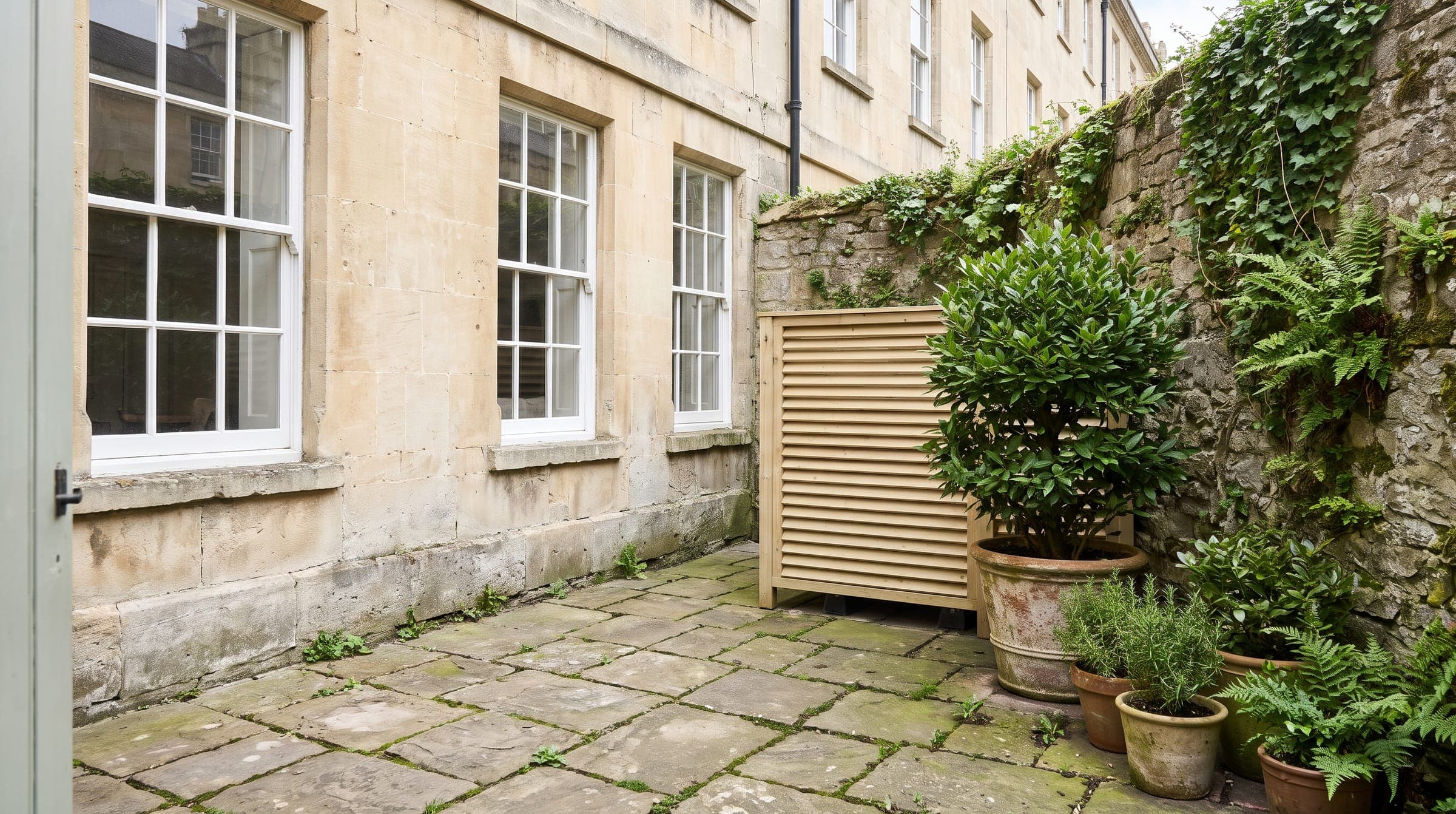
- Bath conservation visit, April 2026
- £76
- same rule as a conservation area
- G.2(j)
- listed buildings in the City of Bath
- About 5,000
- World Heritage Sites in London
- 4
On this page14 sections
The short answer
In planning law, air conditioning that can also heat your home is an air source heat pump. On a house or a block of flats in England it can be permitted development under Class G, which means no planning application, as long as every limit is met.
- Since 29 May 2025 the unit must not be used solely for cooling, so a cooling-only unit never qualifies, inside a World Heritage Site or anywhere else
- Inside a World Heritage Site, Class G adds one rule, paragraph G.2(j), the same rule that applies in a conservation area
- The unit can't go on a wall or roof that fronts a highway, and it can't sit nearer to a bordering highway than the house itself
- A unit at the back or on a side wall away from the road can still be permitted development
- Listed: if the house or block is listed, Class G doesn't apply at all, so you need planning permission and usually listed building consent
- Article 4: a council can remove the right with an Article 4 direction, as some World Heritage Site towns have
- Planning condition: a condition on your home can remove it too
- Our planning permission guide has the full Class G checklist; this page covers what is different in a World Heritage Site
What the law actually says
Paragraph G.2(j) reads: in the case of land within a conservation area or which is a World Heritage Site, development is not permitted if the air source heat pump would be installed on a wall or a roof which fronts a highway, or would be installed so that it is nearer to any highway which bounds the curtilage than the part of the dwellinghouse or block of flats which is nearest to that highway.
- World Heritage Sites are article 2(3) land, with tighter rules, but Class G doesn't use that term
- Article 2(3) land also covers National Parks and National Landscapes, and it restricts house extensions and some solar and wind rules
- For heat pumps, the only area designations that change the rules are conservation areas and World Heritage Sites, and they get the same treatment
- Historic England's Advice Note 18, revised in February 2026, agrees, and says in some sites Article 4 directions restrict permitted development further
- Unless the building is a key building of the site, it says climate changes to individual buildings are unlikely to affect its Outstanding Universal Value, the quality that got it inscribed
- A highway, in the government's householder guidance, is a public right of way such as a road, footpath or bridleway, and for the Order it includes unadopted streets and private ways
- That guidance says a wall at more than 45 degrees to the highway won't normally count as fronting it, and a wall a long way from the road may not either. Councils often use the same test, but ask yours
- A buffer zone gets no special treatment in Class G. Only land that is itself a World Heritage Site is caught, though most buffer zones are conservation areas anyway
World Heritage Sites in England with homes inside
From UNESCO's list for the UK and the sites' own management plans. Liverpool's Maritime Mercantile City was deleted from the list on 21 July 2021, so its rules no longer apply.
| Site | Inscribed | Homes inside | Council |
|---|---|---|---|
| City of Bath (and Bath in the Great Spa Towns of Europe) | 1987 and 2021 | The whole city: 107,161 residents | Bath and North East Somerset |
| Canterbury Cathedral, St Augustine's Abbey and St Martin's Church | 1988 | Few, if any | Canterbury City Council |
| Maritime Greenwich | 1997 | Some, mainly town-centre flats | Royal Borough of Greenwich |
| Palace of Westminster and Westminster Abbey | 1987 | Very few | Westminster City Council |
| Royal Botanic Gardens, Kew | 2003 | A few, on Kew Green | Richmond upon Thames |
| Tower of London | 1988 | A few, for the Yeoman Warders | Tower Hamlets |
| Ironbridge Gorge | 1986 | Yes, about 4,000 residents | Telford and Wrekin; Shropshire |
| Saltaire | 2001 | Yes, every house listed since 1984 | Bradford |
| Derwent Valley Mills | 2001 | Yes: Cromford, Belper, Milford, Darley Abbey | Derbyshire Dales, Amber Valley, Erewash, Derby |
| Cornwall and West Devon Mining Landscape | 2006 | Yes, mining towns and villages | Cornwall; West Devon; Devon |
| Stonehenge, Avebury and Associated Sites | 1986 | Yes, including Avebury and West Kennett | Wiltshire |
| The English Lake District | 2017 | Yes, towns and villages | Lake District National Park Authority |
| Durham Castle and Cathedral | 1986 | A few, around the cathedral | Durham County Council |
| Frontiers of the Roman Empire (Hadrian's Wall) | 1987 | A few, mostly rural | Northumberland, Cumberland and others |
Blenheim Palace, Jodrell Bank, Studley Royal and Fountains Abbey, and the Dorset and East Devon Coast have no homes of note inside them, as far as we found.
The four World Heritage Sites in London
London has four, and three of them hold very few homes. Near most of them, the conservation area and listing rules usually decide the answer, not the World Heritage Site.
- Westminster: the Palace of Westminster and Westminster Abbey site covers 10.3 hectares and has no buffer zone; UNESCO notes the challenge of protecting its wider setting
- Tower of London: 7.5 hectares, with homes only for the Yeoman Warders and their families
- Maritime Greenwich: 109.47 hectares, with a 174.85-hectare buffer zone formed by the East Greenwich, West Greenwich and Blackheath conservation areas
- There are flats and houses in Greenwich town centre inside the site, so G.2(j) applies there directly, and the council treats alterations like those in a conservation area
- Across the Blackheath border in Lewisham, homes are in the buffer zone, where the conservation area rule applies and the council weighs the site's setting
- Kew: Royal Botanic Gardens covers 132 hectares, with a 350-hectare buffer zone taking in Kew Green, the Old Deer Park, Syon Park and the river from Isleworth to Kew Bridge
- Part of the Kew buffer is a conservation area in Hounslow
- Richmond Council's heat pump page (April 2026) says none of its Article 4 directions remove heat pump rights, so conservation area and listing rules decide most Kew cases
London's World Heritage Sites at a glance
| Site | Size | Buffer zone | What usually decides your case |
|---|---|---|---|
| Westminster Palace and Abbey | 10.3 ha | None defined | Listing and the conservation area; Westminster's own plant and noise rules |
| Tower of London | 7.5 ha | None defined | Listing and the surrounding conservation areas in Tower Hamlets and the City |
| Maritime Greenwich | 109.47 ha | 174.85 ha | G.2(j) inside the site; the conservation area rule in the buffer; listing everywhere |
| Royal Botanic Gardens, Kew | 132 ha | 350 ha | Kew Green listing and conservation areas; no Article 4 removes heat pump rights in Richmond |
Sizes from UNESCO's site pages, read October 2026. Westminster's and the Tower's settings have no fixed boundary.
Bath: the whole city is a World Heritage Site
Bath handles more heritage applications than any other World Heritage Site in the UK. The site follows the municipal boundary, about 29 square kilometres, and the 2021 Great Spa Towns inscription uses the same line.
- The management plan endorsed by the council's cabinet on 20 May 2025 says 107,161 people live in it
- It has about 5,000 listed buildings, 3% Grade I, 10% Grade II* and 87% Grade II, the highest concentration of Grade I and II* outside central London
- A single conservation area of 1,486 hectares covers two thirds of the site
- The site generates about 1,500 applications for planning permission and listed building consent a year, the highest of any UK World Heritage Site
- The plan says alterations for climate change, made sensitively, need not harm the site's value, and Georgian buildings have already adapted to plumbing, electricity and central heating
- The council's Article 4 directions cover offices turning into homes, demolition of walls, estate agents' boards, houses in multiple occupation and some parcels of land
- We found none for heat pumps or wall-mounted equipment
- Its Local Listed Building Consent Order, still in development, covers solar panels in hidden roof valleys only, not heat pumps or air conditioning
Does your Bath home need an application?
Is the building listed?
Check the National Heritage List for England. If it is, you need planning permission and listed building consent for an outdoor unit, wherever it goes. The council's guidance says plainly that listed building consent is required for an air source heat pump, and one pre-application officer put it as not permitted development in the curtilage of a listed building.
Does it heat as well as cool?
A cooling-only unit is outside Class G everywhere, so it needs planning permission even on an unlisted house. A heat pump that also cools can use Class G if everything else is met. The council's planning guidance adds that if you want cooling, it should be built into the design from the start.
Where would the outdoor unit go?
On an unlisted house, anywhere in the city, G.2(j) applies because the land is a World Heritage Site, whether or not it is also in the conservation area. A unit on a wall or roof fronting a road, or forward of the house towards a road, needs permission. A unit at the back, meeting the other Class G limits, may not.
Does it pass the noise calculation?
Class G also needs the unit to meet the MCS 020(a) sound calculation at every neighbouring window. In Bath's tight terraces and courtyards, neighbours' windows can be very close. If it fails, a different position, a barrier or a planning application is the answer.
Book a conservation officer visit
For a listed home, the council's Service Level 0 pre-application visit costs £76 (fees from 1 April 2026) and takes about 20 working days. A conservation officer visits and advises on energy measures, heat pumps included. The next level, Level 1, costs £163.
What Bath's guidance asks for
The council's Energy Efficiency, Retrofitting and Sustainable Construction planning document (2022) is the most detailed heat pump guidance any English heritage city publishes.
- The outdoor unit in a discreet location away from the principal elevation, which could be behind greenery or fencing. Ducted units can sit indoors
- Noise mitigated with a silencing enclosure or by moving the unit away from sensitive facades
- The very cold exhaust air kept away from places people use or where ice could form
- For listed buildings: older houses often have microbore pipework that may need careful replacement, and historic radiators are likely to be significant parts of the interior
- The council's January 2025 factsheet, made with the Green Heritage Homes partnership, adds that the noise data and positioning of units will need to be considered
- On applications, specifications, drawings, photographs and photomontages all help, and if in doubt you should provide more detail rather than less
- Objections come where drawings are not of a professional standard, lack detail or are inaccurate
- Precedent is not a determining factor, so a neighbour's unit doesn't prove yours will be approved
- From the city's character appraisal: fine Georgian ashlar has near-invisible joints, so a ground stand or a rear rubble wall is usually a better base than a bracket on dressed stone
Other World Heritage Sites with their own rules
Ironbridge Gorge has the clearest guidance after Bath. Elsewhere the documents are older or silent.
- Ironbridge: Telford and Wrekin's July 2023 planning document names air-to-air heat pumps and says front elevations are unlikely to be supported
- Ground-floor rear positions or discreet corners can usually be supported, with screening and siting to limit noise
- Its Article 4 direction removes the right to fit micro-generation equipment on houses that front a highway, a waterway or open space, so those likely need an application. Ask for the exact wording
- Saltaire: every house in the model village has been listed since 1984, and a 1976 Article 4 direction removed rights for external alterations
- Bradford's shopfront guide says air conditioning units need listed building consent and planning permission and should be at ground level in an unobtrusive place
- Canterbury, in Kent and inside our area, holds few homes within the site itself, but the city centre around it sits almost entirely in conservation areas
- Stonehenge and Avebury: the 2015 plan names permitted micro-generation as a risk to the site
- Cornwall: the 2017 mining landscape guidance still repeats heat pump rules from before 2025, so don't rely on it
- The Lake District's partnership plan covers retrofit generally, and we found nothing specific on air conditioning in the plans for Greenwich, Westminster, Kew, the Tower or Canterbury
Why a heat pump that also cools gets a fairer hearing
Councils and Historic England are far warmer towards heat pumps than towards air conditioning. An air-to-air heat pump is the same equipment as a modern split air conditioner, run mainly for heating.
- Historic England's Advice Note 18 says moving to low-carbon heating such as heat pumps will generally be acceptable
- Its advice on overheating calls mechanical cooling an energy-intensive process
- Its Advice Note 16 says air conditioning is likely to affect a listed building's special interest
- London boroughs such as Camden and Islington ask applicants for cooling to show they have tried shading and ventilation first
- Put the heating case first, the cooling as a second benefit, and set out the shading and ventilation you already use
- Then an application reads as a low-carbon heating upgrade with a comfort benefit, not as cooling for its own sake. It is also the only way to use Class G at all
Positions that work in a World Heritage Site
From the published guidance of Historic England, Bath, Ironbridge and the London boroughs. Every design pack we draw starts here.
- The outdoor unit at the rear, at ground level, out of view from the street and from neighbouring gardens
- A side position only where a wall, gate or extension already hides it from the street
- Never the front elevation, the front garden or a street-facing roof: councils refuse these even with a screen around the unit
- A ground stand or pad in the garden or yard rather than a bracket on the main wall, especially on ashlar or a listed building
- One outdoor unit serving several rooms, rather than a row of single units
- Pipes run inside through existing voids and old holes, with the shortest possible run on the outside wall
- Condensate piped to a drain or into a gravel soakaway at the base of the unit, never across a path
- Cold air pointed away from doors, paths and seating: Historic England's case studies found it can be felt up to 3 metres away
- Anti-vibration mounts, and the unit kept off party walls and away from neighbours' bedroom windows
- A unit colour that blends in, after checking a non-standard finish won't affect the maker's warranty
When you need an application, and where we come in
If your home is listed, the unit has to go on a wall facing a road, the system only cools, or an Article 4 direction applies, you need to apply.
- A householder planning application costs £548 in England from 1 April 2026, listed building consent has no fee, and councils have 8 weeks to decide once it is valid
- If you think the unit is permitted development but want it in writing, a Lawful Development Certificate costs half the planning fee
- Councils decide from drawings, not quotes, and our design pack gives the council what it needs
- It covers scaled plans and elevations, the outdoor unit position and any screen, every pipe route, the equipment specification, the maker's sound data and our MCS 020 calculation
- It costs from £795, can be more for a larger house, a higher listing grade or a council that asks for more, and is a fixed fee agreed in writing before we start
- Where a heritage statement or an acoustic report by a specialist is needed, we tell you at the free survey and can introduce one
World Heritage Site questions
Do I need planning permission for air conditioning in a World Heritage Site?
Not always. A heating-capable unit on an unlisted house can be permitted development under Class G if it isn't on a wall or roof fronting a highway, isn't nearer a bordering road than the house, and meets the size and noise rules. That is the same test as a conservation area. A listed home, a cooling-only unit, a street-facing position or an Article 4 direction all mean you apply.
Is Bath a World Heritage Site, and where is the boundary?
Yes. The whole city is: the City of Bath was inscribed in 1987, and Bath became part of the Great Spa Towns of Europe in 2021. Both follow the municipal city boundary, about 29 square kilometres. So every home in the city is on land that is a World Heritage Site, and the G.2(j) rule applies whether or not the house is also in the conservation area.
Do I need listed building consent for a heat pump in Bath?
If the building is listed, yes. Bath and North East Somerset Council's guidance says listed building consent is required for an air source heat pump, and planning permission is needed too because Class G doesn't apply to listed buildings or their grounds. Listed building consent has no application fee. The council's £76 conservation officer visit is a sensible first step.
Does the buffer zone around a World Heritage Site have the same rules?
No. Class G only names land that is a World Heritage Site. A buffer zone gets the ordinary rules, unless it is also a conservation area, which many are. In Greenwich the buffer is made up of three conservation areas, so the street-facing rule still applies there. The council may also weigh the site's setting if you do need to apply.
Is a World Heritage Site the same as article 2(3) land?
It is article 2(3) land, along with conservation areas, National Parks, National Landscapes and the Broads, but Class G doesn't use that term. For heat pumps, only conservation areas and World Heritage Sites get the extra street-facing rule. Article 2(3) land matters more for house extensions, roof extensions and some solar and wind rules.
Can I put an outdoor unit on the front of my house if I screen it?
In a World Heritage Site, a unit on a wall fronting a highway isn't permitted development, screened or not, so you would need to apply. In practice councils and estate bodies refuse front positions almost everywhere, and a screen doesn't make a street-visible unit acceptable. Welwyn Garden City's estate scheme refused a screened heat pump in a street-visible spot in 2022. Look at the rear or a hidden side first.
Will Historic England be involved in my application?
Only for some listed buildings. Councils must notify Historic England of listed building consent applications for Grade I and II* buildings. For a Grade II house, an air conditioning or heat pump install isn't one of the works that triggers notification, so the council's conservation officer decides. World Heritage status alone doesn't bring Historic England in for an ordinary home.
How long does an application take?
Councils have 8 weeks to decide a householder application or listed building consent once it is valid. Add the time to prepare drawings: our design pack usually takes about 10 working days after the measured survey. A pre-application visit, such as Bath's Service Level 0, takes about 20 working days, so start early if you want the system in before summer.