Can you install air conditioning in a grade 2 listed building?
Yes, often, but never without asking first. A listed home has no permitted development right for an outdoor unit, so you need planning permission, and Historic England says you will normally need listed building consent too. Here's what listing protects, which parts of an install need consent, the risks of skipping it, and which systems councils are most likely to accept.
- listed building entries in England
- Over 370,000
- of listed buildings are Grade II
- 91.7%
- planning and listed building consent
- 2 consents
- on listed building enforcement
- No time limit
On this page15 sections
The short answer
Consent is needed, but a well-placed heating and cooling system is something many councils will agree. Historic England, the government's adviser on the historic environment, answers the question directly in two advice notes.
- Advice Note 16 on listed building consent: 'Air conditioning and electrical comfort cooling are likely to affect special interest and thus need LBC.'
- Advice Note 18, revised in February 2026: 'Listed building consent is normally required for the installation of heat pumps which are fixed to a building.'
- The same note says changing to low carbon heating 'such as heat pumps, will generally be acceptable'
- It adds that their impact 'can generally be minimised through careful siting, design and screening.'
- One more consent: because the house is listed, the permitted development right for heat pumps doesn't apply, so you also need planning permission for the outdoor unit
- Historic England says the two applications should be considered at the same time, and there is a single combined form for both
What listing actually protects
Listing covers far more than the front of the house, and the inside is protected too.
- Under section 1(5) of the 1990 Act, the listed building includes any object or structure fixed to it
- It also includes any structure within its curtilage that has formed part of the land since before 1 July 1948, so an old garden wall, a coach house or an outbuilding can count
- Historic England says that whether a list entry is short or long, 'the whole building (interior and exterior) is listed'
- Many older entries describe only the front elevation, but a short entry doesn't mean the rooms behind it are free to alter
- Newer entries sometimes exclude named parts, such as a modern extension, under section 1(5A). If yours does, that matters for where pipes can run
- Grade has no bearing on whether consent is needed: a Grade II house needs listed building consent for the same works as a Grade I one
- Grade changes how closely the application is looked at and who is told about it, as the table further down shows
Which parts of an install need consent
A split system is several separate pieces of work. These are Historic England's positions on each, with the source.
| Part of the install | Likely position | Source |
|---|---|---|
| The system as a whole | Air conditioning is 'likely to affect special interest and thus need LBC' | Advice Note 16, annex note 36 |
| Outdoor unit fixed to the house (bracket on a wall or roof) | Consent 'normally required' for heat pumps fixed to a building | Advice Note 18, para 94 |
| Core hole through the wall for pipes | An alteration to historic fabric, so treat it as needing consent; reuse an existing hole where you can | Advice Note 16, note 33; Installing New Services |
| Pipe routes inside the house | Consent 'may be needed' where they cut historic fabric or run on show along surfaces | Advice Note 16, note 33(ii) |
| Pipes or trunking outside on the front or a visible side | 'May affect special interest and may thus need LBC' | Advice Note 16, note 33(iv) |
| Electrical cabling | Exposed plastic conduit is 'hardly ever appropriate'; colour-matched metal trunking is preferred | Advice Note 16, note 36 |
| Outdoor unit free-standing in the garden | Planning permission is needed (the curtilage is excluded from permitted development); the pipe entry into the house is still works to it | GPDO Class G, G.2(i) |
| Unit on a pre-1948 garden wall or outbuilding | Treated as part of the listed building, so consent is likely | 1990 Act s.1(5)(b) |
Indoor units fixed to historic walls are part of the same works. Expect the council to look at every piece, inside and out.
Why permitted development doesn't apply
Most houses in England can have a heating-capable air conditioning system without planning permission, under Class G of the permitted development rules. Listed homes are carved out.
- Our planning permission guide covers the Class G rules in full
- Paragraph G.2(i) says the right doesn't apply on a building, or on land within the curtilage, if the house or block of flats is a listed building
- So the garden doesn't help: a unit on a ground frame at the end of the lawn still needs planning permission if the house is listed
- The same goes for scheduled monuments under G.2(h)
- A cooling-only unit never has the right anywhere, because since 29 May 2025 Class G requires the unit not to be used solely for cooling
- The planning application covers how the unit looks and sounds from outside. Listed building consent covers what the works do to the building itself
- They are separate decisions, often made by the same officer, and you need both before work starts
What changes with the grade
Figures from Historic England's listing pages. One list entry can cover a whole terrace, so these count entries, not houses.
| Grade | Share of listed buildings | What it means for your application |
|---|---|---|
| Grade I | About 2.5% | Exceptional interest. The council must tell Historic England about every application and decision, and the bar for change is high |
| Grade II* | About 5.8% | More than special interest. Historic England is told about every application. Expect more detail on fabric and fixings |
| Grade II | About 91.7% | Special interest, and the grade most homes have. A heating and cooling install isn't work Historic England must be told about, so the council decides |
Notification rules from the Arrangements for Handling Heritage Applications Direction 2021. Historic England says Grade I and II* buildings 'are likely to be more sensitive to change'.
What happens if you go ahead without consent
This is the part most installers skip. Under section 9 of the 1990 Act, carrying out unauthorised works that affect a listed building's character is a criminal offence.
- The maximum penalty is six months in prison or a fine on summary conviction, and two years or a fine on indictment
- The court must take account of any financial benefit from the offence
- The offence covers anyone who 'executes or causes to be executed' the works: the owner who commissioned them and the installer who fitted them
- It's why we won't fit an outdoor unit, drill a core hole or run pipes through a listed home until the consents are in place
- No time limit on enforcement: Advice Note 16 says the council can act 'without time limits', against those responsible 'or a subsequent owner', and require the building to be put back
- A buyer's solicitor will usually ask for the consent for any visible unit, so an unconsented install tends to come to light when you sell
- Consent can be granted after the event, under section 8(3), for keeping works already done
- But the works are only authorised from the date of that consent, so it doesn't undo the offence, and if it is refused the unit comes out
Heat pump first, cooling second
How you describe the system matters. An application for a system whose main job is low carbon heating, that also cools, starts from firmer ground than one for 'air conditioning'.
- Historic England calls heat pumps 'generally acceptable'
- Its homeowner page on keeping cool, published 28 August 2026, puts air conditioning in its second tier of measures
- It calls air conditioning 'an energy intensive process that will result in higher electricity bills in the summer.' Some councils and estates discourage it outright
- A modern split system is an air-to-air heat pump. Historic England's heat pump guidance says the indoor units 'are often called air conditioning units', and most air-to-air systems can be reversed to cool
- Councils will still want to see that cooling is needed. Show the simple measures first: shutters, blinds, night ventilation, loft insulation
- Then explain why the rooms still overheat, such as a top floor under a roof, a south or west-facing room, or a home office
- If there are oil tanks or old units the system replaces, offer to take them away: Advice Note 18 says removing redundant plant 'can sometimes offset any harmful impact'
Which systems suit a listed home
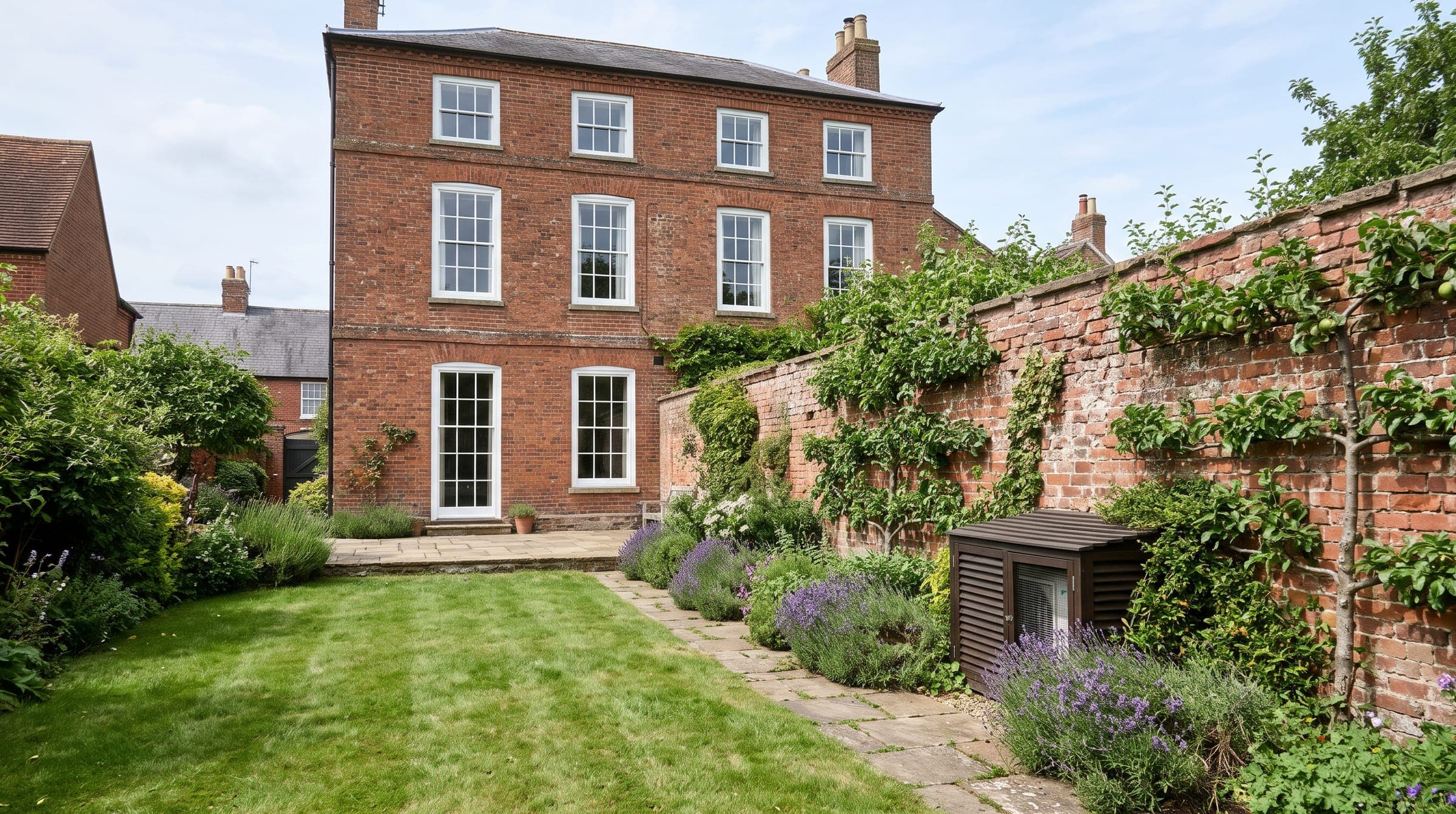
Start with the outdoor unit, because it's what officers look at first. A free-standing unit on a pad in the garden, or beside an outbuilding, is usually easier to agree than one fixed to the house.
- Historic England's own example photo shows a unit 'in an inconspicuous location behind a barn next to the Grade II listed farmhouse'
- Where a wall bracket is the only option, it goes at the rear, low down, with fixings into mortar joints rather than brick or stone faces
- Use as few outdoor units as you can: a multi-split system runs several rooms from one outdoor unit
- Historic England's case study of a Grade II London shop with eight separate outdoor units recorded access and noise problems, and noted a single larger system could have limited the number
- Indoor units don't have to be a white box high on the wall: Historic England says they can sit low like a radiator, in a ceiling void, or in a timber or metal enclosure
- On a high wall in a significant room, it says, 'This does not need to be done.' Consoles, ducted units and units in secondary rooms keep cornices, panelling and plaster untouched
- Outdoor unit: ground mounted, at the rear or beside an outbuilding, screened by planting or a louvred timber surround that keeps its airflow clearances
- Pipes: through existing holes and voids, straight into the building rather than along the outside wall, and out of sight on the front and visible sides
- Indoor units: low-level consoles, ducted or concealed units, in plain walls or later rooms, colour-matched where they show
- Condensate: to an internal waste or a gravel or slate soakaway bed at the base of the unit, never across a path
- Noise: the manufacturer's sound data and our calculation at the nearest neighbour's window
What the council will want to see
From Historic England's advice notes and the councils' own guidance. Our survey collects all of this.
- The list entry number, grade and date, and a note of any parts the entry excludes
- Photos of every elevation and room affected, with the proposed positions marked
- Why the system is needed, the simple measures already in place, and the heating benefit
- The alternative positions considered and why each was rejected
- Scaled existing and proposed plans and elevations showing every unit, pipe and cable route
- How each unit is fixed, where the core holes go, and how it could be removed later without damage
- The make, model, size, colour and sound data of each unit
- Where the condensate goes and how the cold air from the outdoor unit is kept off paths and doors
- A statement of the building's significance and the effect of the works on it, in proportion to the job
- Any redundant plant, brackets or old pipes to be taken away at the same time
Listed homes near us
We're based in Luton, and listed homes are common across our area. Counts are from the national listed building data, read in October 2026.
- Buckinghamshire: the most list entries of any council we cover, about 5,900, with large numbers in Buckingham, Marlow, Amersham and Beaconsfield
- East Hertfordshire: about 3,000, many in Hertford and Ware
- Central Bedfordshire: about 1,900, with Ampthill, Leighton Buzzard and Woburn among the historic centres
- North Hertfordshire: about 1,700, led by Hitchin, Royston and Baldock
- Westminster and Camden: the most in London, around 4,000 and 2,000 entries, concentrated in Mayfair, St John's Wood, Bloomsbury and Hampstead
- St Albans and Dacorum (Berkhamsted, Tring and Hemel Hempstead Old Town): each between 800 and 950
How to go about it
Check the list entry
Search the National Heritage List for England by address or on its map. Every entry has a seven-figure number, a grade and the date it was listed. Note whether your outbuildings and garden walls date from before July 1948.
Free survey and options
We look at the house, the rooms and the garden, check the listing, conservation area and any estate scheme, and agree with you the positions most likely to be accepted. If consent is needed, we tell you before you spend anything.
Talk to the conservation officer
Historic England recommends contacting the council's conservation officer early. Many councils offer pre-application advice, often for a fee. It is the cheapest way to find out what your council will accept.
Prepare the application
Drawings, specification, sound data, photos and the design and access statement, plus a statement of significance. Our listed building consent guide lists every document and who usually prepares it.
Apply for both consents
Planning permission and listed building consent go in together, usually on one combined form through the Planning Portal. Listed building consent is free; the planning fee is £548 from 1 April 2026.
Install to the approved design
Once both are granted and any pre-start conditions are cleared, we fit the system exactly as drawn. Not following an approved design or its conditions is an offence too.
Where our design pack comes in
The council decides from drawings and technical detail, not from a quote. Our design pack is that technical side of the application.
- A measured survey, scaled plans and elevations, and every pipe and cable route
- How each unit is fixed and could be removed, and the equipment schedule
- The maker's sound data and our MCS 020 calculation at the nearest neighbour's window
- The technical text for the design and access statement
- We are air conditioning installers, not architects or heritage consultants
- Where your council wants a statement of significance from a specialist, or a noise report from an acoustician, we say so at the start and can introduce independent specialists
- The council decides, and the fee is payable whether or not consent is granted
The design pack fee
From £795, more for a larger home, a Grade I or II* building or a council that asks for more. You get a fixed fee in writing first, pay it in full when you accept, and it comes off your installation if you accept our install quote within 6 months. One round of changes is included.
- from£795
A design pack for a consent application
Drawings, specification and sound data; taken off the install if you go ahead
Listed building air conditioning questions
Can you install air conditioning in a grade 2 listed building?
Often, yes, with planning permission and, in almost every case, listed building consent. Historic England says air conditioning is likely to need consent and heat pumps fixed to a building normally do. Councils are most likely to agree a heating and cooling system with the outdoor unit at the rear or in the garden, screened, with pipes run inside and indoor units kept off historic features.
Do I need listed building consent for an air source heat pump?
Normally, yes, if it's fixed to the building: that's Historic England's wording in Advice Note 18. A free-standing unit in the garden of a listed house still needs planning permission, because the curtilage of a listed building has no permitted development right, and the pipe route into the house is work to the listed building itself.
Can I put the outdoor unit in the garden to avoid consent?
It doesn't avoid the planning application, because Class G excludes land within the curtilage of a listed house. It can make listed building consent easier, since nothing is fixed to historic walls apart from the pipe entry. A unit beside an outbuilding or behind a hedge is often the position officers prefer. If the outbuilding or wall dates from before July 1948, it may itself count as part of the listed building.
Can air conditioning go inside a listed building without an outdoor unit?
A through-wall unit has no outdoor box, but it needs two large core-drilled holes and grilles in the outside wall, which is an alteration to the fabric and will usually need consent. A portable unit needs nothing fixed, but it is louder and less powerful. Our guide to air conditioning without an outside unit explains the trade-offs. In a listed home it's usually better to find one discreet outdoor position.
Is it a criminal offence to fit air conditioning in a listed building without consent?
Yes, if the works affect the building's character, which Historic England says air conditioning is likely to do. Section 9 of the 1990 Act makes it an offence for anyone who carries out or causes the works, so the owner and the installer. The council can also issue an enforcement notice at any time, even against a later owner, requiring the unit and its pipework to be removed and the building put back.
Does the grade of listing change whether I need consent?
No. Grade I, II* and II buildings all need listed building consent for works that affect their character. Grade changes how the application is handled: Historic England is told about every Grade I and II* application, and those buildings are more sensitive to change. For a Grade II house the council's conservation officer usually decides.
Will an indoor unit on the wall be a problem?
It can be, in a room with cornices, panelling or decorative plaster. Historic England says there is no need to put them high on the wall: low-level consoles, ducted units in a loft or ceiling void, and units built into a timber enclosure are all options. Placing indoor units in secondary rooms or on plain later walls makes consent much more likely.
Is it better to call it a heat pump than air conditioning?
It's more accurate, and it helps. A split system that heats and cools is an air-to-air heat pump, and Historic England calls heat pumps generally acceptable while describing air conditioning as energy intensive. Show the heating benefit, the simple cooling measures you already use, and why the rooms still overheat.
Will the council say yes?
No one can promise that. The council, and for Grade I and II* buildings Historic England as its adviser, makes the decision. What we can do is design the system to the published guidance, choose the positions officers are most likely to accept, and give them complete, accurate drawings and data. Our design pack fee is payable whether or not consent is granted.