Air conditioning without an outside unit: what works in the UK
Yes, you can have air conditioning without an outside unit. A through-wall unit fits everything into one indoor cabinet that breathes through two holes in the outside wall. A portable unit sends its hot air out of a window through a hose. Both are louder indoors and less powerful than a split system, so they suit rooms where an outdoor unit isn't an option.
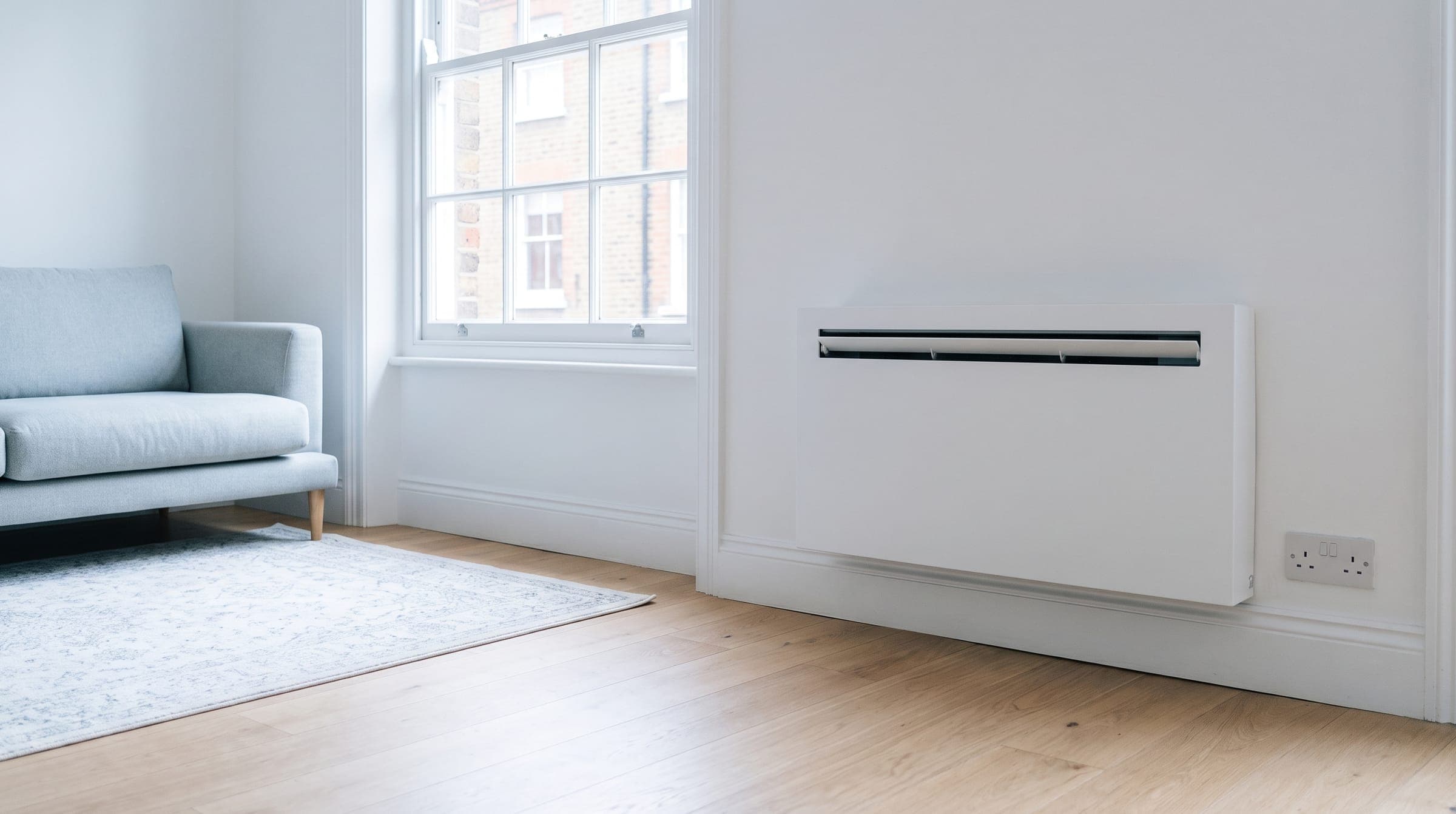
- 162 or 202 mm each, Unico Pro
- 2 wall holes
- nominal cooling, largest Unico Pro
- 3.1 kW
- Unico Pro quietest, fan only, at 2 m
- 32 dB(A)
- quietest premium 2.5 kW split
- 19 dB(A)
How air conditioning without an outdoor unit works
Every air conditioner moves heat from one place to another. A split system does it in two halves: a quiet indoor unit on your wall, and an outdoor unit holding the compressor and the big fan. Refrigerant pipes run between them through one small hole behind the indoor unit.
A through-wall unit, often called a monoblock, puts the compressor, both coils and both fans in one cabinet on the inside of an outside wall. It draws outdoor air in through one hole and blows it back out through the other, carrying the room's heat away. From outside you see two round grilles and nothing else. Heat pump versions run in reverse to heat the room as well.
A portable unit stands on the floor and pushes its hot air outside through a flexible hose, usually out of a window held partly open with a sealing kit. Nothing is fixed to the building, which is why renters often choose them.
Three ways to cool a room
| Feature | Split system | Through-wall unit | Portable unit |
|---|---|---|---|
| What's outside | An outdoor unit on a wall, roof or the ground | Two grilles on the outside wall | A hose out of a part-open window |
| Where the compressor runs | Outside | Inside the room | Inside the room |
| Quietest indoor figure | 19 dB(A) on premium 2.5 kW models | 32 dB(A) fan only, measured at 2 m (Unico Pro) | Compressor and fan beside you |
| Cooling power | 2.5 to 5 kW for most rooms, more with bigger units | 2.6 or 3.1 kW nominal (Unico Pro) | Limited by the hose and the open window |
| Building work | A small hole for the pipes, plus a bracket or stand outside | Two large core-drilled holes and a drain | None |
Split figures from Daikin, Mitsubishi Electric, Panasonic and LG spec sheets (see our quiet air conditioning guide). Through-wall figures from Olimpia Splendid's Unico Pro product page and catalogue, checked October 2026.
Through-wall units in real numbers
Olimpia Splendid's Unico range is one example, and the maker publishes full figures for it. Its most powerful model, the Unico Pro, comes in two sizes with a nominal cooling capacity of 2.6 kW and 3.1 kW, and 1.8 kW and 2.4 kW of heating. The cabinet is 903 mm wide, 520 mm high and 215 mm deep, and weighs 39 kg. It holds 0.46 kg of R32 refrigerant in a sealed circuit.
Noise is the trade-off. Olimpia Splendid lists an indoor sound pressure of 32 to 41 dB(A) for the smaller model and 32 to 43 dB(A) for the larger, measured 2 metres away, with the 32 dB(A) figure on fan only. Its silent mode cuts the sound by up to 10 dB(A), but cooling drops to 1.9 kW. For comparison, premium 2.5 kW split indoor units list 19 dB(A) on their quietest setting, because their compressor is outside.
Sound power, the total noise a unit gives out, tells the same story: 57 dB(A) indoors for the 2.6 kW Unico Pro against 54 dB(A) for Daikin's 2.5 kW Perfera indoor unit. Smaller through-wall models are slimmer and quieter but less powerful: Olimpia Splendid's Unico Air is 16 cm deep, has 1.7 kW or 2.2 kW of cooling and goes down to 27 dB(A) on fan only, measured at 2 metres.
Don't compare energy labels across types. Under the energy labelling rules, through-wall units are rated as double duct air conditioners on their own scale, based on efficiency at one test condition. Split systems are rated on a seasonal scale. An A+ on one doesn't mean the same as an A+ on the other.
Portable units: the stopgap
A portable unit is the only option with no building work at all. It's useful for a short let, a room you can't drill, or a few hot weeks while you sort out something permanent.
The compressor runs in the room with you, and the window can't close properly around the hose, so some warm outside air gets back in. That makes them noticeably louder and less effective than a fixed system. Depending on the model, you may also need to empty a water tank or fit a drain hose.
When no outdoor unit makes sense
A through-wall unit is a good answer to a few specific problems.
- Your lease or freeholder won't allow an outdoor unit, but might allow two grilles
- The only outside walls you can use face the street, where the planning rules limit outdoor units
- The room is on an upper floor with no flat roof, balcony or ground-level spot for an outdoor unit
- You want one small room cooled and heated, and can live with more noise than a split
- The wall is an outside wall with space for the cabinet near the floor or the ceiling
Planning permission, consent and listed buildings
Planning rules for heat pumps on homes in England sit in Class G of the General Permitted Development Order. Class G covers a microgeneration air source heat pump, and its limits are written around an outdoor compressor unit: the volume limit, for example, applies to that outdoor unit. It also requires the unit to meet the MCS planning standards, which include a noise calculation. How a unit with no outdoor part fits those rules isn't spelt out, so ask your council's planning team, or apply for a Lawful Development Certificate, before anyone drills.
Two parts of Class G are clear. Its highway rules apply to the heat pump as a whole, so in a conservation area or World Heritage Site, a unit on a wall or roof that fronts a highway is outside them. And a unit used only for cooling doesn't qualify at all, so a cooling-only through-wall model can't rely on Class G.
Listed buildings are outside Class G entirely. Drilling two large holes through a listed wall needs planning permission and usually listed building consent too. In a leasehold flat, most leases need the freeholder's written consent for alterations like these, whatever the planning position. Our planning checker shows conservation areas and Article 4 directions for your postcode.
Questions to ask before you buy a through-wall unit
- Is the wall thin enough? The Unico Pro's ducts can be at most 1 metre long, with no bends
- What's on the outside? Olimpia Splendid warns that plants, slats, blinds or dense grilles in front of the holes hurt performance
- Where will the water go? Heat pump models need a drain pipe through the wall with a fall of at least 3%
- What happens in winter? The manual warns that drain water outside can form ice, and suggests a heater kit for long running below 5°C
- What are the noise figures, at what distance, and at what fan speed?
- Is the cooling capacity right for the room? Our sizing guide helps
- Who will core-drill the holes and make good the wall inside and out?
- Have you got permission from the council, the freeholder or both?
What it costs
Through-wall units aren't in our price guide: the home systems we fit are split systems from Daikin, Mitsubishi Electric, LG and Panasonic. If you get a through-wall quote elsewhere, check it includes the core drilling, grilles, drain and making good. For comparison, here's what a split system costs with us.
- from£1,850inc. VAT
A bedroom or study
2.5 kW wall unit, 5 m pipe, fitted in a day
- from£2,050inc. VAT
A living room
3.5 kW wall unit
Questions about air con without an outdoor unit
Can you get air conditioning without an outside unit?
Yes. A through-wall unit keeps everything indoors and needs only two holes and grilles in the outside wall. A portable unit needs nothing fixed at all, just a hose out of a window. Both work, but they're louder and less powerful than a split system.
How does an air conditioner without an outdoor unit get rid of heat?
A through-wall unit draws outside air in through one hole, passes it over its hot coil and blows it back out through the other. A portable unit pushes hot air out through its hose. Either way, the heat still goes outside, just without a separate outdoor box.
Are through-wall air conditioners noisy?
Louder than a split, because the compressor is in the room. Olimpia Splendid's Unico Pro lists 32 to 43 dB(A) indoors, measured at 2 metres, where premium split indoor units go down to 19 dB(A). Silent mode helps, at the cost of cooling power.
Do I need planning permission for a through-wall air conditioner?
It depends on the building and the council. The permitted development rules for heat pumps are written around outdoor units, so ask your council or apply for a Lawful Development Certificate first. Listed buildings need consent, and flats need the freeholder's agreement.
Can I fit air conditioning without an outdoor unit in a flat?
Often, yes, if the room has an outside wall and the freeholder agrees to the holes. A portable unit needs no consent. If the freeholder would accept an outdoor unit, a split system is quieter and more powerful, and our flats page explains how to ask.
Do units without an outdoor unit heat as well?
Heat pump versions do. The Unico Pro heat pump models give a nominal 1.8 kW or 2.4 kW of heating. Check the exact model, because some through-wall and portable units only cool, and a cooling-only unit can't use the heat pump planning rules.