Historic England's heat pump guidance and what it means for air conditioning
Historic England's advice on heat pumps is spread across advice notes, web pages and two case study reports, and it names air-to-air systems directly. Read together, it is more supportive than most people expect. Here's which documents matter, what they say about siting, pipes, indoor units and noise, what the case studies found, and how to use it in an application.
- Historic England on heat pumps
- Generally acceptable
- latest revision of Advice Note 18
- February 2026
- unit noise and looks, in case studies
- Not an issue
- of heritage heat pump installers
- No register
On this page14 sections
The documents that matter
Historic England has no single 'air conditioning' publication. These are the ones that cover heat pumps, cooling and the pipes and cables in between.
| Document | Date | What it covers |
|---|---|---|
| Advice Note 18: Adapting Historic Buildings for Energy and Carbon Efficiency | July 2024, revised 16 February 2026 | Heat pumps 'generally acceptable'; consent normally needed when fixed to a building; what an application should show |
| Advice Note 16: Listed Building Consent | 21 June 2021 | Air conditioning 'likely to affect special interest'; pipework, cabling and external fixtures |
| Installing Heat Pumps in Historic Buildings (web page) | Undated; replaced the 2017 heat pump guidance | Air-to-air systems by name; siting, screening, wraps, condensate, flood risk, indoor units, noise, choosing an installer |
| Installing New Services (web page) | Updated 16 August 2024 | Pipe and cable routes, fixings and removal: mitigation, minimisation and reversibility |
| Heat Pumps in Historic Buildings: case studies | Small buildings May 2023; large buildings January 2026 | What happened at real installs, including air-to-air systems |
| How to Keep Cool in Summer in an Older Home | 28 August 2026 | Passive measures first; air conditioning as a second-tier option likely to need consent |
| Overheating in Historic Buildings (web page) | Updated 7 July 2026 | Mechanical cooling as energy intensive and not always a sustainable answer |
Heat pumps: 'generally acceptable'
The key paragraph is 94 of Advice Note 18. It says: 'Changing boilers, heating and hot water systems to low carbon alternatives, such as heat pumps, will generally be acceptable.'
- Siting: 'The impact of heat pumps can generally be minimised through careful siting, design and screening.'
- Its example photo shows a unit in 'an inconspicuous location behind a barn next to the Grade II listed farmhouse'.
- The limits: routing pipework 'may damage historic fabric', and 'Listed building consent is normally required for the installation of heat pumps which are fixed to a building.'
- A trade: 'The opportunity should be taken to remove unsightly plant equipment made redundant by the heat pump, for instance oil tanks. This can sometimes offset any harmful impact of installing a pump.'
- Reversible where possible (paragraph 68), with applications explaining why less harmful options were discounted (paragraph 70).
- Higher grades: Grade I and II* buildings 'are likely to be more sensitive to change'.
Air-to-air systems are named directly
Historic England's heat pump web guidance doesn't treat air conditioning as something separate. It says: 'Direct expansion systems (air-to-air) transfer heat into the building using refrigerant'.
- The indoor units 'are often called air conditioning units, particularly when they are used for cooling.'
- It adds that 'Most air-to-air systems also allow the unit to be reversed and run in a cooling mode.'
- The May 2023 small buildings case study included air-to-air installs: 'Small split systems are widely used in mainland Europe for residential heating and cooling...'
- It concluded: '...small DX systems are a good solution for some applications and should not be overlooked.'
- Why it matters when you apply: a split system that heats and cools is a heat pump in Historic England's own terms, and in planning law too.
- Since 29 May 2025 the permitted development rules have covered air-to-air heat pumps, as long as they aren't used solely for cooling.
What it says about air conditioning and cooling
Cooling on its own gets a cooler reception. Advice Note 16 says 'Air conditioning and electrical comfort cooling are likely to affect special interest and thus need LBC.'
- Overheating in Historic Buildings: 'Mechanical cooling is an energy-intensive process and therefore may not be considered as a sustainable solution', while accepting controlled temperatures can be critical for collections.
- Keeping cool in an older home (28 August 2026) sets an order of measures.
- Priority 1, for everyone: shutters, blinds and curtains, opening windows at night, removing rugs, loft insulation and LED lighting.
- Priority 2, for some homes: external shutters and awnings, reflective finishes, natural and mechanical ventilation, air conditioning and greening.
- It says air conditioning 'is an energy intensive process that will result in higher electricity bills in the summer', and Priority 2 measures are likely to need permissions such as listed building consent.
- The practical reading: present the system as low carbon heating that also cools, show the Priority 1 measures already in place, and explain why the rooms still overheat.
- That's the same advice councils give in their own guidance.
The practical principles in one place
Historic England's position on each part of an install, drawn from the documents above, and how we design to it.
| Topic | Historic England's position | How we apply it |
|---|---|---|
| Outdoor unit position | Inconspicuous, away from main elevations, behind outbuildings; keep a clear air path | Rear or garden positions first; free-standing beats fixing to the house |
| Screening | Units can be screened or put in plant rooms if the maker's guidelines on air intake and discharge are followed | Planting or a louvred timber surround, drawn with the airflow clearances |
| Colour | Colours vary by maker; standard units are off-white to grey; printed vinyl wraps possible if the warranty allows | We state the colour and check any wrap or paint with the manufacturer first |
| Over-concealment | A unit sunk 500 mm into the ground made little difference and collected snow and leaves | No pits; screen above ground instead |
| Pipe routes | Reuse existing routes and voids, follow mouldings, avoid chasing; the route may not be the shortest | Routes agreed at survey and drawn on the plans |
| External pipework | Conspicuous runs or grilles on front or visible side elevations may need consent | Pipes straight into the building at the rear, not along the wall |
| Fixings | As few as possible, into mortar joints, where least visible | Ground frames where we can; mortar-joint fixings where we can't |
| Cabling | Exposed plastic conduit 'hardly ever appropriate'; painted or powder-coated metal trunking | Cables hidden in voids; colour-matched metal where any shows |
| Reversibility | Plan for removal at the end of the system's life | How each unit comes out without damage is shown in the pack |
| Condensate and flood risk | Pipe it to a soakaway or drain; check the flood risk at the unit position | Internal waste or a gravel or slate bed at the base |
| Noise | Use the maker's noise data and careful positioning; an acoustician may be needed | Maker's data and our MCS 020 calculation; we flag when an acoustician is needed |
| Redundant plant | Remove it; it can offset harm | Old units, brackets, tanks and pipes taken away |
Indoor units in historic rooms
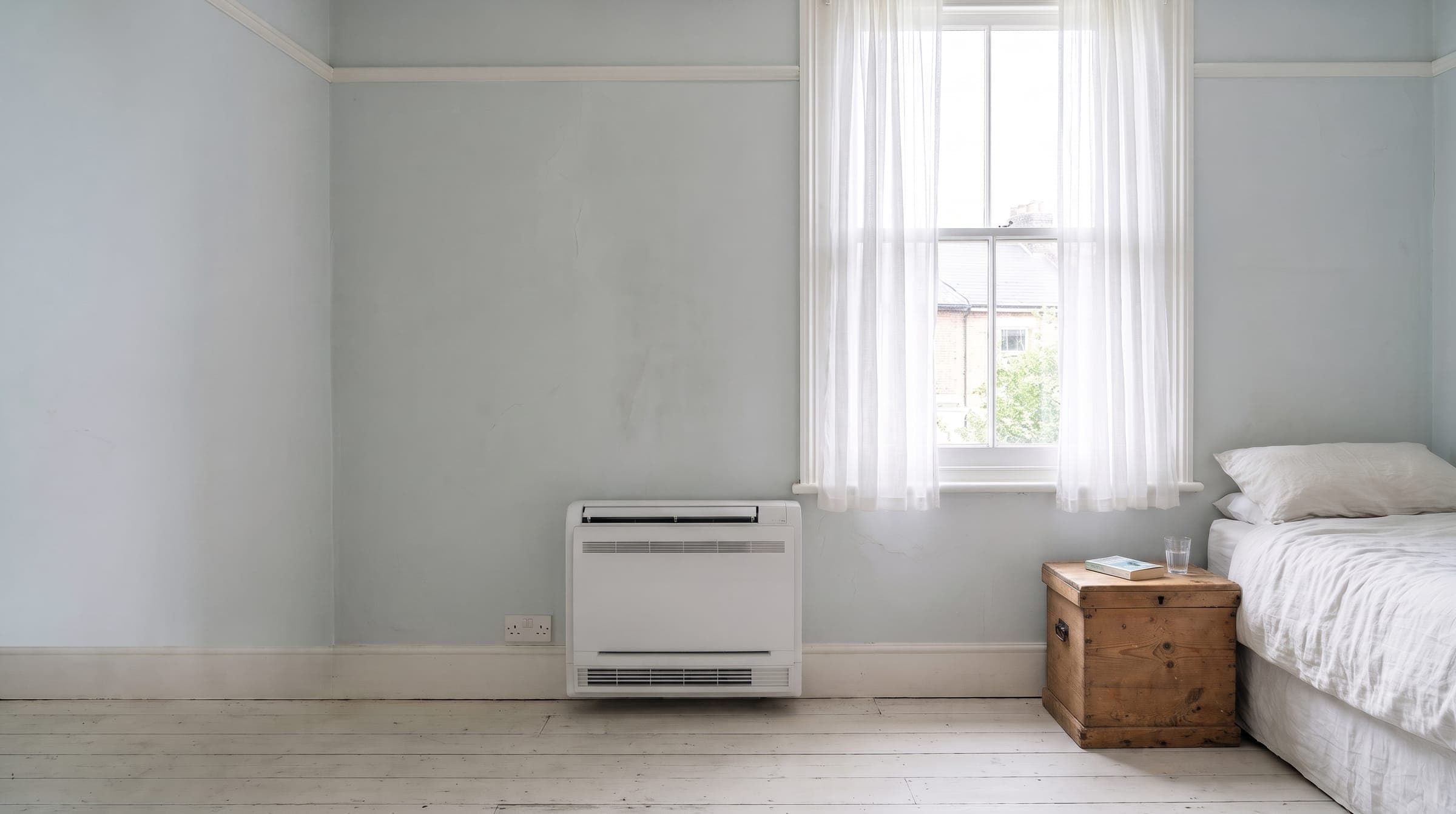
The web guidance is direct about the usual white box high on the wall. It notes 'a trend to site them high up on the wall like an air conditioning unit' and says: 'This does not need to be done.'
- Other options: low level like a radiator, in a ceiling void, or a chassis fitted into 'a decorative wooden or metal enclosure to match the interior.'
- Noise: indoor units 'always incorporate a fan and therefore make some noise when heating or cooling'.
- A 2024 version of the page added that this makes them 'less suitable for residential applications'.
- How we take that seriously: we size units so they don't run flat out, choose quiet models for bedrooms, and give you the indoor sound figures before you decide.
- Fabric (Advice Notes 16 and 2): new services can have 'a considerable, and often cumulative, impact' on significance, and removing or obscuring ornamental plasterwork is likely to affect it.
- So indoor units belong on plain walls, in later partitions and in secondary rooms, with cornices, panelling and decorative ceilings left alone.
What the case studies found
Historic England commissioned two sets of case studies of air source heat pumps in historic buildings: small-scale buildings (May 2023, ten sites) and large buildings (January 2026). Both reached the same headline.
- Small buildings: 'The visual and noise impact of ASHP outdoor fan units and the cold air plume discharges were not an issue in any of the case studies.'
- Large buildings: the impacts 'were not an issue for any of the users'.
- Looks: 'Only one property attempted to conceal the external unit. None of the occupants in the houses were dissatisfied with how the external unit looked.'
- That property sank its unit 500 mm into the ground: little difference from the street, snow and leaf build-up, and possible flooding.
- The problems were practical. A Grade II London shop with eight split outdoor units had access and noise issues, cold air recirculating, and units close to neighbours' single-glazed windows.
- The report says one larger system could have limited the number of units there.
- Another site found a wall-mounted unit with little anti-vibration damping passed vibration into the structure.
- Good practice: condensate into a gravel or slate bed around the base, and the cold air plume, which can be felt up to 3 metres away, kept off doors and paths.
Consent, and what an application should show
The web guidance says consents are likely for any heat pump in a listed building or a conservation area, at a scheduled monument, or where designated wildlife sites are affected.
- Bats and nesting birds must be considered, and all installs must meet the Building Regulations.
- Advice Note 18: permitted development rights 'do not generally apply' to listed buildings, and listed building consent is needed whether or not planning permission is.
- What to show (paragraphs 67 to 71): the significance of the building and the effect on it, why less harmful options were discounted, a meaningful improvement in performance, and public benefits.
- Statement of significance: by 'an appropriately qualified specialist' for major cases, and information 'proportionate to their impact' otherwise.
- Advice Note 16 adds the extent of the works, 'the method to be used, and the materials involved'.
- Talk early: Historic England recommends 'contacting your local authority conservation officer at an early stage'.
- Our guide to listed building consent goes through the process, the fees and the timescales.
Choosing an installer
Historic England is candid here. It says MCS and the Heat Pump Association 'have yet to identify specialist installers for historic buildings, so it is important to look at examples of designers and installers work and check their understanding of the constraints of working in a historic building. This should include how to minimise damage to historic fabric'.
There is no register to check, so the questions below are the test. A good answer is specific: where the unit goes and why, which holes and voids the pipes use, how the units are fixed and how they come out again.
Questions to ask any installer
Ask us these too. You should get a straight answer to each before you agree anything.
- Have you checked the list entry, the conservation area and any Article 4 direction or estate scheme for my address?
- Where would the outdoor unit go, which other positions did you consider, and why did you rule them out?
- Can it stand on the ground or by an outbuilding instead of being fixed to the house?
- Can one outdoor unit serve every room?
- Which existing holes, voids and routes will the pipes and cables use, and where would any new core hole go?
- How will brackets be fixed, and how would the system be removed later without damage?
- Where does the condensate go, and where does the cold air from the outdoor unit blow?
- What are the sound figures for the outdoor and indoor units, and what is the level at my neighbour's window?
- Can the indoor units go low, in a ceiling void, in an enclosure or in a secondary room?
- Will you wait for every consent, and clear every pre-start condition, before starting work?
Where our design pack helps
Historic England's guidance asks for the agreed routes and fixing methods to be recorded on the design drawings. Our design pack does that from a measured survey:
- Scaled plans and elevations
- Every pipe, cable and condensate route, with fixing and removal details
- The screen or enclosure with its airflow clearances
- The equipment schedule, the maker's sound data and our MCS 020 calculation
- Photos with each position marked
- We are air conditioning installers, not heritage consultants or acousticians.
- Where your council wants a specialist statement of significance or an acoustic report, we tell you at the start and can introduce independent specialists.
- Councils decide, and the fee is payable whether or not consent is granted.
The design pack fee
From £795, fixed in writing first and paid in full when you accept. It can be more for a larger home, a Grade I or II* building or a council that asks for more, and it comes off your installation if you accept our install quote within 6 months. One round of changes is included.
- from£795
A design pack for a consent application
Drawings, specification and sound data; taken off the install if you go ahead
Historic England heat pump questions
What does Historic England say about heat pumps in historic buildings?
That changing to low carbon heating such as heat pumps 'will generally be acceptable', and that their impact can generally be minimised through careful siting, design and screening. It also says listed building consent is normally needed for heat pumps fixed to a building, and that pipe routes can damage historic fabric, so the details matter.
Does Historic England's guidance cover air source heat pumps that also cool?
Yes. Its heat pump web guidance covers air-to-air systems by name, says their indoor units are often called air conditioning units, and notes most can be reversed to cool. Its May 2023 case studies concluded that small split systems are a good solution for some applications and should not be overlooked.
What does Historic England say about air conditioning?
Advice Note 16 says air conditioning and comfort cooling are likely to affect special interest and so need listed building consent. Its keeping cool page puts air conditioning after passive measures such as shutters, blinds and night ventilation, and calls it energy intensive. A system presented as low carbon heating that also cools fits its guidance better.
Is the 2017 Historic England heat pump guidance still current?
The old publication address for 'Energy Efficiency and Historic Buildings: Heat Pumps' now redirects to the Installing Heat Pumps in Historic Buildings web page, so we treat the web page as the current version. Advice Note 18, revised in February 2026, is the main policy note to cite alongside it.
Where does Historic England say an outdoor unit should go?
Somewhere inconspicuous, away from the principal elevations, with a clear air path. Its example is a unit behind a barn next to a Grade II farmhouse. It accepts screens and plant rooms if the manufacturer's airflow rules are followed, and found that sinking a unit into the ground caused more problems than it solved.
Do heat pumps look or sound bad on old buildings?
Historic England's own case studies say not. In the small buildings report, the visual and noise impact of the outdoor units 'were not an issue in any of the case studies', and none of the occupants were unhappy with how the unit looked. The large buildings report found the same for all users. The problems it recorded came from too many units and units too close to neighbours' windows.
Is there a list of Historic England approved heat pump installers?
No. Historic England says MCS and the Heat Pump Association have not yet identified specialist installers for historic buildings. It advises looking at examples of an installer's work and checking they understand how to minimise damage to historic fabric. No installer can claim Historic England approval.
Do I still need listed building consent if I follow the guidance?
Usually, yes. Following the guidance makes consent more likely, but it doesn't replace it. Heat pumps fixed to a listed building normally need consent, a listed home also needs planning permission for the outdoor unit, and the council makes both decisions.