Air conditioning pipe trunking: what a neat job looks like
Trunking is the plastic duct that carries an air conditioner's pipes, cable and drain between the indoor and outdoor units. A good installer keeps it short, straight and outside, tight to the wall and lined up with the building. Indoors, on most jobs, you should see none at all.
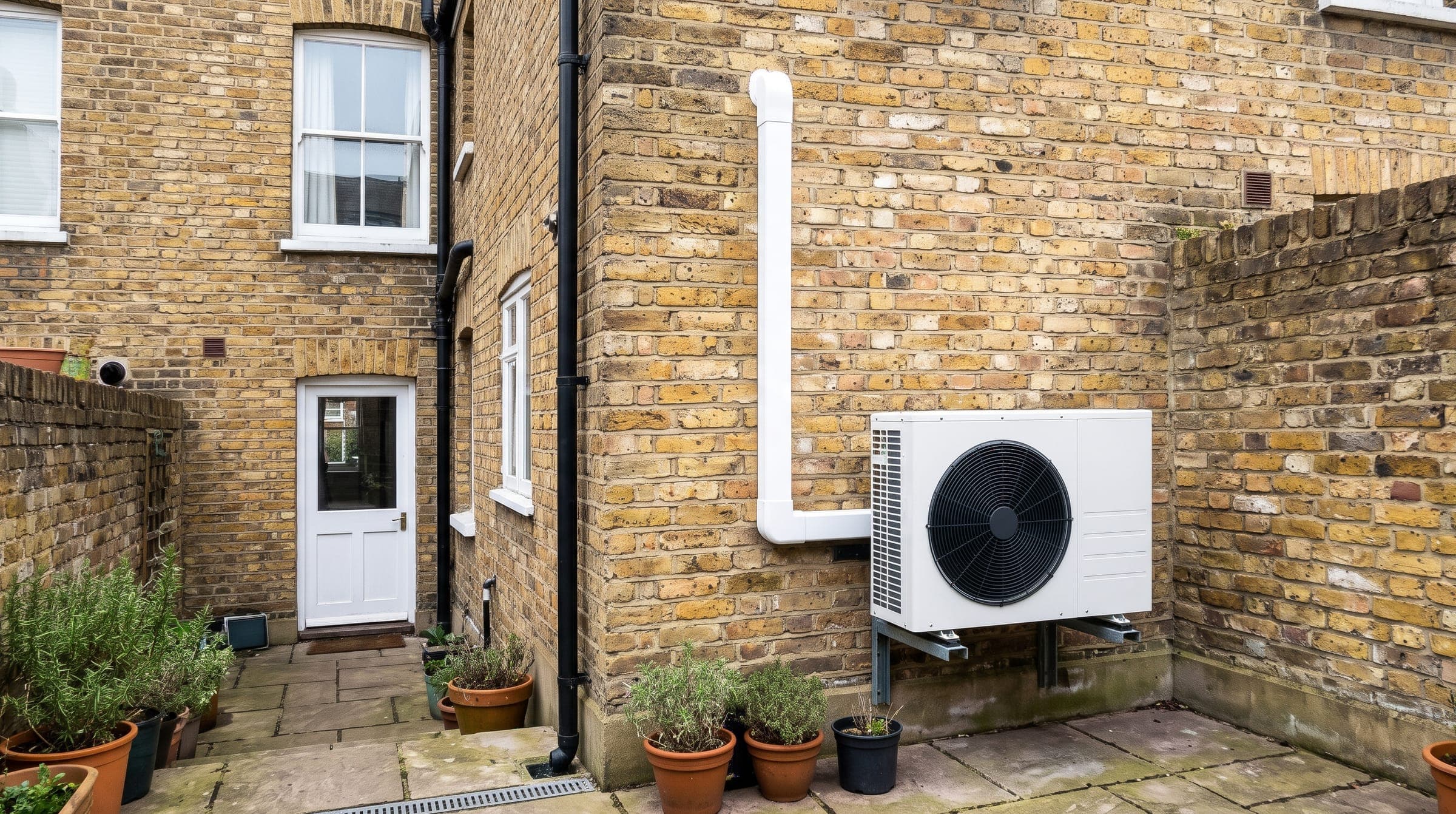
- where trunking goes on most jobs
- Outside only
- common trunking sizes (Slimduct)
- 77 to 140 mm
- max pipe, Mitsubishi MSZ-LN25
- 20 m
- of pipe in our standard price
- 5 m
On this page8 sections
What goes inside the trunking
Every split air conditioner joins its two halves with the same bundle, wrapped together and carried in one duct.
- Two copper refrigerant pipes, each in its own insulation, a thin one and a thicker one
- The interconnecting cable that powers and talks to the indoor unit
- The condensate drain, which carries water from the indoor unit when it cools
- Sometimes a small pump: a trunking pump such as Aspen's Silent+ Mini Lime sits in the run when the drain can't fall by gravity
Trunking sizes and colours
Inaba Denko's Slimduct is one of the most common systems on UK jobs; others are similar.
| Size | Typical use | Colours |
|---|---|---|
| SD-77 | A single wall unit with a short run | White, ivory, brown, black, anthracite grey |
| SD-100 | A larger unit or a pipe bundle with a pump | White, ivory, brown, black, anthracite grey |
| SD-140 | Two or more pipe sets, such as a multi-split | White, ivory, brown, black, anthracite grey |
Sizes and colours from Inaba Denko. White suits render and most brick; brown and black suit dark brick, timber and conservation areas; anthracite grey suits modern cladding and window frames.
What a neat trunking run looks like
- Outside only: the pipes go through the wall directly behind the indoor unit
- As short as possible: the outdoor unit close to where the pipes come out
- Straight and plumb, lined up with a window edge, corner or downpipe
- Tight to the wall with no gaps, on proper fixings
- Clean, square bends using the trunking's own corner pieces
- A colour that suits the wall, not white on black brick by default
- The drain ending somewhere sensible, not across a path
How long can the pipe run be?
Every maker sets limits for length and height. Inside them, shorter is still better.
| Outdoor unit | Max pipe length | Max height difference | No extra refrigerant up to |
|---|---|---|---|
| Mitsubishi Electric MUZ-LN25 | 20 m | 12 m | Check the manual for the model |
| Mitsubishi Electric MUZ-LN35, 50, 60 | 30 m | 15 m | Check the manual for the model |
| Daikin RXP25M (Comfora) | 15 m | 12 m | 10 m |
From each maker's installation manual. Beyond the no-extra-refrigerant length the engineer adds a measured charge. Up to 5 m of pipe is in our standard price.
When you might see trunking indoors
Indoor trunking is the exception. It usually means the indoor unit can't sit on an outside wall.
- Inside walls: the pipes run along to the nearest outside wall, in trunking, in a boxed-in run or above a ceiling
- Through a loft or ceiling void: often the neatest way from a middle room, with the pipes out of sight
- Chased into the wall: possible before decorating, with the joints left accessible as the makers require
- Flats with no outside wall: see air conditioning without an outdoor unit
Back to back: the run with almost no trunking
The tidiest install puts the outdoor unit straight behind the indoor unit on the other side of the wall. The pipes come through the wall and into the outdoor unit with only a short tail of trunking, sometimes none. It needs room outside at the right height, and on a first floor that means a wall bracket and safe access for servicing.
What's included in our price
A single room starts from £1,850 fitted, with up to 5 m of pipe through the wall behind the unit and in neat white trunking outside. A longer run, a coloured trunking or a condensate pump is quoted after the free survey.
- from£1,850
A bedroom or study
2.5 kW wall unit, 5 m pipe, fitted in a day
- from£2,050
A living room
3.5 kW wall unit
- from£3,650
Two rooms, one outdoor unit
Multi-split
- from£5,100
Three rooms
Multi-split
Trunking questions
Does air conditioning need trunking?
Almost always outside, to protect the pipes, cable and drain from sun and weather and to keep the run tidy. Indoors, most wall units need none, because the pipes go straight through the wall behind the unit.
What colour trunking can I have?
White is standard. Common systems also come in ivory, brown, black and anthracite grey, so the run can match dark brick, timber or window frames. Ask at the survey.
How far can the outdoor unit be from the indoor unit?
It depends on the model: for example 20 m of pipe and 12 m of height for Mitsubishi Electric's MSZ-LN25, and 15 m for Daikin's RXP25M. We keep it as short as the building allows.
Can the pipes be hidden in the wall?
Sometimes, if the room is being decorated, and through a loft or ceiling void in many houses. Joints must stay accessible, so we plan it at the survey.
Do I need planning permission for trunking?
Trunking goes with the outdoor unit, which most homes can fit under permitted development. In a conservation area or on a listed building, choose the route and colour with care. See our planning permission guide.
Can a condensate pump go in the trunking?
Yes. Trunking pumps such as Aspen's Silent+ Mini Lime are made to sit in the run and are quiet: Aspen lists 16 dB(A) at 1 m. More in our condensate drain guide.