Condensation, damp and mould in UK homes: what causes it and what actually works
Most damp in UK homes is condensation: warm, moist indoor air meeting cold walls and windows. It peaks in winter, shows up first on bedroom windows and behind wardrobes, and feeds black mould. This guide explains how to tell condensation from a leak or rising damp, what the health guidance and the law say, and which fixes are worth your money, cheapest first.
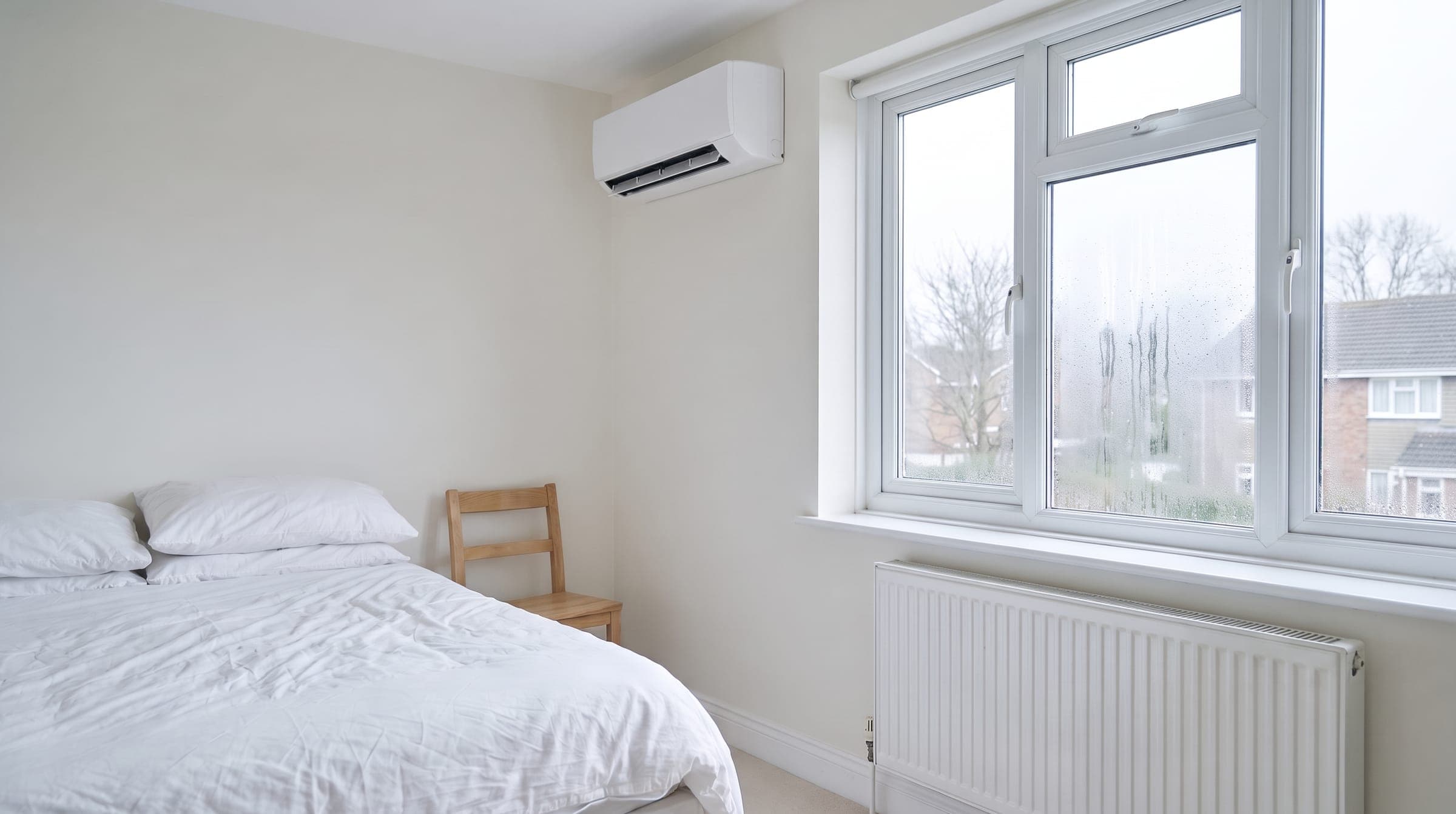
- of moisture a week per household (EST)
- 100 litres
- Awaab's Law began for social homes
- 27 Oct 2025
- to investigate serious damp and mould
- 10 working days
- per kWh, Ofgem cap Oct to Dec 2026
- 26.32p
On this page14 sections
Three kinds of damp, and how to tell them apart
UKHSA guidance splits damp into condensation, penetrating damp and rising damp, with leaks and floods as a fourth, traumatic kind. The fix depends on which one you have, so work this out first.
- Condensation is by far the most common. It appears where warm indoor air touches a cold surface: window glass and frames, the corners of outside walls, the wall behind a wardrobe or sofa
- It is worst in the morning and in cold weather, and it feeds the black spotty mould people recognise
- Penetrating damp is water getting in from outside through a fault: a cracked gutter, a missing tile, failed pointing, a leaking pipe
- It shows as a defined patch that gets worse after rain and can appear at any height
- Rising damp is ground water drawn up a wall where the damp-proof course has failed or is missing
- It stays near the floor, rarely above a metre, with a tide line and salty deposits
- UKHSA notes rising damp is often misdiagnosed, and that chemical testing is the proper way to confirm it
Which kind of damp is it?
| Sign | Condensation | Penetrating damp | Rising damp |
|---|---|---|---|
| Where | Windows, cold corners, behind furniture, bedroom and bathroom walls | A patch below a gutter, roof, window or pipe; any height | Ground floor only, up to about a metre from the floor |
| When it is worst | Cold mornings, winter, after showers and cooking | During and after rain | Steady all year, a little worse in wet months |
| What it looks like | Water droplets, black spotty mould, a musty smell | Defined damp patch, stained plaster, sometimes wet to the touch | Tide mark, crumbling plaster, white salt deposits |
| Who fixes it | You, with ventilation, an even heating pattern and moisture habits | A roofer, plumber or builder: fix the fault, then let it dry out | A damp specialist after an independent survey, not a free one from a seller |
Several can happen at once. A leak that soaks a wall makes that wall colder, so condensation and mould gather on it too.
Why condensation peaks in winter
Warm air holds far more water than cold air. Any surface colder than the dew point of the room air will collect water, exactly like a cold drink on a summer day.
- The dew point is the temperature at which cooling air can no longer hold what it carries
- In winter the gap between indoor and outdoor temperature is at its widest, so window glass, lintels, outside-wall corners and uninsulated walls sit well below room temperature
- Meanwhile indoor air is full of moisture. The Energy Saving Trust says a typical household produces up to 100 litres of moisture a week, roughly 14 litres a day
- That comes from cooking, kettles, showers, washing and breathing
- Homes are also shut up in winter. Windows stay closed, trickle vents get taped over and washing dries on radiators
- The moisture has nowhere to go, so humidity climbs until the coldest surfaces run wet
- That is why it appears overnight: the heating goes off, surfaces cool, sleeping people breathe out around a pint of water each, and by morning the glass is streaming
Mould in a bedroom: why it is so common
Bedrooms are the room most people ask about, and for good reason. Mould needs moisture, a surface to grow on and still air, and bedrooms supply all three.
- They are usually the coldest rooms, because the heating is off while you sleep
- They are occupied for eight hours by people breathing out moisture
- The door is shut and the window is closed against noise and cold
- They are full of furniture pushed against outside walls. The back of a wardrobe on a north-facing outside wall is a classic spot
- So are the top corners of the room, the reveals around the window and the wall behind the bedhead
- If you find mould in these places and nowhere else, the cause is almost always condensation rather than a leak
- Black mould is the one people worry about, but the colour matters less than the cause
- Any visible mould means the surface has been wet for long enough to grow it, and the only lasting fix is to stop that surface getting wet
What the health guidance says
Government guidance on damp and mould, written by UKHSA with the health and housing departments and updated in April 2026, is blunt: damp and mould mainly affect the airways and lungs, can also affect the eyes and skin, and in the most severe cases can cause death.
- It followed the death of Awaab Ishak, a two-year-old who died in 2020 from a respiratory condition caused by prolonged exposure to mould in his family's flat
- Listed effects include coughs, wheeze and breathlessness, more airway infections, and the development or worsening of asthma, rhinitis and other inflammatory airway conditions
- The NHS lists mould among common asthma triggers
- Everyone is affected, but children, older adults and people with existing health conditions are at greater risk. The guidance also recognises the toll on mental health
- Most people can reasonably wipe away condensation and very small amounts of mould with a mould and mildew cleaner, preferred over bleach, wearing a mask, gloves and goggles
- Larger areas should be dealt with by a qualified professional
- Mouldy carpets, soft furnishings and ceiling tiles may need to be thrown away because the mould cannot be fully removed
- If you or a child have symptoms, see a GP and tell your landlord: the guidance says landlords should not wait for medical evidence before acting
Awaab's Law: what it requires and who it covers
Awaab's Law is the name for rules made under the Social Housing (Regulation) Act 2023. From 27 October 2025, social landlords in England must deal with damp and mould that poses a significant risk to health to fixed deadlines.
- The rules are the Hazards in Social Housing (Prescribed Requirements) (England) Regulations 2025, and they apply to councils and housing associations
- Investigate a reported damp and mould hazard within 10 working days of becoming aware of it
- Report a written summary of what it found to the tenant within 3 working days of finishing
- Make safe within 5 working days of the investigation concluding
- Further work to stop it coming back must start, or be booked, within 5 working days and physically begin within 12 weeks
- Hazards that put someone in immediate danger must be investigated and made safe within 24 hours
- If the home cannot be made safe in time, the landlord must offer suitable alternative accommodation at no cost. Its only defence is proving it took all reasonable steps to comply
- From 30 November 2026, subject to Parliamentary approval, the law extends to excess cold, excess heat, falls, structural collapse, fire, electrical hazards and domestic hygiene
- The government has said a third phase in 2027 will cover all remaining Housing Health and Safety Rating System hazards apart from overcrowding
- Private tenants are not covered yet. The Renters' Rights Act 2025 gives ministers the power to apply Awaab's Law to private tenancies and licences
- On 9 October 2026 the government opened a consultation on how, running until 18 December 2026. It proposes the same deadlines and says the earliest feasible start would be 2027
- Until regulations are made, the duties below are what a private tenant can rely on
What a private tenant can do now
Three older laws already apply to every rented home in England, and the UKHSA guidance says it is totally unreasonable to blame damp and mould on lifestyle choices.
- Landlord and Tenant Act 1985: the landlord is responsible for the structure and exterior, including roofs, gutters, windows and outside walls, and the heating, hot water and ventilation they installed
- That covers the faults behind penetrating and rising damp, and the broken extractor fans and boilers that lead to condensation
- Homes (Fitness for Human Habitation) Act 2018: for tenancies under seven years, the home must be fit to live in throughout. If damp and mould make it unfit, you can go to court for repairs and compensation
- Housing Act 2004: councils rate 21 hazards, including damp and mould growth, under the HHSRS (guidance reissued June 2026). A council must act on a category 1 hazard and may act on category 2
- Shelter says a landlord should not tell you to paint over mould, stop cooking or showering, or say it is just condensation without checking. Expect them to fix the cause and check again about six weeks after
- Report it in writing with dated photos, and keep every message. Shelter has a template letter.
- Allow access for an inspection, and ask for a damp survey if the cause is not obvious. You should not have to pay for it.
- Do the condensation basics in the checklist below, so nobody can say the problem is you.
- If nothing happens, contact your council's environmental health team, which can inspect under the HHSRS and order repairs.
- A letting agent who ignores complaints can be challenged through its complaints policy and redress scheme.
- You usually have at least three years to claim compensation for damaged belongings, ill health or extra costs such as running a dehumidifier.
- Do not move out without somewhere to go: the council may treat it as making yourself homeless. Ask them for help first.
What works, in order of cost
Start at the top. Each step down costs more, and the dearer ones only pay off once the cheap ones are done.
| Fix | Cost | What it does | Where it falls short |
|---|---|---|---|
| Moisture habits | Nothing | Lids on pans, bathroom door shut, washing outside or in a vented dryer, furniture pulled off outside walls | Cuts the load, but cannot overcome a cold, unventilated home on its own |
| Trickle vents and windows | Nothing | Background air change carries vapour out; the EST says keep trickle vents open and air rooms for a few minutes several times a day | Loses some heat; people shut them in cold snaps, which is exactly when condensation peaks |
| Extractor fans that work | Low to moderate | Removes steam at source in the kitchen and bathroom; humidity-sensing fans with an over-run switch themselves on | Only helps the room it is in; must vent outside, never into the loft |
| Steady background heating | Running cost only | A low, even temperature keeps wall and window surfaces above the dew point | Costs more in a poorly insulated home; stops moisture condensing but does not remove it |
| Portable dehumidifier | Low to buy, pennies an hour | Pulls litres of water a day out of the air in the room it is in | One room at a time; tanks to empty; desiccant types use more power |
| Positive input ventilation (PIV) | Moderate, fitted | A loft or wall unit gently pushes filtered, drier air in, pushing moist air out through gaps; a whole-house effect | Needs a loft or outside wall; a slight draught from the diffuser; adds a little to heating |
| Insulation and cold-bridge work | Moderate to high | Warmer wall and window surfaces, so the dew point is not reached | Solid walls and old windows are costly; must be planned with ventilation or it can make things worse |
| Heat recovery ventilation (MVHR) | High | Continuous extract and supply with heat recovered from the outgoing air; the most complete answer in airtight homes | Ducting is hard to retrofit; needs a reasonably airtight house to pay off |
| Split air conditioning (dry and heat modes) | High | Dry mode condenses moisture out of the room air; heat mode warms the room evenly and cheaply, lifting surfaces above the dew point | Not a damp fix on its own; fit it for year-round comfort and treat the drier air as a bonus |
Costs are deliberately rough. They depend on the house, and we would rather you picked the right fix than the dearest one.
What a dehumidifier costs to run
Running cost is the power the machine draws × the hours it runs × your rate. The wattage is on the label, and it matters more than the litres-per-day claim on the box.
- We use the Ofgem price cap for 1 October to 31 December 2026: 26.32p per kWh, the GB average for Direct Debit
- A compressor dehumidifier rated at 200 W draws 0.2 kWh an hour, about 5p. Eight hours overnight is about 42p, and every night for a month is roughly £13
- A desiccant model rated at 600 W costs three times that, about 16p an hour, but works better in a cold room and gives off some useful heat
- Most machines cut in and out once the air reaches the set humidity, so real use is usually lower than the label suggests
- Set it to around 50 to 55% relative humidity, close the door of the room it is in, and empty the tank or run the hose to a drain
- A cheap hygrometer tells you whether it is winning
Where air conditioning fits, and where it does not
A split air conditioning system is, among other things, a dehumidifier and a heater. We fit these systems and we still would not call one a damp cure.
- In cooling or dry mode, room air passes over a cold indoor coil, moisture condenses on it and drains outside, and the air returns drier
- In heat mode it warms the whole room evenly and quickly, which lifts walls and glass above the dew point
- At the current price cap it delivers heat for about 5.1p to 5.7p per kWh, against 26.3p for a plug-in heater, so keeping a problem room steadily warm is affordable. Our running costs guide shows the workings
- It does nothing for a leaking gutter or a failed damp-proof course, and it cannot replace extractor fans in a kitchen and bathroom
- In a rented home it needs the landlord's written permission. Do the free and cheap things first
- Where a bedroom or living room is cold, humid and hard to heat, and you want it cool in summer as well, it solves several problems at once, and the drier winter air is a real side benefit
- That is the honest case for it, and it is the only one we make
A winter condensation routine
Ten minutes a day, mostly habits. Do these for two weeks before spending money, and photograph the windows each morning so you can see the difference.
- Every morning, wipe the windows and sills dry with a squeegee or cloth, and wring it out into the sink, not back into the room
- Open bedroom windows wide for five to ten minutes after you get up, even on a cold day, then close them and let the room warm again
- Keep trickle vents open all winter and clear of tape, paint and blinds
- Shut the kitchen and bathroom doors while cooking and showering, run the extractor, and leave it running for 15 minutes afterwards
- Put lids on pans, use the smallest ring that works, and switch the kettle off as soon as it boils
- Dry washing outside, in a vented or condenser dryer, or in one room with the door shut, the window cracked and a dehumidifier running; never on radiators in a closed room
- Pull wardrobes, beds and sofas 5 to 10 cm off outside walls so air can move behind them
- Keep the heating on low and steady in cold weather rather than in short blasts, so walls and windows do not cool right down overnight
- Leave bedroom doors ajar overnight if you can, so moisture spreads to warmer rooms instead of condensing in the coldest one
- Check a hygrometer: aim for under 60% relative humidity in winter, and act when a room sits above it
- Clean small mould patches with a mould and mildew spray, wearing gloves and a mask, and note where it returns; that is your cold spot
- If you rent, write to your landlord with photos once you have done all this for a fortnight and the problem is still there
Older homes around Luton, Dunstable, St Albans, Watford and Hemel Hempstead
Most of the damp questions we get come from three kinds of home that are everywhere in our part of Bedfordshire and Hertfordshire. None of this means the home is faulty: it means the ventilation has to be deliberate rather than accidental.
- Victorian and Edwardian terraces have solid brick walls with no cavity, so the inside face of an outside wall runs cold all winter
- The open chimneys and airbricks that once ventilated them have often been sealed up since
- Inter-war semis, found across Luton, Dunstable, Watford and St Albans, usually have early cavity walls, big bay windows and a cold corner where the bay meets the main wall
- Many had their windows replaced without trickle vents being added, which made them warmer and wetter at the same time
- Post-war flats and maisonettes, common in Hemel Hempstead's new town estates and across Luton, add concrete cold bridges at floor and ceiling edges
- They often have single-aspect layouts that cannot be aired through, and nowhere to dry washing but indoors
- Our Luton page is linked below, and the Dunstable, St Albans, Watford and Hemel Hempstead pages sit alongside it in our areas section
Condensation, damp and mould questions
How do I stop condensation on my windows overnight?
Reduce the moisture going into the bedroom and keep the glass a little warmer. Air the room for ten minutes before bed and again in the morning, keep the trickle vents open, leave the door ajar, keep the heating on low rather than off, and move furniture off outside walls. A small dehumidifier running overnight in the bedroom clears most of what remains. Wipe whatever forms each morning so it does not feed mould.
Why is condensation worse in winter in the UK?
Because the gap between warm, moist indoor air and cold surfaces is widest. Warm air holds more water than cold air; when it touches glass or a wall below its dew point, the water drops out. In winter, windows and outside-wall corners are at their coldest, homes are shut up, and washing dries indoors, so humidity rises until the coldest surfaces run wet.
What causes mould in a bedroom?
Nearly always condensation. Bedrooms are the coldest rooms, occupied for eight hours by people breathing out moisture, with the door shut and furniture against outside walls. Mould grows where that moisture settles: behind wardrobes, in top corners, around the window reveals and behind the bed. If mould is only in those places, the fix is ventilation, even heating and moisture habits, not a leak repair.
Is mould in a bedroom dangerous to health?
It can be. UKHSA guidance says damp and mould mainly affect the airways and lungs and can cause serious illness, with children, older adults and people with existing health conditions most at risk. Effects include coughs, wheeze, infections and new or worsening asthma. Small patches can be cleaned safely with a mould cleaner, gloves and a mask; larger areas should be handled professionally, and the cause must be fixed or it returns.
What is the law on damp and mould in the UK?
In England, Awaab's Law has applied to social landlords since 27 October 2025: investigate serious damp and mould within 10 working days, report in writing within 3 working days, make safe within 5 working days, and deal with immediate dangers within 24 hours. Every rented home is also covered by the repair duties in the Landlord and Tenant Act 1985, the Homes (Fitness for Human Habitation) Act 2018 and council enforcement under the HHSRS. Scotland, Wales and Northern Ireland have their own rules.
What are my rights as a private tenant with damp and mould?
Your landlord must repair the structure, exterior, heating and any ventilation they installed, and keep the home fit to live in. Report the problem in writing with photos, allow an inspection, and ask the council's environmental health team to inspect if nothing happens. The government is consulting on extending Awaab's Law to private tenancies, with 2027 given as the earliest feasible start, so for now these existing duties are the ones to use.
Does air conditioning dehumidify a room?
Yes. In cooling and in dry mode, moisture condenses on the cold indoor coil and drains outside, so the air returns drier. Dry mode removes water with little cooling, which suits mild, muggy days. In heat mode it does not remove moisture, but warming the room evenly keeps walls and glass above the dew point, so condensation stops forming.
Should I buy a dehumidifier or air conditioning for a damp house?
For a damp problem on its own, start with ventilation and a dehumidifier: it is cheaper and targets the right thing. Choose air conditioning when the room also overheats in summer or is expensive to heat, because one system then cools, heats cheaply and dries the air. Neither fixes penetrating or rising damp, which need a builder.