Can I get air conditioning in my rented flat or house?
Yes, but only with your landlord's written permission. A fixed system means a hole through an outside wall and a unit on the building, so it's an alteration. In a flat the freeholder usually has to agree too, and council and housing association tenants go through their landlord's own process. Here's who decides, what to ask for, and what works if the answer is no.
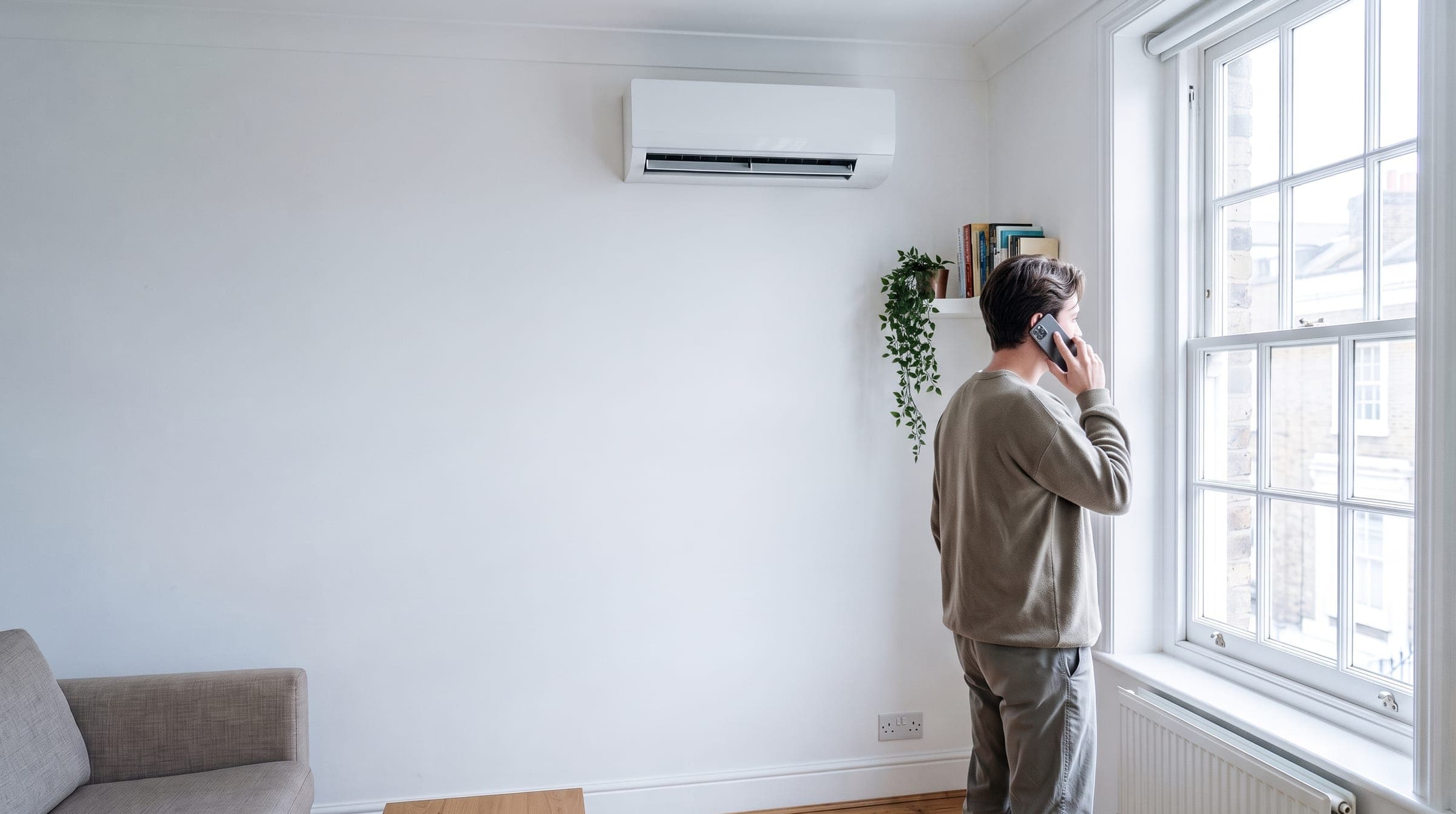
- from your landlord, before any work
- Written consent
- for landlords to fit air conditioning
- No legal duty
- a hazard councils can assess
- Excess heat
- one room, fitted, inc. VAT
- From £1,850
Who has to say yes
A fixed split system needs the agreement of whoever owns and manages the building. Planning is a separate check on top.
| Your home | Who must agree | Good to know |
|---|---|---|
| Privately rented house | Your landlord, in writing | Ask the landlord directly. Shelter notes letting agents usually can't agree to works without them |
| Privately rented flat | Your landlord, and usually the freeholder or managing agent | Your landlord asks the freeholder under their own lease, which can take weeks |
| Council home on a secure tenancy | The council, in writing | The law says consent mustn't be unreasonably withheld. Start with your housing officer |
| Housing association home | The housing association, in writing | Check your tenancy agreement and their alterations or improvements policy |
If you own a leasehold flat rather than rent it, see our flats page: the consent is the freeholder's, usually called a licence for alterations.
Can I get air conditioning in my council house?
If you're a secure council tenant, section 97 of the Housing Act 1985 makes it a term of your tenancy that you don't make any improvement without the council's written consent. Improvement is defined widely, as any alteration or addition to the home, so a wall unit, a hole through the wall and an outdoor unit all count.
The same section says the council must not unreasonably withhold consent. In practice councils have their own alterations process, may set conditions on how the work is done, and may refuse for genuine reasons such as the building's structure. Flexible tenancies are treated differently, so check which tenancy you have.
Housing association tenancies depend on the tenancy agreement. Shelter's advice is that your landlord has to agree in writing to any serious work, and you might need permission for smaller changes too. In a block of flats, planning rules only allow one heat pump per block without an application, so expect your landlord to look at the whole building.
What to put in your request to the landlord
A clear, specific request is easier to say yes to. We give you most of this after a survey.
- The exact make, model and size of the indoor and outdoor units, from a written quote
- Photos marked with where each unit goes, and the pipe route straight through the wall behind the indoor unit
- The outdoor unit's sound data and its distance from neighbours' windows
- Who fits it: an F-Gas certified installer, and how the electrics will be done and certified
- The planning position: permitted development, or an application needed
- Who pays for the install, the yearly service and any repairs
- What happens when you leave: it stays, you take it, or it's removed and the wall made good
- How the hole would be filled and the wall repaired if it's removed
- A request for the answer in writing, with any conditions spelled out
How to ask, step by step
Read your tenancy agreement
Find the clause on alterations or improvements, and who your landlord and managing agent are.
Get a survey and a written quote
We agree the unit positions and pipe route with you and send a fixed price naming the exact model, so the landlord sees exactly what's proposed.
Ask in writing
Send the request and the details to your landlord, not only the agent. Council and housing association tenants use their landlord's alterations form if there is one.
Freeholder and planning
In a flat, your landlord gets the freeholder's consent. The owner also needs to be happy with the planning position, which we check at the survey.
Get the yes in writing
Book the install only once you have written consent, including who owns the system and what happens at the end of the tenancy.
Planning permission when you rent
Planning attaches to the building, not to who lives there, so the rules are the same as for an owner. A heating-capable unit on a house is often permitted development in England, with no application, if it meets every condition. Blocks of flats are allowed one heat pump per block with an outdoor unit up to 0.6 m³, and conservation areas and listed buildings add limits.
Our planning permission guide sets out the current rules, and our planning checker looks up your postcode in the government's planning data. Share the result with your landlord: it saves them a job.
Does my landlord have to provide air conditioning?
No. There's no legal duty on landlords in England to fit air conditioning or keep a home below a set temperature, and hot weather alone isn't normally a repair issue. Councils such as Cornwall say so plainly in their tenant guidance.
But excess heat is one of the 21 hazards in the Housing Health and Safety Rating System (HHSRS), which the government updated in June 2026. Councils use it to judge how risky a home is, with people aged 65 and over as the most vulnerable group. The guidance names rooms under uninsulated roofs, poor ventilation at night and strong sun through windows as the main issues.
The fixes it lists include external shading, insulation, ventilation and air conditioning, but it says passive measures should be considered before energy-hungry ones. A landlord is also responsible where heat is caused or made worse by disrepair, such as windows that won't open. Report it to your landlord in writing, then to your council's private housing or environmental health team if nothing happens.
What the Renters' Rights Act 2025 changed
From 1 May 2026, most private tenancies in England became rolling assured periodic tenancies, landlords can no longer use section 21 'no fault' evictions, and rent can only go up once a year. Councils also have new powers to act when landlords break the law.
Nothing in the government's overview of the Act gives tenants a right to fit air conditioning or make other alterations. Shelter's current advice is still to get your landlord's agreement in writing first. Without it, a landlord might ask you to put things back, keep some of your deposit, or try to evict you.
If your landlord says no
Ask for the reasons in writing first. Many refusals are about where the outdoor unit goes or noise, and a different position or a quieter model can change the answer. If it's still no, these help.
| Option | Permission needed? | The honest verdict |
|---|---|---|
| Close curtains or blinds on sunny windows | No | Free and worth doing, though the HHSRS guidance notes blinds only reflect some of the heat |
| External shutters, awnings or roller blinds | Usually, as they're fixed outside | UKHSA calls them very effective, so they're worth asking for as a smaller change |
| Open windows at night | No | UKHSA advises it when the air outside feels cooler and it's safe to do so |
| Electric fan | No | UKHSA says use one if the air is below 35°C, and don't aim it directly at your body |
| Portable air conditioner with a window kit | Usually not, but check your tenancy | Cools one room, but louder, less efficient than a split, and the hose keeps a window ajar |
Our guide to keeping a bedroom cool covers these in more detail.
For landlords: why some fit it
Every home system we fit heats as well as cools. At the Ofgem cap for October to December 2026, a modern split system delivers heat for about 5.1p to 5.7p per kWh, against 26.3p for plug-in electric heaters. In a let with poor heating, that's a real improvement as well as summer comfort.
The HHSRS guidance lists air conditioning among the ways to reduce excess heat, alongside shading, insulation and ventilation. If you fit it, you choose the model and positions, and you keep the service records: manufacturers need a yearly service to keep their warranty valid. A multi-split runs several bedrooms from one outdoor unit, which suits a terrace or semi where permitted development allows one heat pump.
What it costs if your landlord agrees
Home prices include VAT. Whoever pays, the quote names the exact model, so your landlord can see what's going on the wall.
- from£1,850inc. VAT
A bedroom or study
2.5 kW wall unit, 5 m pipe, fitted in a day
- from£2,050inc. VAT
A living room
3.5 kW wall unit
- from£3,650inc. VAT
Two rooms, one outdoor unit
Multi-split
- from£119inc. VAT
An annual service
Keeps the manufacturer warranty valid
Renting and air conditioning questions
Can I get air conditioning in my rented flat?
Yes, with your landlord's written permission, and your landlord will usually need the freeholder's or managing agent's consent too. Send them the model, the unit positions, the sound data and who pays and owns it. Planning rules for flats are tighter than for houses, so check those as well.
Can I get air conditioning in my council house?
Only with the council's written consent. For secure tenants, section 97 of the Housing Act 1985 requires it for any improvement, and says consent mustn't be unreasonably withheld. Ask your housing officer how the council's alterations process works and what conditions it sets.
Does my landlord have to provide air conditioning?
No. There's no legal duty in England. If your home gets dangerously hot because of how it's built or because of disrepair, the council can assess it under the excess heat hazard in the HHSRS. The fix might be shading, insulation or ventilation rather than air conditioning.
Can I use a portable air conditioner in a rented flat?
Usually, because nothing is fixed to the building, but check your tenancy agreement. A portable unit vents hot air through a hose in a window that has to stay ajar. It's louder and less efficient than a split system, and it only cools one room.
Who owns the air conditioning when I move out?
Whatever you agree in writing before it's fitted. The usual choices are that it stays with the property, that you take it, or that it's removed and the wall made good. Agree who pays for each, and who pays for the yearly service in the meantime.
Can I fit air conditioning without telling my landlord?
Don't. Shelter warns that a landlord might ask you to change things back, keep your deposit or try to evict you. Since 1 May 2026, private landlords need a legal ground to end a tenancy, and unauthorised alterations could give them one. Ask first and get the answer in writing.