Is air conditioning worth it in the UK?
For many homes, yes. Top-floor flats, loft rooms, sunny bedrooms and home offices get hot enough in a UK heatwave to spoil sleep and work, and a modern system heats in winter too. For a shaded room that's only warm a few days a year, probably not. Here's how to decide, with real costs and the cheaper fixes to try first.
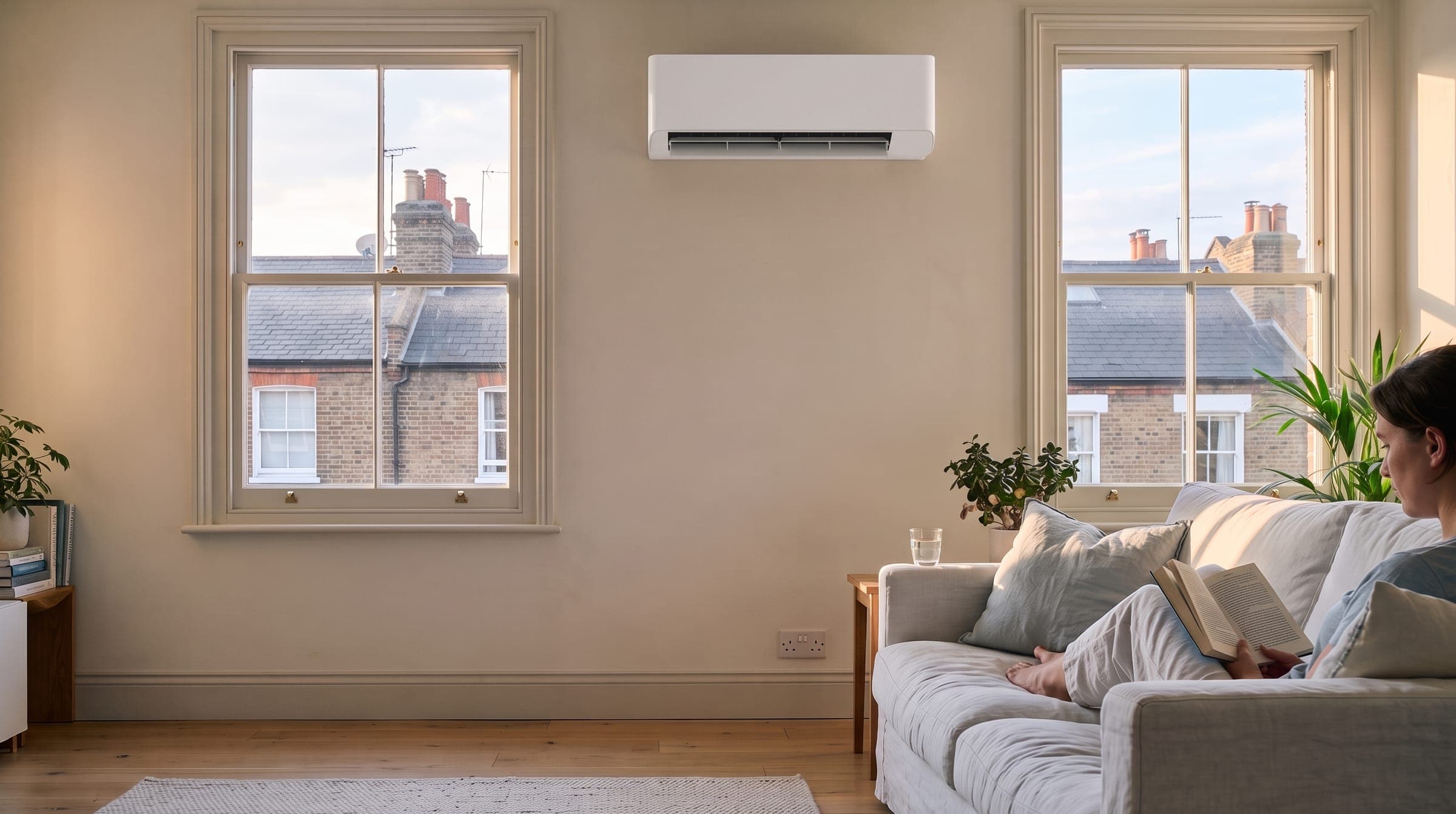
- a bedroom unit, fitted, inc. VAT
- From £1,850
- an hour to cool a bedroom
- 7p–17p
- more 30°C days in London than 1961–1990
- Over 4 times
- per kWh of heat, against 8.9p for gas
- 5.1p–5.7p
The short answer
It depends on two things: how hot your rooms really get, and whether you'd use it for heating. If a room is regularly too hot to sleep or work in, and the free fixes haven't solved it, air conditioning is usually worth it. If you'd also use it to heat that room in winter, the case gets stronger.
UK summers are warming. The Met Office's State of the UK Climate report, published in July 2026, found that in Greater London the number of days above 30°C and nights above 18°C both more than quadrupled in 2016 to 2025 compared with 1961 to 1990. Summer 2026 is provisionally the UK's warmest on record. Our guide to whether UK summers are getting hotter has the full figures.
Who gets the most from it
The government's housing hazard guidance (HHSRS, 2026) names the same causes of overheating we see at surveys: rooms under the roof, strong sun through glass and poor ventilation at night.
| Home or room | Why it gets hot | Worth it? |
|---|---|---|
| Top-floor flat | Heat through the roof, and flats in bigger buildings overheat more often | Often yes |
| Loft conversion | Rooms right under the roof, often with rooflights | Often yes |
| Bedroom facing south or west | Sun through the glass all afternoon, then a warm room at bedtime | Often yes, if it costs you sleep |
| Home office | Computers, screens and daytime sun while you're in the room | Often yes, if you work from home in summer |
| Glass extension or big glazing | Solar gain in summer, and often cold in winter | Often yes, for heating as much as cooling |
| Shaded, north-facing room | Little direct sun | Usually not. Try ventilation and a fan first |
UKHSA lists people aged 65 and over, young children and people with some health conditions as more at risk from heat. If that's someone in your home, a cool room counts for more.
Try the cheaper fixes first
The HHSRS guidance says passive measures should come first, UKHSA's keep-cool checklist is built around them, and they cost little. Shade sunny windows: external shutters, awnings and roller blinds are very effective, and closed curtains help. Open windows when the air outside feels cooler, such as at night, if it's safe. UKHSA says electric fans are fine below 35°C air temperature, as long as you don't aim them straight at your body.
If you've done all that and a room is still too hot, that's the point where air conditioning earns its place. Our guide to keeping a bedroom cool goes through each fix in order.
Should I get air conditioning in London?
London adds a few things to weigh. Cities hold heat: the HHSRS guidance says urban heat islands can raise temperatures in large urban areas by as much as 4°C, and warm nights in London are far more common than they were. Noise, traffic fumes and security also stop many Londoners opening windows after dark, and the same guidance says mechanical cooling can make sense where windows can't be left open.
Most Londoners live in flats, so consent and planning matter. A leaseholder usually needs the freeholder's written consent, and permitted development allows only one heat pump per block of flats. Many streets are in conservation areas, where units can't go on walls facing the road without an application. None of this rules air conditioning out, but it's worth checking before you set your heart on it.
The heating half of the decision
Every home system we fit is an air-to-air heat pump: it cools in summer and heats in winter. The planning rules in England expect that, as a unit used solely for cooling can't be permitted development.
Heating is where the running costs compare well. At the Ofgem cap for October to December 2026, a modern split system delivers heat for about 5.1p to 5.7p per kWh, against about 8.9p for a gas boiler at 90% efficiency and 26.3p for plug-in electric heaters. It doesn't heat water, so it works best alongside your boiler, warming a loft, an extension or a room the radiators struggle with.
What it costs to fit
Our starting prices for homes, including VAT. Two rooms on one outdoor unit usually cost less than two separate systems.
- from£1,850inc. VAT
A bedroom or study
2.5 kW wall unit, 5 m pipe, fitted in a day
- from£2,050inc. VAT
A living room
3.5 kW wall unit
- from£2,450inc. VAT
Open plan or a loft
5 kW wall unit
- from£3,650inc. VAT
Two rooms, one outdoor unit
Multi-split
- from£119inc. VAT
An annual service
Keeps the manufacturer warranty valid
What it costs to run
Cooling costs from our running costs guide, at the Ofgem cap of 26.32p per kWh for October to December 2026. Ranges run from a premium model at seasonal efficiency to a value model flat out.
| Unit size | Per hour, cooling | 8-hour night | A year's cooling |
|---|---|---|---|
| 2.5 kW, bedroom | 7p–17p | 55p–75p | £24–£33 |
| 3.5 kW, living room | 10p–26p | 78p–£1.08 | £34–£47 |
| 5 kW, loft or open plan | 16p–42p | £1.24–£1.53 | £54–£67 |
Yearly figures are the energy label consumption, which assumes 350 hours of cooling. Most UK homes use less. Add £119 a year for a service, including VAT.
Does air conditioning add value to a house?
It isn't well evidenced. We found no independent UK study comparing sale prices of homes with and without air conditioning. Some estate agents publish estimates, but not the method behind them. We'd treat it as comfort and lower-cost heating, not as an investment.
If you do fit it, keep the paperwork a buyer's solicitor may ask for: the freeholder's consent if you're in a flat, any planning decision or Lawful Development Certificate, the commissioning record and the yearly service records.
It's probably worth it if
- A bedroom is too hot to sleep in on summer nights, even with the windows open
- You live in a top-floor flat or a loft conversion
- A room has big south- or west-facing windows or a glass roof
- You work from home and your office gets hot in the afternoon
- You can't leave windows open at night because of noise, fumes or security
- Someone at home is older, very young or unwell and struggles in the heat
- You'd also use it to heat a room the radiators don't reach, or that relies on plug-in heaters
It's probably not worth it if
- The room is only uncomfortable a handful of days a year
- Shading, night ventilation and a fan already keep it comfortable
- You're moving soon and can't take it with you
- There's nowhere for the outdoor unit that the freeholder, planning rules and neighbours would accept
- You'd only ever use it for cooling and the budget is tight
Is it worth it? Questions
Is air conditioning worth it in the UK?
For rooms that regularly overheat, yes: top-floor flats, lofts, sunny bedrooms and home offices. It also heats in winter, at about 5.1p to 5.7p per kWh of heat at the October to December 2026 price cap. For a shaded room that's warm only a few days a year, try shading and a fan first.
Should I get air conditioning in London?
Cities hold heat, nights above 18°C in Greater London were more than four times as common in 2016 to 2025 as in 1961 to 1990, and many homes can't keep windows open after dark. That makes a stronger case than in most of the UK. Check consent and planning first if you're in a flat or a conservation area.
Is it cheaper to buy a portable air conditioner?
Cheaper to buy, yes. But portables are louder, vent hot air through a hose in the window, and use more electricity for the cooling you get. A fixed split system costs more upfront, runs more quietly and can heat the room in winter.
How much does air conditioning cost to run in summer?
For a 2.5 kW bedroom unit, about 55p to 75p for an 8-hour night at full output, at 26.32p per kWh. The energy label puts a year's cooling at about £24 to £33. Our running costs guide has the workings for every size.
Will air conditioning put my energy bills up a lot?
Summer cooling adds less than most people expect, because a modern unit moves heat rather than making it. Heating through the winter is a bigger cost, but if it replaces plug-in heaters it costs about a fifth as much for the same warmth.
Does air conditioning increase house value in the UK?
There's no good independent evidence either way. We'd buy it for comfort and heating, not resale. Keep the consent, planning and service records, which buyers' solicitors may ask for.