Air conditioning in Kensington and Chelsea
We install, service and repair air conditioning across the Royal Borough, from Chelsea and South Kensington to Notting Hill and North Kensington. Most homes here are flats, most streets are in a conservation area and thousands of buildings are listed, so the survey matters as much as the kit.
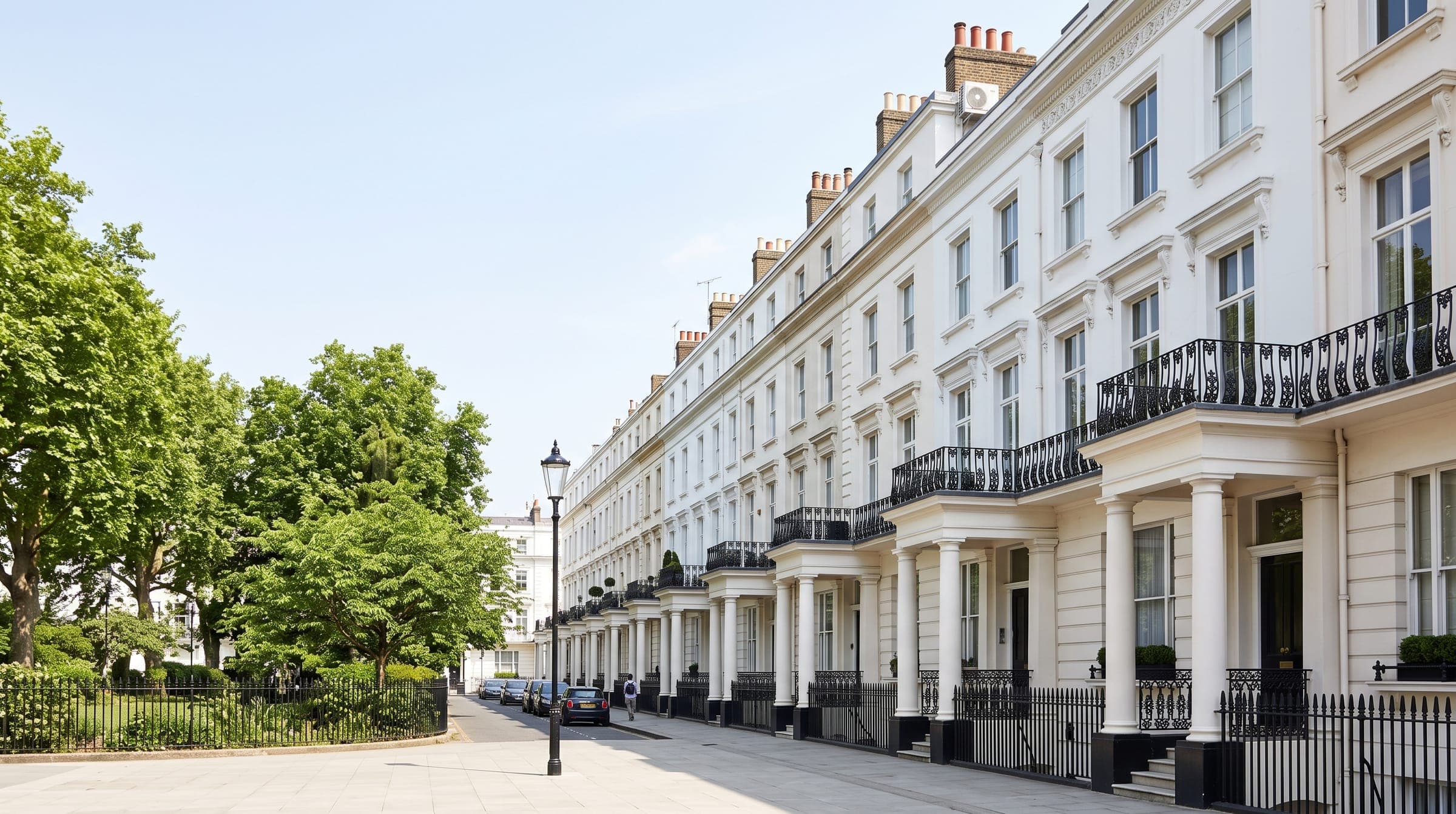
- conservation areas in the borough
- 38
- listed buildings (council figure)
- 4,000+
- of homes are flats or maisonettes
- 85%
- only for noisy building work
- Mon to Fri
Air conditioning installation in Kensington and Chelsea
We fit air conditioning in Kensington and Chelsea homes, flats and businesses: wall-mounted units for a single room, multi-split systems for several rooms on one outdoor unit, and ducted systems where nothing should show. A single room starts from £1,850 fitted, two rooms on one outdoor unit from £3,650.
Every install starts with a free survey. Our engineer checks where the units and pipes can go and gives you a fixed price in writing, and most single rooms are fitted in a day. We install Daikin, Mitsubishi Electric, LG and more. See how installation works or get a free quote.
Air conditioning servicing and repairs in Kensington and Chelsea
We service and repair any brand in Kensington and Chelsea, whoever fitted it. An annual service starts from £149 and keeps the manufacturer's warranty valid; a repair is priced in writing before any work starts. Air conditioning servicing and repairs.
Prices in Kensington and Chelsea
These are our standard London prices. Planning drawings come in our design pack, from £795. Enclosures and long internal pipe runs are quoted after the survey, and acoustic reports are by an independent acoustician.
- from£1,850
A bedroom or study
2.5 kW wall unit, 5 m pipe, fitted in a day
- from£3,650
Two rooms, one outdoor unit
Multi-split
- from£5,100
Three rooms
Multi-split
- from£7,500
Four rooms
Multi-split
- from£4,950
Ducted, per zone
Hidden in the ceiling, survey needed
- from£550
Design range upgrade
Daikin Emura and Stylish, Mitsubishi Electric Zen
Why Kensington and Chelsea needs a different approach
The Royal Borough of Kensington and Chelsea (RBKC) says nearly three quarters of the borough sits inside its 38 conservation areas. Its Local Plan 2024 counts over 4,000 listed buildings and over 100 garden squares. Flats and maisonettes make up 85 per cent of the housing stock.
So the question is where the outdoor unit can go, who has to agree and how quiet it must be. We plan that at the survey.
Mansion blocks, stucco terraces and mews houses
Mansion blocks in South Kensington, Earl's Court and around Kensington High Street need consent from the freeholder or managing agent, and often a lift booking and agreed working hours. The council's Local Plan notes that buildings such as mansion blocks don't have the permitted development rights that houses have, so planning permission is the usual route for an outdoor unit.
Terraced houses in Chelsea, Holland Park and Notting Hill usually take the outdoor unit on a rear flat roof, a rear wall below the parapet, or down in a lightwell, with pipes routed internally. Mews houses have little or no rear space, so we look at roof positions and compact units with low sound levels.
Where a building is listed, or the street front is protected, ducted or multi-split systems often work best. One discreet outdoor unit can serve several rooms, and indoor units can be hidden in a ceiling void.
Planning in RBKC: what the council looks at
Policy GB8 of the Local Plan 2024 says the council will resist plant, including air conditioning units and air source heat pumps, that would have an unacceptable noise and vibration impact on neighbours. Policy CD10 covers small additions such as mechanical plant, which must be discreetly located and must not harm the building's appearance.
Policy GB5 asks applicants to reduce reliance on air conditioning by following the London Plan cooling hierarchy. In practice, an application for a unit should show that shading and ventilation have been considered first. We help you write that part of the statement.
The noise bar is high. The council's Noise SPD (2009, read October 2026) sets plant, assessed to BS 4142, at a rating level 10 dB below the background (LA90), or 15 dB below where the sound is tonal. In a 2025 committee decision on two condensers on a mansard roof in the Ladbroke Conservation Area, the council set a condition that plant noise must stay 10 dB(A) below the lowest background level, measured 1 m from the nearest home's window, and that the units sit on anti-vibration mounts. That is the standard we design to here.
- Listed buildings: the council says listed building consent is needed even for smaller changes, and names air conditioning and vents in its list
- Article 4 directions in conservation areas control changes to front elevations, windows, doors, boundary walls and roofs
- A borough-wide Article 4 direction also covers basement extensions to houses
- Pre-application advice runs from Level 1 (£587 for a householder in 2026 to 2027) and Level 1 isn't available for listed building alterations
Cadogan consent, RBKC's noise rules and the design pack
On the Cadogan estate in Chelsea and Knightsbridge, consent comes through your lease. If the lease needs Cadogan's consent, you apply for a Licence to Alter. Its June 2023 guidelines say that where air conditioning or comfort cooling is proposed, the position of every external item of plant must be shown. The application must come with an acoustic engineer's report showing how RBKC's noise criteria will be met.
Cadogan says new external pipework will not normally be permitted, and no new pipes may be fixed to outside walls, so the pipes run inside. It prefers electric heating and cooling, and air source heat pumps where unit size and space allow, which suits an air-to-air heat pump that also cools. When we read its guidelines in October 2026, its administration charge and the solicitors' fees for a routine licence came to more than £2,800, and it aimed to decide within 90 days.
For planning, RBKC's Noise SPD asks for a noise survey and report by a competent acoustician who is a member of the Institute of Acoustics, with a noise checklist, and all plant on proprietary anti-vibration mounts. In a 2026 committee report, officers noted that earlier applications had been withdrawn for lack of an acoustic report, and found a unit in an enclosure in a courtyard discreetly located and acceptable.
We give the acoustician the unit data, positions and distances they need.
Our design pack, from £795, gives Cadogan or your freeholder, and the council, one set of scaled drawings, the specification, the maker's sound data and our MCS 020 calculation. The fee is agreed in writing first and comes off the installation if you go ahead. Each body decides for itself, and nobody can promise consent.
Conservation areas we work in
These are some of the borough's 38 conservation areas. Each has its own appraisal, and we check the conservation area rules for your street before suggesting a position.
- Chelsea, Cheyne, Royal Hospital and Sloane Square
- The Boltons, Courtfield and Queen's Gate
- Thurloe/Smith's Charity and Brompton
- Kensington Square, Kensington Court and De Vere
- Ladbroke, Pembridge, Norland and Holland Park
- Edwardes Square/Scarsdale & Abingdon
- Earl's Court Square, Earl's Court Village and Philbeach
- Hans Town, Sloane/Stanley, Lots Village and Colville
Shops and restaurants on King's Road, Kensington High Street and Portobello
The London Plan names Knightsbridge an International centre, and Kensington High Street and the east end of King's Road Major centres. Smaller centres include Notting Hill Gate, Portobello, South Kensington, Brompton Cross, Fulham Road and Earls Court Road. The council runs Portobello Market with Golborne Road, and a Friday market outside the Chelsea Theatre on the World's End estate.
Nearly three quarters of the borough is in conservation areas, so on these streets the outdoor unit usually goes on a rear roof or in a yard, away from any flats above, with the acoustic report the council asks for. We fit shop air conditioning, cafe air conditioning and restaurant air conditioning, sized for busy shop floors and hot kitchens.
Parking and access for engineers
There are no uncontrolled streets in the borough. Our van parks on pay-by-phone bays or on a suspended bay. RBKC suspensions for building work are for trades vans, not cars. Permit bays need 10 working days' notice and pay-by-phone bays need two. From 1 April 2026 the fee is £82 per space per day for the first five days. If a job needs a suspension, we apply for it and show the council's fee on your quote.
RBKC is stricter than most boroughs on noise. Noisy work audible beyond the site is allowed 8am to 6pm on weekdays and not at all on Saturdays, Sundays or bank holidays. Drilling through walls is planned inside those hours.
The borough is outside the Congestion Charge zone. The ULEZ covers all of London.
How a Kensington and Chelsea install runs
Survey
We check the listing, the conservation area, the lease and where an outdoor unit could sit, and note the nearest neighbours' windows if planning is likely.
Consents
We give you drawings and noise data for the freeholder, the managing agent and, where needed, a planning or listed building consent application.
Book access
Once consent is in place we book the bay suspension, lift and working hours with the building.
Install
Anti-vibration mounts, neat internal pipe routes and noisy drilling kept to weekday hours. Then commissioning and F-Gas records.
Neighbourhoods we cover
We work across the whole Royal Borough, including:
- Chelsea, King's Road and World's End
- South Kensington, Brompton and Brompton Cross
- Kensington and Kensington High Street
- Earl's Court and West Brompton
- Notting Hill, Ladbroke Grove and Portobello
- Holland Park and Notting Dale
- North Kensington, Golborne and Kensal
- Lots Road and the RBKC side of Knightsbridge
Kensington and Chelsea in official figures
- households (2021 Census)
- 66,884
- live in a flat
- 83 in 100
- live in a house
- 17 in 100
- listed building entries
- 1,350
Of 66,884 households in the 2021 Census, 17 in 100 lived in a house (1 detached, 3 semi-detached, 13 terraced) and 83 in 100 in a flat. Most installs here are in flats, so the freeholder's consent usually comes first.
In a conservation area an outdoor unit can't go on a wall or roof facing a road without planning permission, and an Article 4 direction can remove permitted development rights altogether. Check your postcode to see whether either applies to your street.
Sources: ONS Census 2021, table TS044 (accommodation type); Historic England's National Heritage List entries within the council boundary, through planning.data.gov.uk (one entry can cover several buildings). Checked October 2026.
Air conditioning for shops, cafes and restaurants in Kensington and Chelsea
- shops and other retail premises
- 1,905
- licensed restaurants
- 385
- cafes and unlicensed restaurants
- 195
- pubs and bars
- 85
The Kensington and Chelsea area has about 1,905 shops and other retail premises, 580 restaurants and cafes and 85 pubs and bars. Restaurants and cafes are a bigger share of trade here than in most of the areas we cover. Kitchens, ovens and grills add heat of their own, so a dining room is sized for the equipment as well as the covers, with the outdoor unit kept clear of the kitchen extract.
Permitted development for heat pumps covers homes, not shops, cafes or restaurants, so check with the council and your landlord before an outdoor unit goes up, and take extra care with a shopfront in a conservation area. Check your postcode.
- Shop air conditioning
- Cafe and coffee shop air conditioning
- Restaurant air conditioning
- Pub and bar air conditioning
- Salon and barber air conditioning
Business premises (local units) in the whole Kensington and Chelsea area, rounded by the ONS. Source: ONS UK Business Counts 2026, through Nomis.
Kensington and Chelsea questions
Do I need planning permission for air conditioning in Kensington and Chelsea?
Often, yes. An outdoor unit on a flat or mansion block usually needs planning permission, and nearly three quarters of the borough is in a conservation area. Listed buildings need listed building consent. An unlisted house may not need planning if the unit heats as well as cools and isn't on a street-facing wall or roof in a conservation area.
Can I have air conditioning in a listed building in Chelsea or Kensington?
Yes, with listed building consent. RBKC names air conditioning and vents among the smaller changes that need consent. We design around the building, usually with internal pipe routes and an outdoor unit out of sight, and give you the drawings for the application.
How quiet does the outdoor unit need to be?
Recent RBKC conditions require plant noise to stay 10 dB(A) below the lowest background level at the nearest neighbour's window, or 15 dB(A) below if the sound is tonal. We pick the unit and position to meet that, and use anti-vibration mounts.
Can you fit air conditioning in a mansion block flat?
Usually, once the freeholder or managing agent agrees and, for the outdoor unit, planning permission is granted. Common positions are a rear flat roof, a lightwell or a balcony. We give you what the freeholder or agent usually asks for, and work to the building's rules on lifts and hours.
Can you work on Saturdays in Kensington and Chelsea?
Not on noisy work. RBKC allows building noise audible beyond the site only from 8am to 6pm, Monday to Friday. Quiet tasks, such as commissioning or a service visit, can be booked in our Saturday hours.
Who pays for the parking suspension?
If your job needs a suspended bay, we apply for it and show the council's fee on your quote. From 1 April 2026 RBKC charges £82 per space per day for the first five days. Permit bays need 10 working days' notice, so we book it as soon as consents are in place.