Wall-mounted air conditioning: how it works, where it goes and what it costs
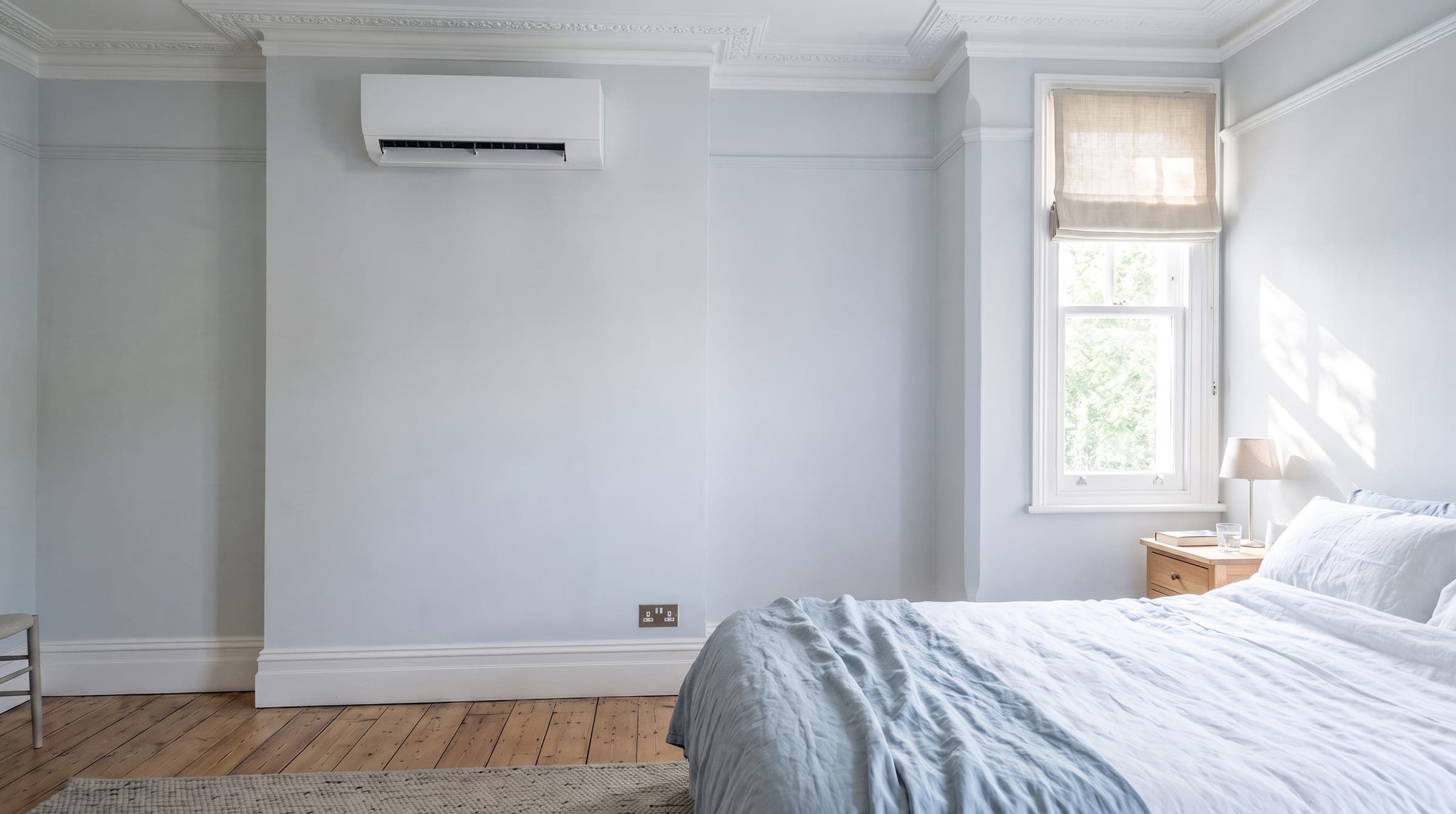
A wall-mounted air conditioner is the slim white unit you see high on a wall. It's the indoor half of a split system: an outdoor unit does the noisy work, and two small refrigerant pipes join them through one hole in the wall behind the unit. It cools in summer, heats in winter, and it's the lowest-priced system we fit for a single room.
- 2.5 kW room, fitted, inc. VAT
- From £1,850
- quietest setting, premium 2.5 kW units
- 19 dB(A)
- minimum height from the floor (Daikin)
- 1.8 m
- one hole through the wall
- 65 mm
What a wall-mounted air conditioner is
A wall-mounted unit (also called a wall-hung unit, a wall unit AC or simply wall aircon) is the indoor part of a split air conditioner. Inside the casing are a coil, a quiet fan, washable filters and a louvre that opens when it runs and steers the air up, down and across the room. The compressor and the big fan sit in a separate outdoor unit.
The two halves are joined by two insulated copper refrigerant pipes, a power and control cable and a drain hose for the water the unit takes out of the air. All four go through one hole in the wall behind the indoor unit. Daikin's installation manual for its Perfera wall units and Mitsubishi Electric's drawings for the MSZ-LN both show a 65 mm wall hole.
Every home system we fit is reversible, so the same wall unit heats in winter. In planning terms that makes it an air source heat pump: an air-to-air one. Our split air conditioning guide explains how this fits with multi-splits and ducted systems.
Wall unit sizes and which room each suits
Size is the cooling the unit delivers, in kW, not the size of the box. Starting points for a room with a 2.4 m ceiling, ordinary windows and average insulation.
| Unit size | About in BTU | Typical room | Floor area |
|---|---|---|---|
| 2.0 or 2.5 kW | 8,500 (2.5 kW) | Bedroom, study, small office | Up to about 20 m² |
| 3.5 kW | 12,000 | Living room, large bedroom, loft bedroom | About 25 to 35 m² |
| 5 kW | 17,000 | Open-plan kitchen and living, large loft | About 35 to 50 m² |
Based on Daikin's UK starting point of about 0.1 kW per m², then allowing for the warmer South-East. Big south-facing glass, high ceilings and lofts push the size up. Our what size air conditioner guide has the full method.
Where a wall unit goes, and why
High up, for two reasons. Cool air is heavier than warm air, so a unit near the ceiling can throw it across the room and let it settle, instead of pooling it around your feet. And a high unit is out of the way of furniture, curtains and people. Daikin's installation manual asks for the Perfera to be at least 1.8 m from the floor, with at least 30 mm to the ceiling and 50 mm to the walls either side, and says nothing should block the airflow.
On an outside wall where possible. Then the pipes, cable and drain go straight through the wall behind the unit and nothing shows in the room. Daikin's manual has the hole drilled with a downward slope towards the outside, so condensation drains out by gravity. On our installs the pipework runs outside in neat white trunking, never across the room.
Aimed at the room, not at you. The best spot usually throws air along the longest length of the room, over the area where people sit, rather than straight down onto a bed, a sofa or a desk.
How we choose the spot on your wall
We agree the exact position with you before anything is drilled.
- At least 1.8 m up, with the gaps to the ceiling and side walls the manufacturer asks for
- On an outside wall where we can, so the pipes go straight through the wall behind the unit
- No pipes or trunking on show in the room. If a unit has to go on an inside wall, the pipe route is shown and agreed on your quote first
- Not above the head of a bed, and angled so air doesn't blow straight onto a bed, sofa or desk
- Clear of curtains, tall wardrobes and shelves that would block the air coming out or going in
- Where you can reach the filters to clean them
- Not above a hob or cooker, where grease and steam would clog the filters
- In period rooms, below the cornice and picture rail, never cutting into original plasterwork
How big the indoor unit is
Smaller than most people expect. Mitsubishi Electric's service manual gives the 2.5 and 3.5 kW MSZ-LN as 890 mm wide, 307 mm high and 233 mm deep, weighing 15.5 kg: under a metre wide and about 30 cm tall. Your quote gives the exact size of the model we recommend, so you can mark it out on the wall first.
If looks matter most, design ranges such as Daikin Emura, Mitsubishi Electric Zen and LG Artcool have flatter fronts and different finishes. They cost more, and our design range upgrade price is below.
What a wall-mounted unit costs, fitted
Home prices include VAT and cover a standard install: up to 5 m of pipe through the wall and in white trunking outside, the outdoor bracket, commissioning and warranty registration. Business prices are plus VAT. A free survey or a few photos confirm the price.
- from£1,850inc. VAT
A bedroom or study
2.5 kW wall unit, 5 m pipe, fitted in a day
- from£2,050inc. VAT
A living room
3.5 kW wall unit
- from£2,450inc. VAT
Open plan or a loft
5 kW wall unit
- from£250inc. VAT
Premium range upgrade
Quieter, more efficient unit
- from£550inc. VAT
Design range upgrade
Daikin Emura, Mitsubishi Electric Zen, LG Artcool
- from£1,795+ VAT
Commercial wall unit
Fitted in business hours
How quiet a wall unit is: the spec sheet figures
Indoor sound pressure in cooling, in dB(A), for 2.5 kW wall units, from each manufacturer's UK spec sheet or product page.
| Model | Quietest | Low | High |
|---|---|---|---|
| Daikin Perfera (FTXM25A) | 19 | 25 | 41 |
| Mitsubishi Electric MSZ-LN25VG3 | 19 | 23 | 42 |
| Panasonic Etherea (KIT-Z25-CKE) | 19 | 25 | 39 |
| LG DUALCOOL Deluxe (DC09RH) | 19 | 27 | 42 |
Bigger units can't turn down as far: Daikin's 5 kW Perfera lists 27 dB(A) at its quietest. The outdoor unit is louder, at about 46 dB(A) in cooling for a 2.5 kW model. Our quiet air conditioning guide has more models and the neighbour noise rules.
It heats as well as cools
A wall unit usually gives out more heat than its cooling rating. Daikin's 2.5 kW Perfera gives 2.8 kW of heat at its nominal rating, and Mitsubishi Electric's MSZ-LN25 gives 3.2 kW. Daikin lists the RXM25A outdoor unit that goes with it as heating in outdoor temperatures down to minus 21°C.
It's also cheap heat. At the Ofgem cap for October to December 2026, 26.32p per kWh of electricity, a unit with a seasonal efficiency (SCOP) of 4.6 to 5.2 delivers heat for about 5.1p to 5.7p per kWh. A plug-in electric heater costs 26.3p. It heats the room's air only, not your hot water.
Wall-mounted vs floor console vs ceiling cassette vs ducted
All four are indoor units for a split system, with an outdoor unit outside. The difference is where the indoor unit goes.
| Type | Where it goes | Best for | From |
|---|---|---|---|
| Wall-mounted | High on a wall, ideally an outside one | Most bedrooms, living rooms and home offices | £1,850 inc. VAT for a home |
| Floor console | Low on the wall, near the skirting | Under a window, loft rooms with sloping ceilings, rooms with no high wall space | £2,350 inc. VAT |
| Ceiling cassette | Set into a suspended ceiling | Offices, shops and restaurants with a ceiling grid | £2,750 + VAT |
| Ducted | Hidden in a ceiling void or loft, with grilles in the room | Renovations, and rooms where you don't want to see a unit | £4,950 per zone inc. VAT |
Wall units are the lowest-priced and simplest to fit. Daikin's fully flat cassette sits almost flush in standard ceiling tiles; ducted systems are best planned while ceilings are open.
The outdoor unit and the planning rules
Every wall unit needs an outdoor unit, usually on a bracket on a back or side wall, on a ground stand or on a flat roof. Daikin lists the RXM25A, the outdoor unit for its 2.5 kW Perfera, at 610 mm high, 923 mm wide and 367 mm deep, about 0.21 m³. Daikin allows up to 20 m of pipe between it and the indoor unit; our prices include 5 m.
In England, a heating-capable unit on a house is usually permitted development under Class G, so no planning application, if it meets the rules. The outdoor unit must be no bigger than 1.5 m³ on a house (0.6 m³ on a block of flats). A semi-detached or terraced house, or a block of flats, can have one heat pump, and a detached house two. The noise must pass the MCS 020(a) calculation: 37 dB(A) at 1 metre outside a neighbour's habitable room window.
In a conservation area the outdoor unit can't go on a wall or roof facing a highway, and elsewhere not on a wall facing a highway above ground-floor level. A unit used only for cooling isn't covered at all, and listed buildings always need consent. Our planning permission guide has every rule.
What to look for when choosing a wall unit
- The right size in kW for the room, not the biggest you can afford
- The Low fan speed noise figure, not only the quietest, because that's where it spends most of its time
- Heating output and SCOP if you'll heat with it. Energy labels run from A+++ to D
- R32 or another low-impact refrigerant. Since 2025, new single splits in Great Britain can't use one with a global warming potential above 750
- Wi-Fi or app control if you want to switch it on before you get home
- Filters you can slide out and rinse easily
- What the manufacturer warranty needs: most ask for a yearly service, and LG asks for two a year
- An installer who is F-Gas certified. It's against the law to work on these systems without the right F-gas certification
- A written quote naming the exact model, size, pipe route and outdoor position
Wall-mounted air conditioning questions
How much does a wall-mounted air conditioning unit cost to install?
With us, a 2.5 kW wall unit for a bedroom starts at £1,850 fitted, a 3.5 kW unit for a living room at £2,050, and a 5 kW unit at £2,450, all including VAT for homes. That includes the outdoor unit, up to 5 m of pipe, the bracket, commissioning and warranty registration. A commercial wall unit starts at £1,795 + VAT.
Does a wall-mounted air conditioner need an outdoor unit?
A split wall unit does: the outdoor unit holds the compressor, which is why the indoor unit can be so quiet. Through-wall units with no outdoor unit exist, but they're louder and less powerful. Our guide to air conditioning without an outside unit compares them.
How high should a wall-mounted air conditioner be?
High on the wall. Daikin's installation manual for its Perfera wall units asks for at least 1.8 m from the floor, at least 30 mm below the ceiling and 50 mm from the side walls. In most UK rooms that means just below the ceiling, above a door or window height.
Can a wall unit go on an inside wall?
Sometimes, but the pipes, cable and drain then have to travel to an outside wall, through a cupboard, a loft or a boxed-in route. We prefer an outside wall so everything goes straight through the wall behind the unit. If an inside wall is the only option, we show you the route and agree it on your quote first.
Can a wall-mounted air conditioner heat a room?
Yes. Every home system we fit heats as well as cools, and usually gives out more heat than its cooling rating. At the October to December 2026 price cap it delivers heat for about 5p to 6p per kWh, against 26.3p for a plug-in heater.
Is a wall-mounted unit better than a portable air conditioner?
For a room you'll use every summer, yes. The compressor is outside, so it's much quieter indoors, and there's no hose out of an open window letting warm air back in. It heats in winter too. A portable unit suits a short let or a room you can't drill.
Do I need planning permission for a wall-mounted air conditioner?
The indoor unit doesn't need it; the outdoor unit is what counts. On many houses in England a heating-capable unit is permitted development under Class G, if it meets the size, position and 37 dB(A) noise rules. Conservation areas, listed buildings and walls facing the street are the usual exceptions.