Split air conditioning explained: single split, multi-split and ducted
A split system splits the air conditioner in two: an indoor unit in the room and an outdoor unit outside, joined by refrigerant pipes. It's the standard kind of fixed air conditioning in UK homes, and it heats as well as cools. The real choice is which kind of split: one room per outdoor unit, several rooms on one, or a ducted system hidden in the ceiling.
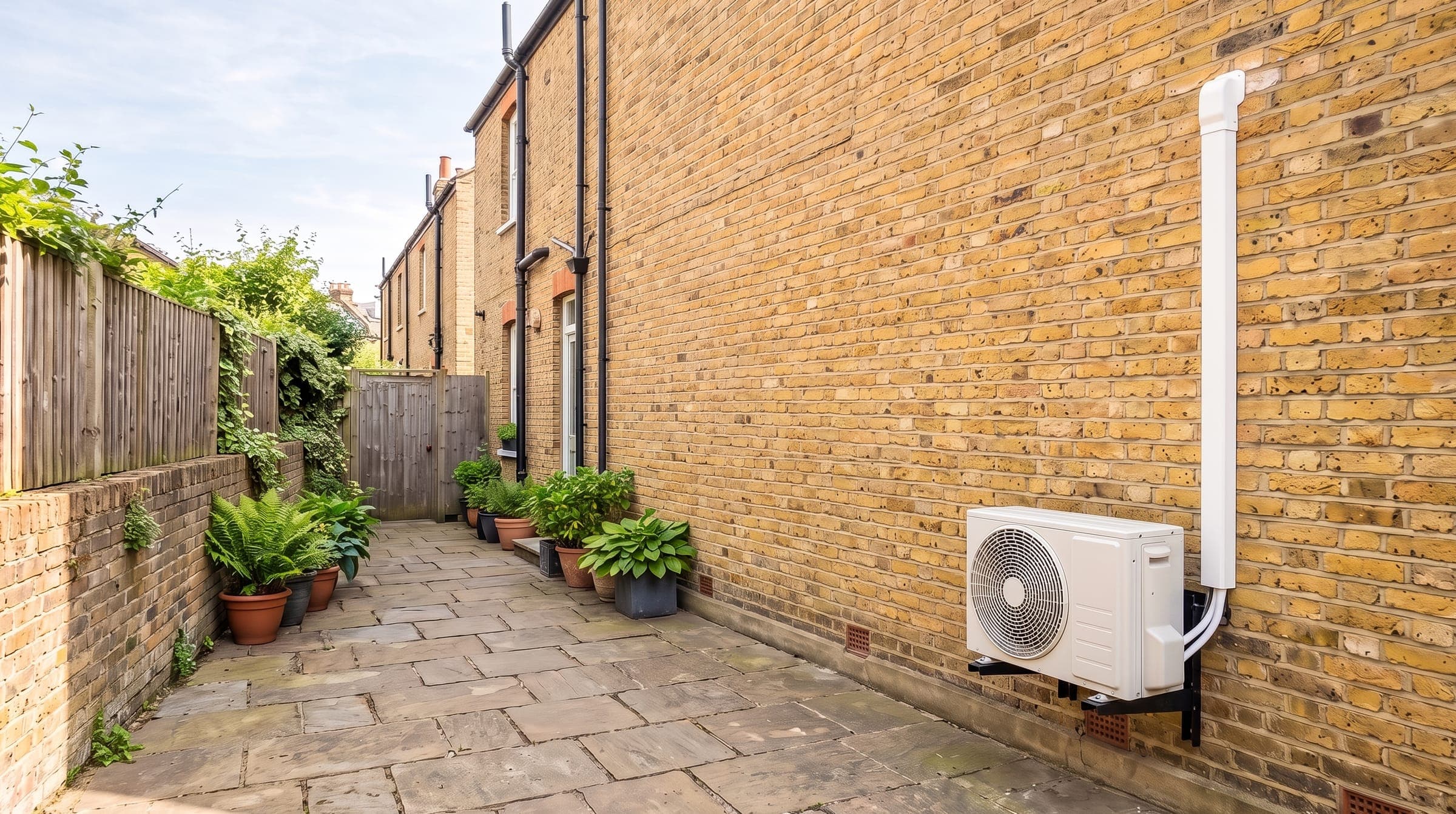
- indoor unit, outdoor unit, pipes between
- 2 parts
- on one home multi-split outdoor unit
- Up to 5 or 6 rooms
- refrigerant, GWP 675
- R32
- single split, one room, inc. VAT
- From £1,850
What split air conditioning means
Every air conditioner moves heat with a refrigerant, a compressor and two coils. A split system puts the noisy parts, the compressor and the big fan, in an outdoor unit. The room only gets a quiet indoor unit with a coil, a fan and filters. Two insulated copper pipes carry the refrigerant between them, with a cable and a drain, through one hole in the wall.
The government's F-gas guidance describes a single split as a system with one cooling coil connected to a remote condensing unit. The alternatives are one-box units: a portable on the floor, or a through-wall unit with two grilles outside. Both keep the compressor in the room with you, which is why split systems are quieter and more powerful.
Most split systems sold for homes are reversible: a valve changes the direction the heat moves, so the same system heats in winter. That makes them air-to-air heat pumps, and every home system we fit works this way.
Mini split, ductless and split AC: the same thing
If you've read American sites, you'll have seen "mini split" and "ductless". The US Department of Energy calls these systems ductless mini-split heat pumps. They're called ductless because the indoor unit blows air straight into the room instead of through ducts.
In the UK the same thing is just called a split system, a split AC unit or wall-mounted air conditioning. The products are the same families from the same manufacturers. One difference to watch: US articles quote sizes in BTU and prices in dollars, and their planning and electrical rules don't apply here.
Single split, multi-split and ducted compared
| Compared | Single split | Multi-split | Ducted split |
|---|---|---|---|
| What it is | One indoor unit, one outdoor unit | Two or more indoor units on one outdoor unit | An indoor unit hidden in the ceiling, feeding grilles |
| Rooms served | One | Up to five (Daikin 5MXM) or six (Mitsubishi Electric MXZ-F) | One zone: a large room or a few rooms used together |
| What you see inside | A wall, floor or ceiling unit | A unit in each room, mixed styles allowed | Grilles and a controller |
| If the outdoor unit fails | That room stops | Every room on it stops | That zone stops |
| One room heating, another cooling | Not applicable | No, every room runs in the same mode | No, one setting per zone |
| Planning on a semi or terrace | Each room's outdoor unit counts as one heat pump | One outdoor unit, counted once however many rooms | One outdoor unit per system |
| Best for | One room, or rooms at opposite ends of the house | Bedrooms and living rooms in a house or flat | Renovations with open ceilings or a loft above |
| Home price from, inc. VAT | £1,850 | £3,650 for two rooms | £4,950 per zone |
How many rooms can one outdoor unit run?
On home multi-splits, up to five or six. Daikin says up to five indoor units can be connected to its 5MXM outdoor unit, and that they don't need to be installed at the same time, so a room can be added later if the outdoor unit was chosen for it. Mitsubishi Electric's MXZ-F range runs up to six indoor units, in sizes from 3.3 to 12.2 kW, and lets you mix wall, floor, cassette, ducted and ceiling units on one system.
Pipe limits set the layout. Daikin's 5MXM90A allows up to 25 m of pipe to any one room, 75 m in total, and 15 m of height between the outdoor unit and an indoor unit. In practice, beyond four or five rooms a second system is often the better design, and we check the limits against your real pipe routes at the survey.
Single split: pros and cons
A single split is one room's system. It's the cheapest way to cool and heat one room, and the most efficient, because the outdoor unit is matched to that one indoor unit.
- Lowest price for one room: from £1,850 inc. VAT for a 2.5 kW bedroom unit
- Each system is independent, so a fault only affects one room
- One room can heat while another system cools
- Most single-room installs take a day
- But each room needs its own outdoor unit, which takes wall space and counts towards the planning limit
Multi-split: pros and cons
A multi-split trades a little flexibility for a much tidier outside wall. Mitsubishi Electric's service manual explains the main catch: if one room asks for cooling and another for heating, the room that started first sets the mode and the other waits until they match.
- One outdoor unit for two to five or six rooms, which keeps the back of the house tidy
- On a semi, terrace or block of flats, it keeps you within the one heat pump allowed as permitted development
- Each room still has its own unit, remote and temperature
- Usually a little cheaper than the same number of single splits
- But every room stops if the outdoor unit fails, and all rooms run in the same mode
- Running one small room on a big outdoor unit is usually a little less efficient than a single split
Ducted split: hidden indoor unit
A ducted system is still a split system. The indoor unit sits out of sight in a ceiling void, loft or bulkhead, and insulated ducts carry the air to slim grilles. You see grilles and a controller, nothing on the wall. It needs space above the ceiling and an access hatch for servicing, so it's best fitted during a loft conversion, extension or refurbishment. Our ducted air conditioning page has the details.
What each type of split system costs with us
Home prices, including VAT, for a standard install with up to 5 m of pipe per room, the outdoor bracket, commissioning and warranty registration. Ducted systems are always priced after a survey.
- from£1,850inc. VAT
A bedroom or study
2.5 kW wall unit, 5 m pipe, fitted in a day
- from£2,050inc. VAT
A living room
3.5 kW wall unit
- from£2,450inc. VAT
Open plan or a loft
5 kW wall unit
- from£3,650inc. VAT
Two rooms, one outdoor unit
Multi-split
- from£5,100inc. VAT
Three rooms
Multi-split
- from£6,500inc. VAT
Four rooms
Multi-split
- from£4,950inc. VAT
Ducted, per zone
Hidden in the ceiling, survey needed
Heating and efficiency: SCOP and SEER
SCOP (seasonal coefficient of performance) is the heat a system delivers over a heating season divided by the electricity it uses. SEER is the same for cooling. Both are on the energy label, which runs from A+++ to D. Panasonic's spec sheets give its premium Etherea a SCOP of 5.2 and its value-range TZ 4.6.
At the Ofgem cap for October to December 2026, 26.32p per kWh of electricity, a SCOP of 5.2 means heat for about 5.1p per kWh, and 4.6 about 5.7p. A plug-in electric heater costs 26.3p. Daikin rates its 5MXM multi-split outdoor unit up to A+++ in cooling and A++ in heating. Our running costs guide has the hour-by-hour figures.
R32 refrigerant and the F-gas rules
Current home ranges such as Daikin's Perfera and 5MXM and Mitsubishi Electric's MXZ-F use R32. Daikin lists its global warming potential as 675, and says it cuts environmental impact by 68% compared with R-410A, the refrigerant many older systems use. Since 2025, new single split systems holding less than 3 kg of refrigerant can't be sold in Great Britain with a refrigerant whose global warming potential is above 750.
R32 is mildly flammable, so manufacturers set minimum room sizes and installation rules for it in their manuals. Working on these systems is controlled by law: the government says it's against the law to work with F gas without the right certification. Our engineers are F-Gas and REFCOM certified.
Planning: why the number of outdoor units matters
In England, a heating-capable split system on a house is usually permitted development under Class G, but Class G counts heat pumps. A semi-detached or terraced house, or a block of flats, can have one; a detached house can have two. Each outdoor unit is one heat pump.
So two rooms on two single splits on a semi or terrace means a second heat pump, which needs a planning application. A multi-split serving both rooms from one outdoor unit stays within the limit. If you already have an air-to-water heat pump for your radiators, any air conditioning outdoor unit is a second one.
The outdoor unit must also be no bigger than 1.5 m³ on a house or 0.6 m³ on a block of flats, and pass the MCS 020(a) noise calculation of 37 dB(A) at a neighbour's window. Even a five-room Daikin 5MXM90A is 734 by 974 by 408 mm, about 0.29 m³. Units that only cool aren't covered, and conservation areas and listed buildings have extra rules: see our planning permission guide.
Which split system should I choose?
- One room you use a lot, such as a bedroom or home office: a single split
- Two to four rooms in a semi, terrace or flat: usually a multi-split, to keep to one outdoor unit
- Rooms at opposite ends of a detached house: two single splits can be permitted development there
- You need one room heating while another cools: separate single splits
- A loft conversion or extension with ceilings still open: consider ducted
- A loft room with sloping ceilings: a floor console on a single or multi-split
- You plan to add a room later: a multi-split outdoor unit chosen with spare capacity
Split air conditioning questions
What is a split air conditioning system?
An air conditioner in two parts: an indoor unit in the room and an outdoor unit outside, joined by refrigerant pipes through a small hole in the wall. The compressor is outside, so the room stays quiet. Most home split systems heat as well as cool.
What is the difference between a split and a multi-split?
A single split has one indoor unit on one outdoor unit. A multi-split runs two or more indoor units, in different rooms, from one outdoor unit. Each room keeps its own temperature, but all rooms run in the same mode, heating or cooling.
Is a mini split the same as a split system?
Yes. Mini split and ductless are American terms for the same split systems sold in the UK: an indoor unit in the room, with no ducts, and an outdoor unit outside. The US Department of Energy calls them ductless mini-split heat pumps.
How much does split air conditioning cost?
With us, a single split for one room starts at £1,850 for 2.5 kW, £2,050 for 3.5 kW and £2,450 for 5 kW. Multi-splits start at £3,650 for two rooms, £5,100 for three and £6,500 for four. Ducted starts at £4,950 per zone. All home prices include VAT.
How many rooms can one outdoor unit cool?
Up to five on Daikin's 5MXM and up to six on Mitsubishi Electric's MXZ-F range, within each maker's pipe length and capacity limits. For most terraces and semis, two to four rooms on one outdoor unit is the usual design.
Is a multi-split cheaper than separate split systems?
Usually a little, and it needs only one outdoor unit. Separate single splits cost more in outdoor units and wall space but keep each room independent. If you mostly use one room, a single split for that room is the cheapest option.
Do I need planning permission for a split system?
Often not on a house in England, if the outdoor unit meets the Class G size, position and noise rules and the system can heat. A semi or terrace can have only one heat pump as permitted development, so a second outdoor unit needs permission, and a multi-split avoids that.