Heat pump vs air conditioning: what's the difference?
Less than most people think. A modern split air conditioner that heats is a heat pump: an air-to-air one. What most people mean by a heat pump is air-to-water, which heats radiators and your hot water instead of blowing warm air. Here's how the two compare on heating, hot water, cooling, cost, grants and planning, and when to choose each.
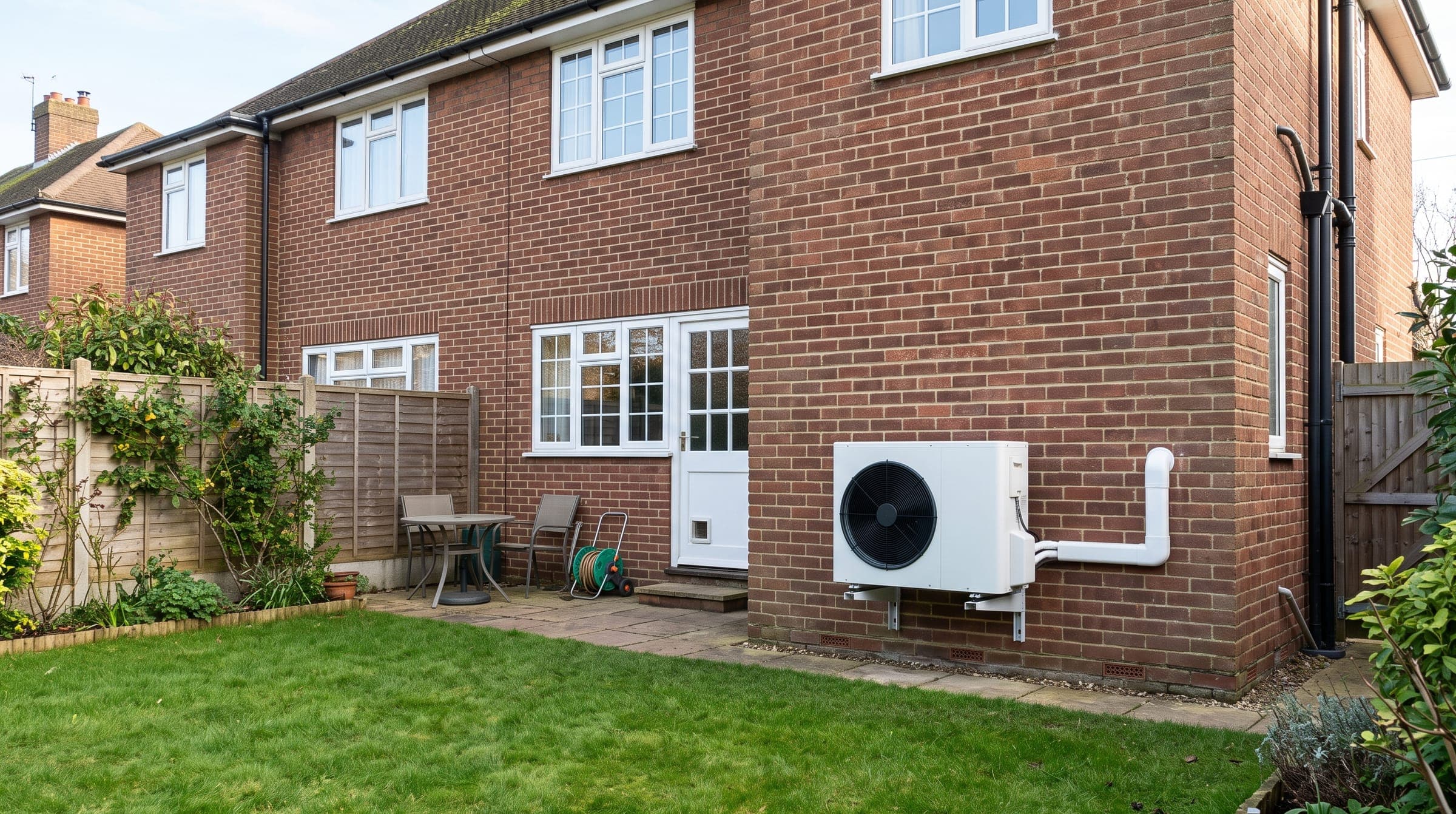
- both move heat from the outside air
- Same technology
- air-to-water median, April to June 2026
- £12,908
- air-to-air for one room, inc. VAT
- From £1,850
- grants: air-to-water vs air-to-air
- £7,500 vs £2,500
Air conditioning is a heat pump
Every heat pump, and every air conditioner, works the same way. A refrigerant circuit and a compressor move heat from one place to another. An air conditioner that only cools moves heat out of your room. A heat pump moves heat in. Most split systems sold for homes today do both: a reversing valve switches the direction, so the same unit cools in summer and heats in winter.
That makes a heating-capable split system an air-to-air heat pump. It takes heat from the outside air and delivers it into the room as warm air. Planning law in England calls it an air source heat pump, and the government's Boiler Upgrade Scheme lists air-to-air as its own type of heat pump.
Air to air vs air to water heat pump
Both take heat from the outside air. The difference is what they put it into.
An air-to-air heat pump puts heat into the air of a room through an indoor unit on the wall or floor, or a ducted system in the ceiling. It heats and cools, room by room, but it doesn't touch your radiators or hot water.
An air-to-water heat pump puts heat into water. That water runs through radiators or underfloor heating, and through a hot water cylinder for your taps and showers. It replaces a boiler completely. It runs best at lower water temperatures than most boilers, so some radiators may need to be bigger. It usually doesn't cool through standard radiators.
Heat pump vs air conditioner: side by side
| Compared | Air-to-air (air conditioning) | Air-to-water heat pump |
|---|---|---|
| What it heats | The air in each room, through an indoor unit | Water for radiators or underfloor heating |
| Hot water for taps and showers | No | Yes, with a hot water cylinder |
| Cooling in summer | Yes | Not through standard radiators |
| Replaces your boiler | For room heating only; you still need hot water | Yes, for heating and hot water |
| Typical installed cost | From £1,850 for one room, £3,650 for two, £5,100 for three (our prices, inc. VAT) | Median £12,908, middle half £11,128 to £15,627, April to June 2026 |
| Boiler Upgrade Scheme grant | £2,500 in law, not claimable yet | £7,500, or £9,000 for some off-gas oil and LPG homes until March 2027 |
| Disruption | One room is usually fitted in a day; one hole behind each indoor unit | Outdoor unit, cylinder, and often radiator and pipework changes |
| Control | Each indoor unit has its own setting | Usually by zone or one thermostat |
| Planning in England | Class G permitted development; must not be cooling-only | Class G permitted development |
Air-to-water costs are government Boiler Upgrade Scheme statistics: what MCS installers reported for a median 8 kW system, including VAT and the grant value. Air-to-air costs are our own starting prices.
Heat pump vs air conditioner cost
To fit, air-to-air costs far less for a few rooms. Our starting prices run from £1,850 for one bedroom unit to £6,500 for four rooms on one outdoor unit, including VAT. The government's Boiler Upgrade Scheme statistics put the median air-to-water install at £12,908 for April to June 2026, before taking off the £7,500 grant.
Those two figures don't buy the same thing. Air-to-water heats the whole house and your hot water. Four air-to-air rooms heat and cool four rooms. For a fair comparison, price what you actually need heated, cooled and supplied with hot water.
Running costs: what each kWh of heat costs
Both run on electricity, so the cost of heat depends on efficiency (SCOP). Prices are the Ofgem cap for 1 October to 31 December 2026: 26.32p per kWh of electricity, 7.97p per kWh of gas.
| Heating | Efficiency | Cost per kWh of heat |
|---|---|---|
| Air-to-air, premium split system | SCOP 5.2 | 5.1p |
| Air-to-air, value split system | SCOP 4.6 | 5.7p |
| Any heat pump at SCOP 3.5 | SCOP 3.5 | 7.5p |
| Air-to-water at the grant's minimum | SCOP 2.8 | 9.4p |
| Gas boiler, well set up | 90% | 8.9p |
| Plug-in electric heater | 100% | 26.3p |
Workings: 26.32p ÷ SCOP, and 7.97p ÷ 0.9 for gas. Air-to-air SCOPs are from Daikin and Panasonic spec sheets. Air-to-water efficiency depends heavily on the design and the water temperature, so ask your installer for the figure for your home.
Reading the running costs fairly
Air-to-air and air-to-water SCOPs are measured under different test conditions, so don't compare the numbers directly. An air-to-water heat pump heats water for radiators and taps, and the hotter the water it has to make, the lower its efficiency. The Boiler Upgrade Scheme rules require an air-to-water heat pump to have a SCOP of at least 2.8.
Either way, a well-designed heat pump costs less per kWh of heat than plug-in electric heating by a wide margin. Against gas, the result depends on the efficiency your system really achieves. Our running costs guide has the full workings for 2.5, 3.5 and 5 kW air-to-air units.
Choose air-to-air if
- You want cooling in summer as well as heating in winter
- You're heating particular rooms: a loft, extension, conservatory, garden room or home office
- You have electric panel or storage heaters and want lower bills
- You live in a flat with no space for a hot water cylinder
- You want each room controlled on its own
- You're happy to keep your boiler, cylinder or immersion for hot water
Choose air-to-water if
- You want to replace your boiler completely, hot water included
- You want to keep heating through radiators or underfloor heating
- You have room inside for a hot water cylinder and outside for the outdoor unit
- You want the £7,500 grant, which needs an MCS-certified installer
- You don't need cooling
Using both together
Some homes have an air-to-water heat pump for heating and hot water, and add air conditioning to the rooms that overheat in summer, often bedrooms and lofts. Others keep a gas boiler and add air-to-air for cooling and to heat the rooms the boiler struggles with.
Planning is the thing to check. Under Class G, a semi-detached or terraced house can have only one heat pump as permitted development, and a detached house two. If you already have an air-to-water heat pump on a semi or terrace, adding an air conditioning outdoor unit means a second heat pump, which needs planning permission. A multi-split, with several rooms on one outdoor unit, keeps the count down.
Grants: £7,500 and £2,500
The Boiler Upgrade Scheme in England and Wales gives £7,500 towards an air-to-water heat pump. Until March 2027, homes heated by oil or LPG with no mains gas connection can get an extra £1,500. The installer must be MCS certified and applies for you. You can't get a grant for a hybrid system that keeps a boiler for heating.
Since 28 April 2026 the scheme has also included £2,500 towards an air-to-air heat pump, but it can't be claimed yet. No installer can be MCS certified for air-to-air until the certification bodies are accredited, and government statistics show 145 applications by the end of August 2026 and no vouchers issued. When it opens it will need the system to heat the whole home and replace existing fossil fuel or electric heating.
Planning: the same rules for both
In England both are air source heat pumps under Class G of the permitted development rules. The outdoor unit must be no bigger than 1.5 m³ on a house, meet the MCS 020(a) noise limit of 37 dB(A) at neighbours' windows, and stay off pitched roofs and walls facing a highway in conservation areas. For air conditioning there's one extra rule: since 29 May 2025, a unit that only cools isn't covered. Our planning permission guide has every rule.
What air-to-air costs with us
Every home system on this list heats and cools. Prices include VAT. A free survey confirms the size and price.
- from£1,850inc. VAT
A bedroom or study
2.5 kW wall unit, 5 m pipe, fitted in a day
- from£2,050inc. VAT
A living room
3.5 kW wall unit
- from£2,450inc. VAT
Open plan or a loft
5 kW wall unit
- from£3,650inc. VAT
Two rooms, one outdoor unit
Multi-split
- from£5,100inc. VAT
Three rooms
Multi-split
- from£6,500inc. VAT
Four rooms
Multi-split
Heat pump or air conditioning: questions
What's the difference between air conditioning and a heat pump?
Very little in how they work. A heating-capable air conditioner is an air-to-air heat pump. What most people call a heat pump is air-to-water: it heats radiators and hot water instead of blowing warm air, and usually doesn't cool.
Is a heat pump the same as air conditioning?
A reverse-cycle air conditioner is a heat pump, because it can move heat into your home as well as out. A cooling-only air conditioner isn't. Every home system we fit heats as well as cools.
Which is cheaper, a heat pump or air conditioning?
To install, air-to-air is cheaper for a few rooms: from £1,850 for one room with us, inc. VAT. The median air-to-water install was £12,908 in April to June 2026, before the £7,500 grant. To run, both cost far less per kWh of heat than plug-in electric heating.
Can an air source heat pump cool my house?
Air-to-water heat pumps usually don't cool through standard radiators. Air-to-air heat pumps, which is what heating-capable air conditioning is, cool and heat.
Can I have a heat pump and air conditioning?
Yes. Check planning first: on a semi-detached or terraced house only one heat pump is permitted development, so a second outdoor unit needs planning permission. A multi-split serving several rooms from one outdoor unit helps.
Do I need planning permission for either?
Often not, on a house in England. Both are covered by Class G permitted development if the outdoor unit meets the size, position and noise rules. Air conditioning must also be able to heat, because cooling-only units aren't covered.