How to heat a garden office (and keep it cool in July)
The cheapest heater to buy is the dearest to run, and none of the plug-in options does anything about summer. A small split air conditioner is an air-to-air heat pump: it heats the office for about a fifth of the cost per kWh of a fan heater and cools it when the sun comes round. This guide compares every option, with the arithmetic.
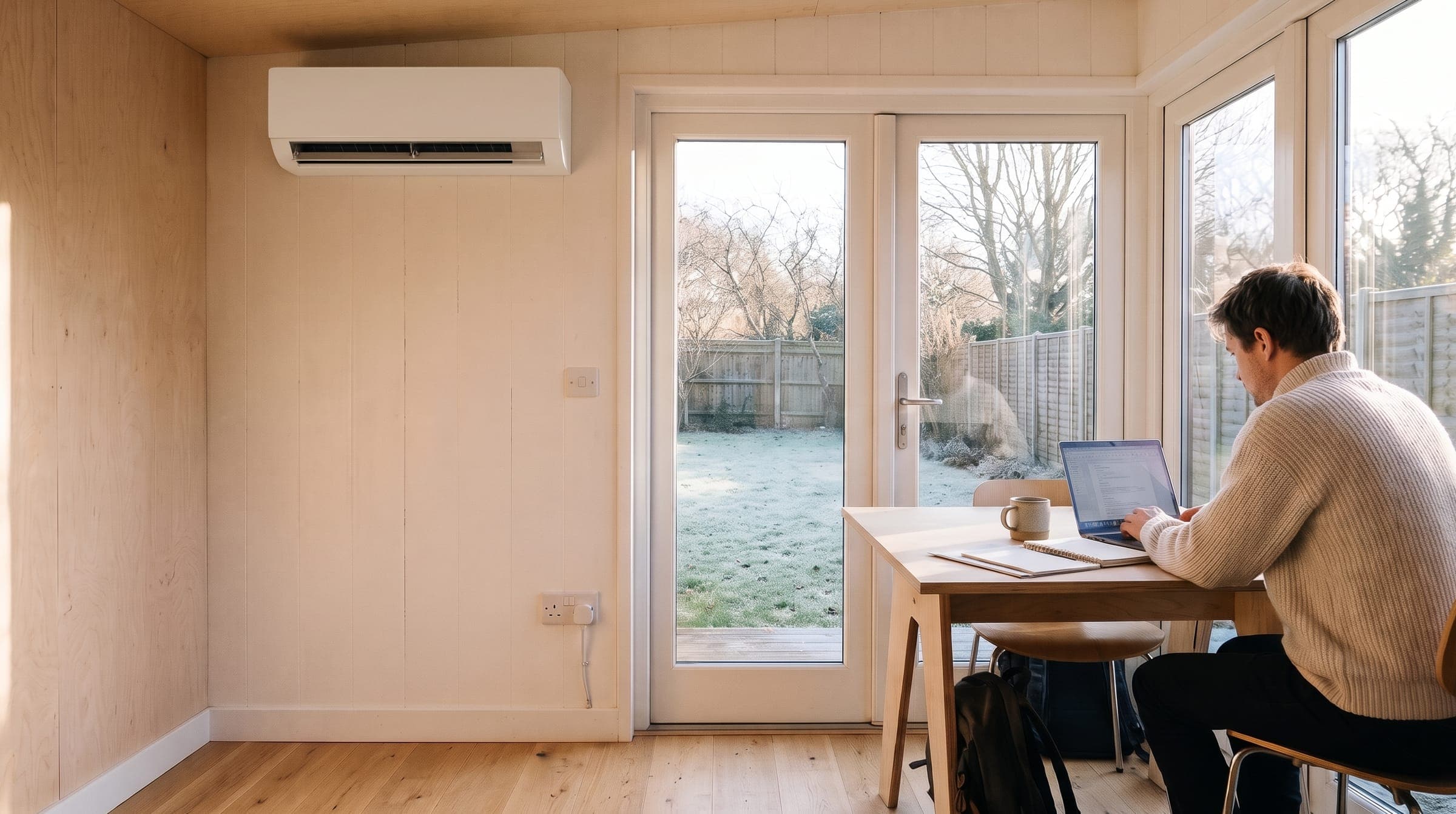
- per hour, 2 kW fan heater
- 52.6p
- per hour, 2.5 kW heat pump, flat out
- 16p
- per kWh of heat at SCOP 4.6
- 5.7p
- 2.5 kW unit, fitted
- From £1,850
On this page8 sections
Why a garden office is hard to heat
A garden office is small, light and often half glass, and it's used in bursts. That's why it feels either cold or stuffy, and rarely right.
- Almost no stored heat: a brick house holds warmth for hours after the heating goes off. A light timber-framed room cools in minutes once the heater stops, and warms as fast when sun hits the glass.
- Warm-up speed matters: you want it at 20 °C from nine o'clock, not warm all night.
- A heater that takes an hour to make a difference means working in a coat until mid morning, or leaving it on a timer and paying for heat nobody is using.
- Insulation and air tightness decide everything else. The Energy Saving Trust's advice for any building is to cut the heat loss first.
- In a garden room that means insulation in the floor, walls and roof, double glazing, and sealed joints where the panels meet.
- A well-built room with 100 mm or more of insulation all round needs a small heater and very little running time. A thin, single-glazed summerhouse will swallow whatever you put in it.
- Building regulations rarely help. In England, a detached outbuilding with no sleeping accommodation is exempt if under 15 m² (Building Regulations 2010, Schedule 2).
- It's also exempt between 15 and 30 m² if it's at least 1 m from the boundary or built mainly of non-combustible material.
- Exempt means nobody checks the insulation against the Part L standards that apply to a house extension: it's whatever your supplier chose.
- Ask for the U-values in writing before you buy, or measure the panel thickness if the room is already there.
Garden office heating options compared
Cost per hour at the Ofgem price cap for 1 October to 31 December 2026, 26.32p per kWh of electricity (GB average, Direct Debit), at the heater's full output. Kit costs are rough retail prices, not quotes.
| Heater | Typical power and cost per hour | Warm-up | Cools in July? | Rough kit cost |
|---|---|---|---|---|
| Electric panel or convector heater | 1 to 2 kW: 26.3p to 52.6p | 15 to 30 minutes to feel warm; heats the air, which escapes fast | No | About £30 to £150 |
| Oil-filled radiator | 1.5 to 2.5 kW: 39.5p to 65.8p | Slow, 20 to 40 minutes; stays warm a while after switching off | No | About £40 to £150 |
| Infrared panel | 0.35 to 1.2 kW: 9.2p to 31.6p | Warms you and the desk within minutes; the air itself stays cool | No | About £100 to £400 per panel |
| Electric underfloor heating | About 150 W per m²; 20 m² is 3 kW: 79p | Slow, often an hour or more on a timber floor; usually left on a timer | No | About £20 to £40 per m² in materials, plus fitting and a new floor finish |
| Fan heater | 2 kW: 52.6p | Fast, a few minutes, but noisy and dries the air | No | About £15 to £50 |
| Split air conditioner (air-to-air heat pump) | 2.5 kW class gives 2.8 kW of heat for about 0.61 kW: 16p | 10 to 15 minutes; a fan moves warm air round the whole room | Yes, the same unit cools and dehumidifies | From £1,850 fitted |
Workings: kW drawn × 26.32p. The heat pump figure uses SCOP 4.6 from a value-range datasheet (2.8 kW ÷ 4.6 = 0.61 kW). Every plug-in heater gives exactly 1 kWh of heat per kWh of electricity.
The heat pump option in detail
A wall-mounted split system moves heat from the outside air into the room instead of making it from scratch, and its efficiency over a heating season is the SCOP on its energy label. Sizing starts from the floor area, then allows for glass, insulation and how many people work there.
- Efficiency: datasheets for the 2.5 and 3.5 kW wall units we fit list a SCOP of 4.6 for Panasonic's TZ range and 5.2 for Daikin's Perfera: 4.6 to 5.2 kWh of heat per kWh of electricity.
- Cost of heat: at 26.32p per kWh, that's 5.1p to 5.7p per kWh of heat against 26.32p from any plug-in heater. These are European seasonal averages: lower on the coldest mornings, higher on mild days.
- About 10 m², well insulated: a 2.5 kW unit is more than enough, and its heating output of around 2.8 kW holds the room on the coldest day.
- About 20 m²: still usually 2.5 kW, or 3.5 kW if one wall is mostly glass.
- About 30 m², or two desks and a gym corner: we'd normally fit a 3.5 kW unit, which gives about 4 kW of heat. Our sizing guide explains the rules of thumb; the survey settles it.
- Outdoor unit: about the size of a suitcase, on a stand or bracket at the back or side of the garden room, out of sight from the house. Thin panel walls often can't take a bracket, so a stand on a paving slab is usual.
- It needs clear space in front of it for air to flow, and somewhere for defrost water to drain in winter.
- Pipes: two copper pipes, a drain and a cable go through one hole of about 65 mm behind the indoor unit, set high to blow along the room, not at the desk. The run is often under 3 m, with no trunking across the garden.
- Noise matters more in a garden, near a neighbour's fence. Under MCS 020(a), the calculated level must not exceed 37 dB(A) 1 m outside the centre of any neighbour's habitable room window or door.
- The calculation starts from the datasheet sound power level, such as 60 dB(A) for Mitsubishi Electric's MUZ-LN25VG3, and allows for distance, reflecting walls and screens. We move the unit if it fails.
- Electrics: it draws a few amps but needs its own circuit, typically 16 A, with a lockable isolator, fed by a proper submain (normally armoured cable to a small consumer unit), never an extension lead or lighting circuit.
- Part P: in England a new circuit is notifiable, so it's done by an electrician registered with a competent person scheme, or inspected by building control.
Planning: Class G on a garden room
Planning is usually straightforward. Class G of Part 14 of the General Permitted Development Order 2015, as amended by SI 2025/560 from 29 May 2025, treats a heating-capable unit on a house, or on a garden room in its grounds, as an air source heat pump.
- Permitted development if it meets the MCS Planning Standards (the noise calculation above) and is not used solely for cooling.
- How many: one heat pump in total for a terraced or semi-detached house and its garden, or two for a detached house.
- Size: an outdoor unit, including any housing, no bigger than 1.5 m³.
- Roofs: not on a pitched roof, and on a flat roof at least 1 m from the edge.
- Exclusions: the house must not be listed, the site not a scheduled monument, and no wind turbine on the building or in the garden.
- No boundary distance rule any more: SI 2025/560 removed it.
- Conservation area or World Heritage Site: not on a wall or roof fronting a highway, or nearer a bordering highway than the house.
- Elsewhere: not above ground-floor level on a wall fronting a highway.
- Siting: so far as practicable, to minimise its effect on the look of the building and the area, and removed when no longer needed.
- Our planning permission guide and planning checker go through each rule for your address.
From enquiry to warm office
Tell us about the room
Size, what's in the walls and roof, how much glass, and what powers it today. Photos of the room and the outside wall help us plan before we visit.
Free survey
We measure the room, check the insulation and glazing, pick the indoor and outdoor positions, run the noise calculation and test the electrical supply.
Fixed written price
One price naming the exact model and size, the pipe route, the drain and the electrical work. If the supply needs upgrading, that's priced as a separate line so you can see it.
Supply check and any electrical work
If a new circuit is needed, a registered electrician fits it first and issues the Part P certificate, so the air conditioning connects to a compliant supply on the day.
Fitted in a day
Most garden offices are a single day: indoor unit, stand or bracket, pipes through the wall, pressure test, vacuum and commissioning by our F-Gas and REFCOM certified engineers.
Handover
We set the heating schedule with you, show you the remote and the app, explain the filter clean and leave the manufacturer's paperwork and our guarantee.
Running cost example: a 30 m² office, 8 hours a day
Take a 30 m² garden office that needs 2 kW of heat to hold 20 °C on a cold working day, with the heater running flat out for all 8 hours.
- That's the worst case: an insulated room and a thermostat cut both figures in proportion, and the comparison stays the same.
- Fan heater, 2 kW: 2 kW × 8 hours = 16 kWh. 16 kWh × 26.32p = £4.21 a day, £84.22 over a 20-day working month and £421 over a 100-day season, roughly November to March.
- Heat pump at SCOP 4.6: the same 16 kWh of heat takes 16 ÷ 4.6 = 3.48 kWh of electricity. 3.48 kWh × 26.32p = 91.6p a day, £18.31 a month and £91.55 over the same 100 days.
- The difference is about £329 a season, before counting the summer cooling you don't get from the fan heater at all.
- Premium, SCOP 5.2: 16 ÷ 5.2 = 3.08 kWh, or 81p a day.
- The Ofgem cap resets every three months, so recheck the unit rate in January 2027. Our running costs guide has the hour-by-hour figures for cooling as well.
Garden office heat pump prices
Fully fitted home prices for the two sizes that suit garden offices. Any upgrade to the electrical supply is priced separately after the survey.
- from£1,850
A bedroom or study
2.5 kW wall unit, 5 m pipe, fitted in a day
- from£2,050
A living room
3.5 kW wall unit
Garden office heating: questions
What's the cheapest way to heat a garden office?
To buy, a fan heater at about £15 to £50. To run, a heat pump: at the October to December 2026 price cap it delivers heat at 5.1p to 5.7p per kWh against 26.32p from any plug-in heater. If you use the office most weekdays through winter, the heat pump pays back its higher price over a few seasons, and it also cools in summer. If you use it one afternoon a week, a plug-in heater and better insulation may be the sensible answer.
Can air conditioning heat a garden office in winter?
Yes. Every home system we fit is a heat pump that heats as well as cools. Manufacturer datasheets list heating operation down to about -15 °C outside, well below a normal Home Counties winter. Output falls a little on the coldest mornings, which is why we size from the heating demand on a cold day, not just the summer heat.
Is underfloor heating good for a garden office?
It's comfortable and invisible, but it's direct electric heating, so each kWh of heat costs 26.32p at the current cap, and a timber floor takes an hour or more to warm through. It suits a room that's used all day, every day, on a timer. For a room used in bursts, a heat pump warms the air in 10 to 15 minutes for about a fifth of the running cost.
Are infrared panels any good in a garden office?
They work differently: they warm you, the desk and the walls rather than the air, so you feel warm within minutes at a desk in front of one. Step out of the beam and it's cold. A 600 W panel costs about 15.8p an hour, which is cheap per hour but still 26.32p per kWh of heat, and it does nothing in summer.
Why is my garden office so hot in summer?
Lightweight walls, a lot of glass and full sun. Timber and composite panels store almost no heat, so the room follows the sun, and a laptop, a screen and a person add more warmth in a small space. Blinds or film on the sunniest glass help. A split system takes the heat out and dries the air, and the same unit heats the room in winter.
Do I need planning permission for a heat pump on a garden office?
Usually not, in England. Class G covers a heating-capable unit on a building within the grounds of a house if every limit is met: it counts towards one heat pump for a terraced or semi-detached house or two for a detached house, the outdoor unit is under 1.5 m³, it passes the MCS 020(a) noise calculation, and the house isn't listed. Conservation areas add rules about walls facing a highway. The garden room itself has its own permitted development limits.
Does a garden office need a new electrical circuit for air conditioning?
It needs its own circuit, typically 16 A, with an isolator by the outdoor unit. If the garden room already has an armoured submain and a small consumer unit with a spare way, that's often enough. If it's fed by an extension lead or one lighting circuit, a new supply is needed first. New circuits are notifiable under Part P, so a registered electrician does the work and issues the certificate.
Can I sleep in a garden room?
Not without checking two things. A garden room built as permitted development must be used for something incidental to the house, such as an office or gym, not as separate living accommodation. And the Building Regulations exemption for outbuildings applies only where there's no sleeping accommodation; add a bed and the full regulations, including insulation and fire safety, apply. Ask your council before you plan to use it as a bedroom.