What's the best conservatory air conditioning?
A heat pump split system: it cools the conservatory in summer and heats it in winter. Fit a wall unit if there's a solid wall with enough height, or a floor console on the low dwarf wall if there isn't. Glass gains and loses heat fast, so a conservatory usually needs more power than a room of the same size.
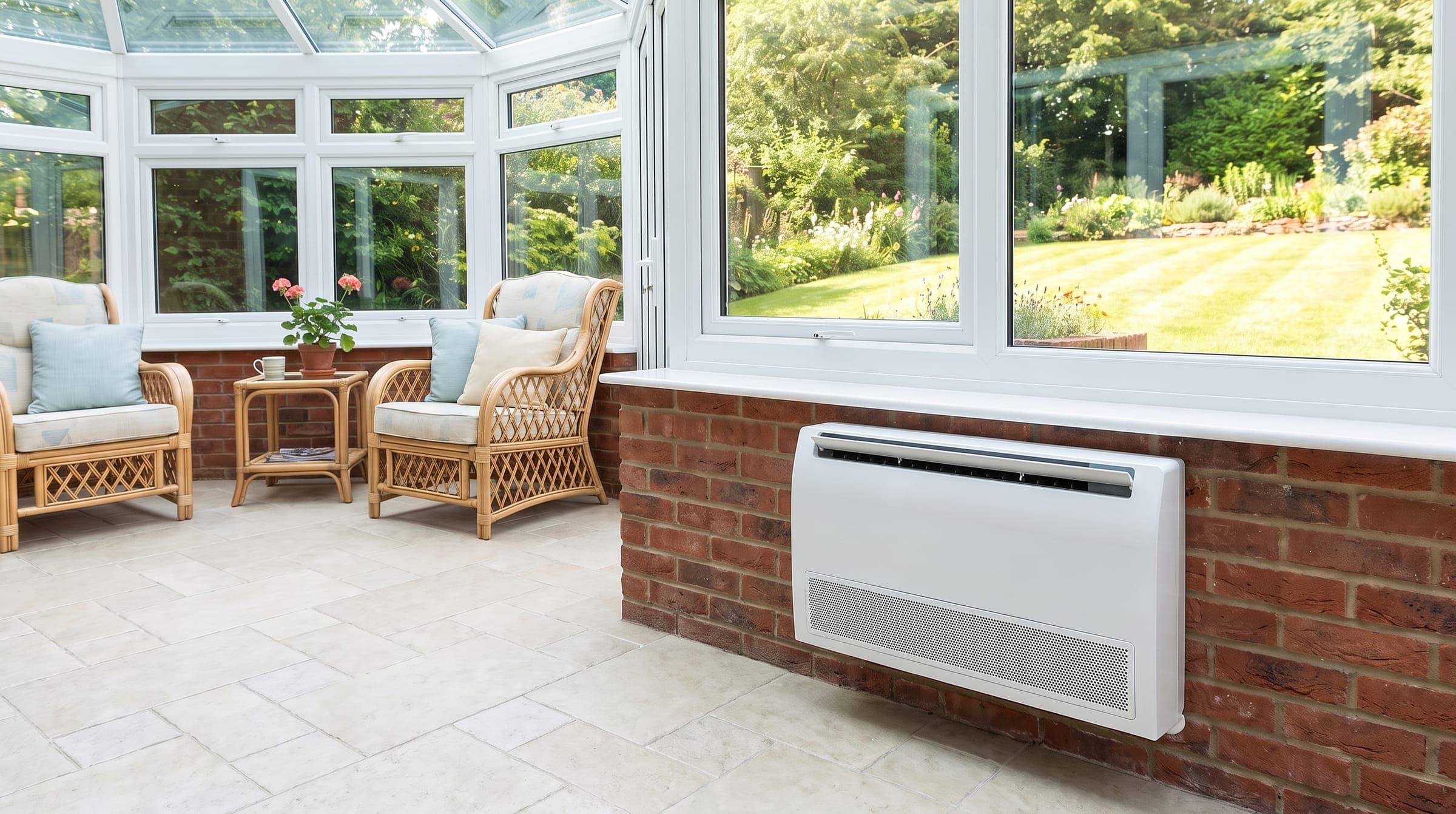
- 2.5 kW wall unit, fitted, inc. VAT
- From £1,850
- 2.5 kW floor console, inc. VAT
- From £2,350
- one system for the whole year
- Heats and cools
- outdoor unit limit on a house
- 1.5 m³
Why conservatories overheat, and then go cold
A conservatory is mostly glass, and the roof is often glass or polycarbonate too. Sunlight passes straight through, warms the floor, the furniture and the air, and the heat can't get out as fast as it comes in. A glazed roof takes the sun overhead for most of the day, which is why a conservatory can be uncomfortable by late morning even when the rest of the house is fine.
In winter the same glass works the other way. It loses heat far faster than an insulated wall, so the room cools quickly once the heating goes off. That's why the right answer is a system that does both jobs, not just a fan or a cooler for summer.
Conservatory air conditioning and heating units compared
| Option | Where it goes | Best for | Watch out for |
|---|---|---|---|
| Wall-mounted split | High on a solid outside wall, such as a brick end wall | Conservatories built against a solid wall with enough height | Needs a clear space near the top of the wall |
| Floor-standing console | Low down, on or in front of the dwarf wall | Glass-walled conservatories with no high solid wall | Takes a little floor space; costs a bit more |
| Multi-split | Conservatory unit plus other rooms on one outdoor unit | Cooling or heating a bedroom or living room as well | Planned as one system at the survey |
| Ceiling cassette | In a suspended ceiling | Rarely suitable: a glazed roof has no ceiling void | Only an option under a solid, insulated roof with a void |
| Portable unit | On the floor, with a hose out of a window or door | A stopgap in a heatwave | Noisier, needs a gap left open, and many only cool |
Wall unit or floor console?
A wall unit is the first choice where it fits. It sits high, spreads air across the room and is the lowest-cost option. It needs a solid wall with outside air behind it, such as a brick end wall, so the pipes can go straight out.
A floor console is the answer for an all-glass conservatory. It sits low against the dwarf wall, about the size of a small radiator cover. Because it sits low, it suits heating: warm air starts near the floor and rises through the room, which matters in a room you'll use through winter.
Either way, the pipes go straight through the wall behind the indoor unit to the outside, so you don't see pipework or trunking inside. Each unit also needs a drain for the water it takes out of the air, which we plan at the survey.
Sizing a glass room
Normal room-sizing rules assume ordinary windows and insulated walls. A conservatory has neither. Daikin's UK size guide suggests a tenth to a fifth more capacity just for large south- or west-facing windows, and a conservatory is mostly glass, often with a glass roof as well. So size from the glass, the direction it faces and the roof, not from the floor area alone.
For heating, the glass matters again: a cold conservatory can need more power to heat in winter than to cool in summer. We size for whichever is bigger. A small, shaded conservatory may suit a 2.5 kW unit; a large south-facing one with a glass roof can need 3.5 or 5 kW. Our sizing guide explains the rules of thumb, and the survey settles the answer.
How to cool a conservatory: fix the roof first
If the roof is the main problem, cutting the heat that gets in can mean a smaller, quieter unit, or sometimes no unit at all.
- Fit roof blinds, ideally reflective ones, and close them on sunny afternoons
- Shade the glass from outside where you can: awnings or external blinds stop heat before it gets in
- Ask a glazier about solar control film or glass for the roof panels
- Open roof vents and doors early in the day to let hot air out
- Consider a replacement solid or tiled roof, which reduces overhead sun and heat loss
- Then size the air conditioning for the room as it will be, not as it is
Building regulations: roofs and heating
The Planning Portal says a conservatory is normally exempt from building regulations when it's single storey, at ground level, under 30 square metres, separated from the house by external-quality walls, doors or windows, and heated by an independent system with its own temperature and on/off controls. A split system has its own thermostat and on/off control. Extending the house's central heating into the conservatory is a different matter, so check before you do it.
A replacement solid roof is building work. The Planning Portal says a new roof must comply with building regulations, so it's structurally safe, energy efficient and ventilated. Planning permission may be needed if the change significantly alters the roof's structure or appearance, though most roof alterations are permitted development. Speak to your council's building control or an approved inspector before you order one.
Using it all year
Every home system we fit heats as well as cools, so the same unit keeps the conservatory usable from autumn to spring. At the Ofgem price cap for October to December 2026, a modern split system delivers heat for about 5.1p to 5.7p per kWh, against 26.3p from a plug-in electric heater. That's about a fifth of the cost for the same warmth.
Our running costs guide has the cost per hour for each size, and our guide to heating with air conditioning compares it with gas.
Where the outdoor unit goes, and planning
The outdoor unit usually sits on the ground or on a wall bracket at ground level, close to the conservatory so the pipe run is short. It needs space around it for air to flow, and somewhere for water to drain, because it drips while it heats and defrosts in winter.
On a house in England, a heating-capable unit is usually permitted development under Class G. The outdoor unit must be no bigger than 1.5 m³, pass the MCS 020(a) noise calculation of 37 dB(A) at neighbours' windows, and not be used solely for cooling. In a conservation area it can't go on a wall facing a highway. A semi-detached or terraced house can have one heat pump as permitted development, so if you already have one, ask us about a multi-split. Our planning permission guide and planning checker cover the details.
Conservatory air conditioning cost
Starting prices for the units that suit conservatories. Home prices include VAT. Long pipe runs or a condensate pump are priced in your quote after the survey.
- from£1,850inc. VAT
A bedroom or study
2.5 kW wall unit, 5 m pipe, fitted in a day
- from£2,050inc. VAT
A living room
3.5 kW wall unit
- from£2,450inc. VAT
Open plan or a loft
5 kW wall unit
- from£2,350inc. VAT
Floor-standing unit
2.5 kW console
- from£3,650inc. VAT
Two rooms, one outdoor unit
Multi-split
How we plan a conservatory install
Survey
We measure the room and note the glass, which way it faces, the roof and the walls that can take a unit.
Choose the unit
A wall unit or floor console, sized for both the summer heat and the winter cold.
Plan the outside
We pick the outdoor position, check it against the planning rules and work out the noise at neighbours' windows.
Fixed quote
A written price naming the exact model and size, with the pipe route and drain explained.
Fit and commission
Our F-Gas and REFCOM certified engineers fit, test and commission the system and show you how to use it.
Conservatory air conditioning: questions
Can you put air conditioning in a conservatory?
Yes. A wall unit goes on a solid wall with enough height, and a floor console goes on the dwarf wall of an all-glass conservatory. Both heat as well as cool, so the room is usable all year.
How much does conservatory air conditioning cost?
With us, a 2.5 kW wall unit starts from £1,850 and a 2.5 kW floor console from £2,350, including VAT. Larger or sunnier conservatories may need a 3.5 kW unit, from £2,050, or a 5 kW unit, from £2,450. The survey confirms the size and price.
What size air conditioner do I need for a conservatory?
Usually more than a room of the same floor area, because glass walls and a glass roof let in far more heat and lose more in winter. We size from the glazing, the direction it faces and the roof, often 2.5 kW for a small shaded conservatory and 3.5 or 5 kW for a large sunny one.
Are small conservatory air conditioning and heating units any good?
A 2.5 kW floor console or wall unit suits a small conservatory well if it's sized for the glass. Portable units are small but noisier, need a window or door left open for the hose, and many only cool, so treat them as a stopgap.
Do I need planning permission for conservatory air conditioning?
Often not, on a house in England. The outdoor unit can be permitted development under Class G if it meets the size, position and noise rules and the system heats as well as cools. Listed buildings and some conservation area positions need permission.
Will air conditioning heat my conservatory in winter?
Yes, if it's sized for winter. Glass loses heat fast, so we check the heating output against the coldest weather, not just the summer. It costs about a fifth as much per kWh of heat as a plug-in electric heater.
Should I replace my conservatory roof instead?
If the roof is the main cause, a solid roof or good shading can make the room far more comfortable and reduce the size of unit you need. A new solid roof must comply with building regulations, so check with building control first. Many people do both.