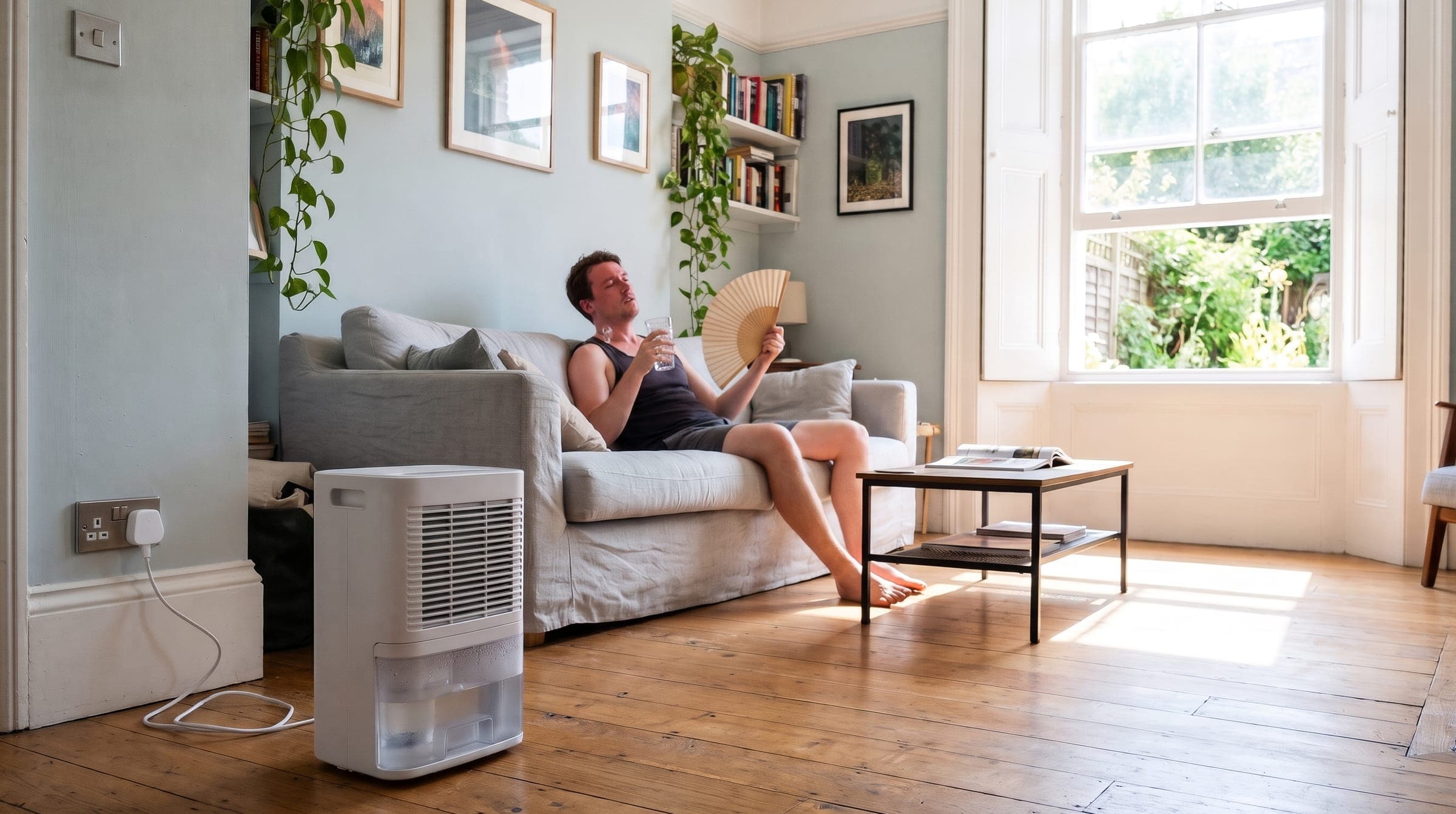
Does a dehumidifier cool a room?
No. A dehumidifier does not lower the air temperature. A compressor model warms the room slightly, because it gives back the heat it takes out of the air plus the heat from its own motor, and a desiccant model warms it more. What it can do is make a muggy room feel more comfortable, because drier air lets sweat evaporate.
- temperature drop from a dehumidifier
- None
- warmer air out, compressor (Meaco)
- About 2°C
- warmer air out, desiccant (Meaco)
- 10 to 12°C
- a fitted 2.5 kW split, our price
- From £1,850
On this page8 sections
Does a dehumidifier cool a room? The short answer
A dehumidifier takes water out of the air, not heat, so the thermometer will not drop.
- Picture a 200 W model in a shut bedroom on a hot night: it uses electricity like a 200 W heater
- All of that power ends up in the room as heat
- Ebac says the energy its machines use warms the air, so it is warmer when it leaves the unit (Ebac)
Why a dehumidifier makes a room warmer
Turning water into vapour takes a lot of energy, which is why sweating cools you. Condensing it back releases that heat again.
- It takes about 540 calories per gram at boiling point and 580 at body temperature (HyperPhysics, Georgia State University)
- When a compressor dehumidifier condenses that vapour back into water on its cold coil, the same heat is released, and its fan blows it back into the room
- Meaco, a UK dehumidifier maker, puts numbers on it. Air leaving a compressor model is about 2°C warmer than the room, which it says will not noticeably warm the room
- Air leaving a desiccant model is about 10 to 12°C warmer, which can warm a room significantly (Meaco)
Compressor vs desiccant dehumidifier: heat and power
| What changes | Compressor | Desiccant |
|---|---|---|
| Air coming out | About 2°C warmer than the room | About 10 to 12°C warmer |
| Power drawn | 150 to 260 W, about 3.9p to 6.8p an hour | About 330 W, about 8.7p an hour |
| Works best | 16°C and above; poor below 10°C | All temperatures; Meaco's pick below 10°C |
| In a hot summer room | Adds a little heat | Adds noticeable heat |
Figures from Meaco at 20°C and 60% relative humidity. Costs at 26.32p per kWh, the Ofgem price cap, 1 October to 31 December 2026.
Can a dehumidifier make a room feel cooler?
It can make a sticky room feel less oppressive. The Met Office explains that in hot, humid conditions sweat does not evaporate efficiently, so the body struggles to cool down (Met Office). Drier air lets sweat evaporate again, so you feel less clammy at the same temperature.
That helps on a warm, muggy day. On a properly hot day the dehumidifier's extra heat works against you. For why homes get hot and sticky, see why is my house so hot and humid.
When a dehumidifier is the right tool
A dehumidifier is the right choice when the problem is moisture, not heat. In those jobs its small heat output is a bonus.
- Condensation on windows and black mould in winter: see condensation, damp and mould
- Drying washing indoors, in one room with the door shut
- A damp spare room, basement or garage that needs no cooling
- A cold room below 10°C: choose a desiccant model (Meaco)
Which one actually cools? Dehumidifier, portable or split
| What changes | Dehumidifier | Portable air conditioner | Split air conditioning |
|---|---|---|---|
| Room temperature | Rises slightly | Falls, but outside air leaks back in | Falls; heat goes outside |
| Humidity | Falls | Falls while cooling | Falls while cooling; also has dry mode |
| Electricity drawn | 150 to 330 W, about 3.9p to 8.7p an hour | 1.35 kW cooling, about 35.5p an hour | 0.49 kW for 2.5 kW of cooling, about 12.9p an hour |
| Noise | Compressor and fan in the room | Compressor and fan in the room | Compressor outside; only a fan indoors |
| Cost to buy | Shop price, no fitter | Shop price, no fitter | From £1,850 fitted, our price |
Portable figure from Olimpia Splendid's Dolceclima Air Pro 14 HP datasheet; split figure from Eurovent's certificate for the Mitsubishi Electric MSZ-LN25VG2.
Does a dehumidifier help with heat? What to use instead
A hot room needs something that moves heat out.
- A portable air conditioner does this through a window hose, but the air it blows out pulls outdoor air back in, especially with single-hose models (US Department of Energy)
- See fixed vs portable air conditioning
- A split system cools and dehumidifies at the same time: moisture condenses on its cold indoor coil and drains away
- On muggy days its dry mode runs at lower capacity to remove moisture without overcooling (Daikin Australia)
- See air conditioner with dehumidifier for how one unit replaces several appliances
- Or try the free fixes in how to keep a bedroom cool first
Dehumidifier and cooling questions
Does a dehumidifier cool a room?
No. It removes water, not heat, and the electricity it uses ends up in the room as heat. A compressor model warms the room slightly; a desiccant model warms it more.
Do dehumidifiers cool the air?
No. Air leaves a compressor dehumidifier about 2°C warmer than the room and a desiccant model about 10 to 12°C warmer, according to Meaco.
Can a dehumidifier make a room cooler?
It cannot lower the temperature, but drier air lets sweat evaporate, so a humid room feels less sticky. On a hot day that is not enough.
Does a dehumidifier help with heat in a heatwave?
Not really. In a heatwave the problem is the temperature, and a dehumidifier adds a little heat. Shade the windows, ventilate when it is cooler outside, and cool the room if it still overheats.
Should I buy a dehumidifier or air conditioning to keep cool?
Air conditioning, if the room gets hot: it cools and dries the air at once, and a split system also heats in winter. A dehumidifier is for damp, condensation and drying washing. Our air conditioner with dehumidifier guide compares the two in full.
Is a compressor or desiccant dehumidifier better in summer?
A compressor model. Meaco says it works best at 16°C and above and adds only a little heat, while a desiccant model blows out much warmer air. Desiccant models suit cold rooms below 10°C.
Sources
9
- Meaco, when to buy a desiccant dehumidifier and when to buy a compressor dehumidifier
- Ebac, 25 facts about Ebac dehumidifiers
- HyperPhysics, Georgia State University, heat of vaporization
- Met Office, what is humidity and how does it affect human health
- Daikin Australia, the importance of dehumidification in home air conditioning
- Olimpia Splendid, Dolceclima Air Pro 14 HP NW datasheet
- Eurovent, Mitsubishi Electric MSZ-LN25VG2 certificate
- US Department of Energy, portable air conditioner test procedure final rule (2016)
- Ofgem, energy price cap unit rates and standing charges