How does an air-to-air heat pump work?
It moves heat instead of making it. A refrigerant picks up heat from the outside air, even on a freezing day, a compressor concentrates it, and the indoor unit blows it into your room as warm air. Run backwards, the same system cools. Here's each part in plain English, what happens in winter and why the outdoor unit sometimes pauses to defrost.
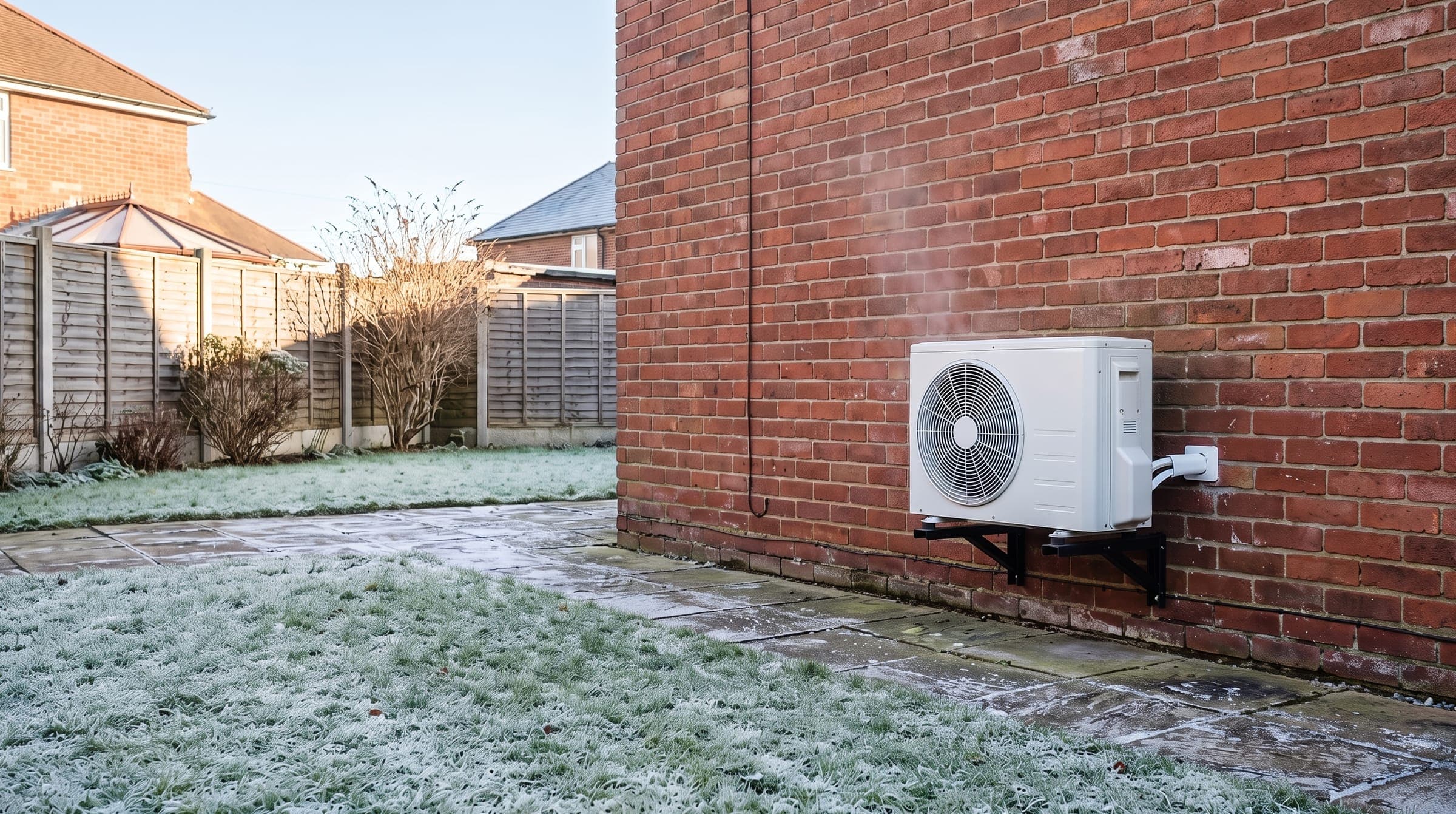
- it doesn't burn fuel to make heat
- Moves heat
- kWh of heat for each kWh used
- SCOP 4.6–5.2
- heating range on typical spec sheets
- Down to -15 °C
- a typical defrost pause, per Daikin
- 3–10 minutes
The short answer
A heat pump works like a fridge. A fridge takes heat out of the food compartment and gives it off from a coil at the back or sides, which is why they feel warm. An air-to-air heat pump does the same job on a bigger scale: it takes heat out of the outside air and gives it off inside your room.
Moving heat takes far less electricity than making it. A plug-in heater turns 1 kWh of electricity into 1 kWh of heat. A modern split system moves about 4.6 to 5.2 kWh of heat into the room for each kWh of electricity, averaged over a heating season, according to Daikin and Panasonic spec sheets.
Air-to-air means it takes heat from the air and delivers it as warm air. A heating-capable split air conditioner is exactly this, which is why planning law and the government's Boiler Upgrade Scheme treat it as a heat pump.
Why there's heat in cold air
Cold air still holds heat. Air at 0 °C or even -10 °C has plenty of heat in it; it just feels cold because it's colder than you. The trick is a refrigerant that boils at a temperature far below freezing. Pass freezing air over a coil full of even colder liquid refrigerant and heat flows from the air into the refrigerant, which boils into a gas as it soaks that heat up.
That gas is then squeezed by the compressor. Squeezing a gas makes it hotter, in the same way a bicycle pump gets warm as you use it. Now the refrigerant is hotter than your room, so it can give its heat away indoors.
The heating cycle, step by step
Outdoor coil: picks up heat
The outdoor fan draws air across a coil filled with cold, low-pressure liquid refrigerant. Heat flows from the outside air into the refrigerant, which boils into a gas. In heating mode this outdoor coil is the evaporator.
Compressor: concentrates it
The compressor in the outdoor unit squeezes the gas into a much smaller space. Its pressure and temperature rise sharply. This is the step that uses most of the electricity.
Indoor coil: gives heat to the room
The hot gas travels through the insulated copper pipes to the indoor unit. The indoor fan blows room air across the coil, the refrigerant gives up its heat and turns back into a liquid. In heating mode this indoor coil is the condenser.
Expansion valve: resets the cycle
The warm liquid passes through an expansion valve, a tiny controlled opening. Its pressure drops, and with it the temperature, until the refrigerant is colder than the outside air again.
Round again
The cold liquid flows back to the outdoor coil and the cycle repeats, continuously, for as long as the room needs heat. The refrigerant is sealed inside the pipes. It isn't burned or used up.
Cooling: the same cycle in reverse
A reversing valve in the outdoor unit switches the direction the refrigerant flows. In cooling mode the indoor coil becomes the cold one: it picks up heat from your room, and the outdoor coil gives that heat away outside. This is why heating-capable units are called reverse-cycle air conditioners.
Cooling also dries the air. Moisture in the room condenses on the cold indoor coil, like water on a cold glass, and runs away through a small drain pipe to the outside.
One system runs one mode at a time. Daikin says its air-to-air heat pumps can only heat or cool at any one time, so on a multi-split every room is heating, or every room is cooling, though each room has its own temperature setting.
What each part does
| Part | Where it is | What it does |
|---|---|---|
| Outdoor coil | Outdoor unit | Picks up heat from the outside air when heating; gives heat away when cooling |
| Compressor | Outdoor unit | Squeezes the refrigerant gas so it gets hot enough to heat the room |
| Indoor coil | Indoor unit | Gives heat to the room when heating; takes heat out when cooling |
| Expansion valve | Usually the outdoor unit | Drops the refrigerant's pressure and temperature so it can pick up heat again |
| Reversing valve | Outdoor unit | Switches the flow between heating and cooling, and runs the defrost |
| Fans | Both units | Move air across each coil; the indoor fan sets how fast warm air reaches you |
| Refrigerant pipes | Through the wall between the units | Two insulated copper pipes carry the refrigerant in a sealed loop |
How it works in winter
It keeps working below freezing, within the range on its spec sheet. Panasonic lists its TZ range as heating with the outdoor temperature anywhere from -15 °C to 24 °C. Mitsubishi Electric's MSZ-LN25 is certified to keep heating down to -15 °C with its standard outdoor unit, and down to -25 °C with its Hyper Heating outdoor unit.
It does give out less heat as it gets colder, because there's less heat in the air to collect and the compressor has to work harder. Panasonic's figures for the TZ25 show 3.3 kW of heat at its nominal rating and 2.7 kW at -7 °C outside. Efficiency falls too. That's why, when you'll rely on it for heat, we size each unit for the coldest weather, not just for summer.
When you first switch to heating, warm air doesn't come out straight away. Daikin says the unit warms up first, for about 3 minutes, so it doesn't blow cold air at you.
Defrost: why it pauses on cold, damp days
On a cold, damp day the outdoor coil runs below freezing, so moisture in the air freezes on it as frost. Frost blocks the airflow and cuts the heat it can collect. Daikin's manuals explain that the unit then switches to defrost on its own and stops blowing warm air while it clears the frost.
During defrost the reversing valve briefly sends hot refrigerant to the outdoor coil to melt the ice. Daikin's guidance is to wait about 3 to 10 minutes. You may hear water flowing, and see water or steam coming off the outdoor unit as the frost melts. That's normal, not a fault, and the melt water needs somewhere to drain away, which we plan for at the survey.
COP and SCOP: how efficiency is measured
COP, the coefficient of performance, is the heat a unit gives out divided by the electricity it uses, measured at one test condition. A COP of 4 means 4 kWh of heat for every 1 kWh of electricity. A plug-in heater's COP is 1.
SCOP is the seasonal version. It averages performance over a whole heating season, including mild days, cold days and part-load running, for an average European climate. It's on the energy label and it's the figure to compare. Value ranges such as Panasonic's TZ reach 4.6, and premium ranges such as Daikin's Perfera 5.2.
In money terms, at the Ofgem price cap for October to December 2026 (26.32p per kWh of electricity), a SCOP of 4.6 to 5.2 means heat at about 5.1p to 5.7p per kWh, against about 8.9p from a gas boiler at 90% and 26.3p from a plug-in heater. Our running costs guide has the full workings.
What the inverter does
Older units ran their compressor at full speed until the room was warm, switched off, then started again once it cooled, so the room swung between too warm and too cool. Daikin describes inverter units as using variable-speed compressors that adjust their output to match what the room needs.
So an inverter unit runs flat out to warm a cold room quickly, then slows right down and ticks over to hold the temperature. Running slowly and steadily is where a heat pump is most efficient, which is a big part of why seasonal figures are as good as they are.
What an air-to-air heat pump can and can't do
- Heats rooms in winter and cools them in summer from the same indoor unit
- Dries the air as it cools
- Gives each room its own temperature setting, with a unit in every room you heat
- Heats a room quickly, without waiting for radiators to warm up
- Doesn't make hot water for taps, baths or showers
- Doesn't connect to radiators or underfloor heating
- Can't heat one room and cool another at the same time on one system
- Pauses for a few minutes to defrost in cold, damp weather
How heat pumps work: questions
How does a heat pump work in simple terms?
Like a fridge working the other way round. A refrigerant soaks up heat from the outside air, a compressor squeezes it to make it hotter, and the indoor unit gives that heat to your room. The refrigerant then cools again through an expansion valve and goes back outside to collect more.
How does an air heat pump work in winter?
The same way. The refrigerant boils far below freezing, so it still collects heat from cold air. Typical spec sheets show heating down to -15 °C outside, and some models lower. Output and efficiency fall as it gets colder, so the unit needs sizing for winter if you'll rely on it.
Is a heat pump the same as an air conditioner?
A reverse-cycle air conditioner is a heat pump: it can move heat into your home as well as out. A cooling-only air conditioner isn't. Every home system we fit heats as well as cools.
Why has my heat pump stopped blowing warm air?
On a cold, damp day it's most likely defrosting. The outdoor unit melts the frost on its coil and the indoor unit stops blowing warm air while it does. Daikin says to wait about 3 to 10 minutes. If it doesn't restart, or it stops very often, book a repair.
Why is steam coming from my outdoor unit?
It's the frost melting during a defrost, which can come off as water or steam. It's normal. It isn't smoke and there's nothing burning: heat pumps don't burn anything.
Can an air-to-air heat pump heat and cool at the same time?
Not on one system. Daikin says its air-to-air heat pumps can only heat or cool at any one time. On a multi-split every room uses the same mode, though each room has its own temperature.
Does an air-to-air heat pump heat water?
No. It heats air only. You keep your boiler, a hot water cylinder or another water heater for taps and showers. If you want one system for radiators and hot water, that's an air-to-water heat pump.