How does air conditioning work?
Air conditioning doesn't make cold. It moves heat. A fluid called refrigerant soaks up heat from your room in the indoor unit, carries it through a pipe to the outdoor unit and lets it go outside. Run the same circuit backwards and it brings heat in, which is how air conditioning heats in winter. Here's each part in plain English, with what it means for running costs, noise and servicing.
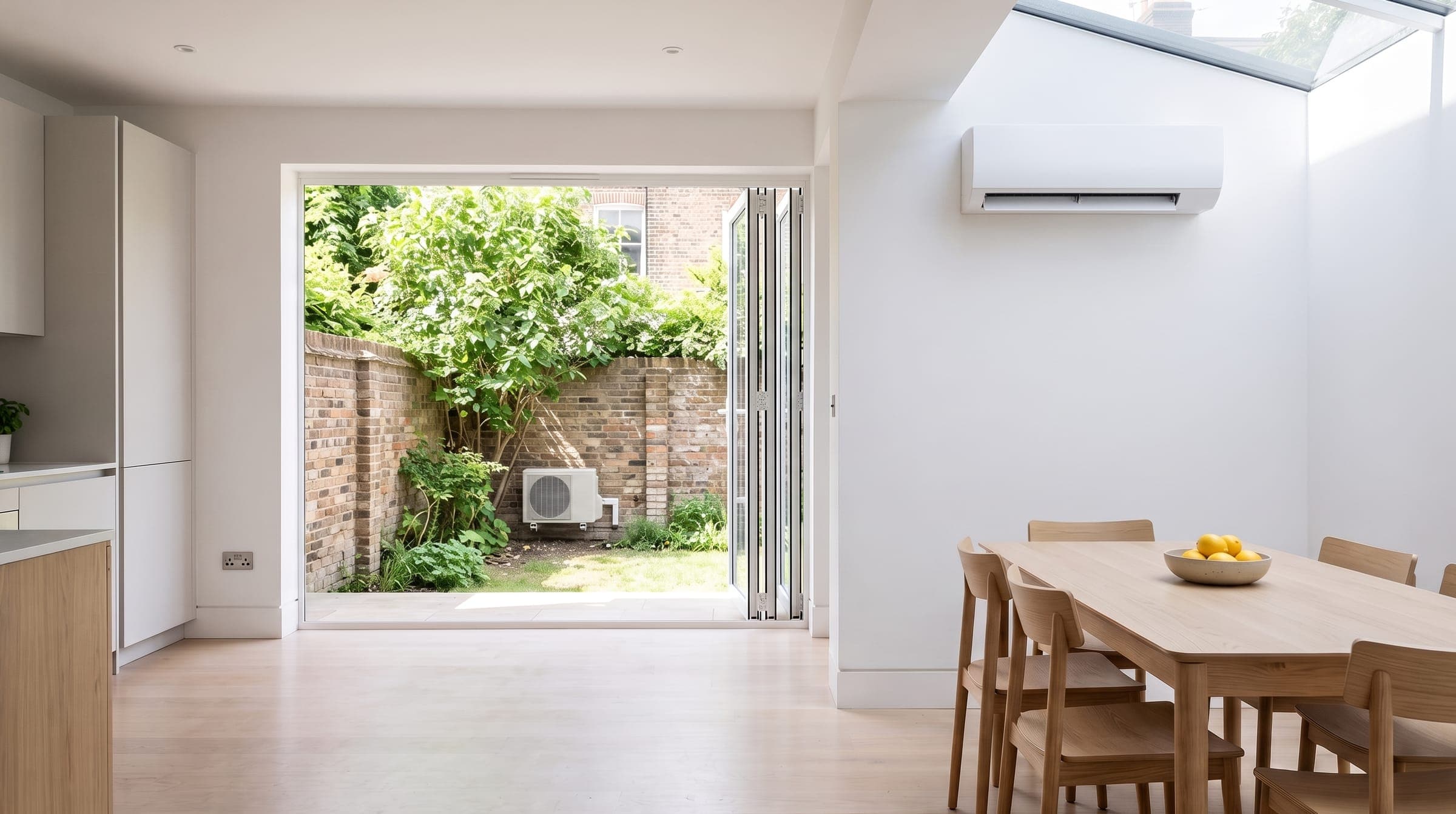
- evaporator, compressor, condenser, valve
- 4 parts
- less electricity with inverter, Daikin
- Up to 30%
- refrigerant in most new home systems
- R32
- kWh of heat per kWh, Panasonic SCOP
- 4.6 to 5.2
The simple answer: it moves heat from inside to outside
A fridge keeps food cold by pumping heat out of the cabinet and into the kitchen through the warm grille at the back. Air conditioning does the same for a room. It takes heat out of the air indoors and puts it into the air outside.
The work is done by refrigerant, a fluid sealed inside a closed loop of copper pipe. Refrigerant boils at a very low temperature. When a liquid boils it soaks up heat, and when the gas turns back into a liquid it gives that heat out again. Air conditioning uses those two changes, one indoors and one outdoors, to carry heat where it's wanted.
The refrigerant cycle in four steps
Evaporator: soaks up the room's heat
The indoor unit holds a coil called the evaporator. Cold, low-pressure liquid refrigerant flows through it. A fan draws warm room air across the coil, the refrigerant absorbs the heat and boils into a gas, and the cooled air blows back into the room.
Compressor: squeezes the gas
The gas travels through a pipe to the outdoor unit, where the compressor squeezes it. Squeezing a gas raises its pressure and its temperature, until it's hotter than the air outside. The compressor uses most of the electricity and makes much of the noise.
Condenser: lets the heat go outside
The hot gas flows through a second coil in the outdoor unit, the condenser. The outdoor fan blows outside air across it, the gas gives up its heat and turns back into a liquid. That's the warm air you feel blowing from an outdoor unit in summer.
Expansion valve: drops the pressure
The warm, high-pressure liquid passes through a narrow valve. Its pressure falls sharply, and so does its temperature, until it's much colder than your room. It flows back to the indoor coil and the loop starts again, round and round, for as long as the unit runs.
Indoor unit, outdoor unit and the pipes between them
A split system is called split because the work is shared between two boxes. The indoor unit holds the evaporator coil, a quiet fan, washable filters and a tray that catches water. The outdoor unit holds the compressor, the condenser coil and a larger fan. Keeping the compressor outside is why a wall unit can run at 19 dB(A) on its quietest setting, by the premium manufacturers' own figures.
Between them run two insulated copper refrigerant pipes, one for liquid and one for gas, plus a power and control cable and a drain pipe. We take them straight through the wall behind the indoor unit, so nothing shows on your inside wall, and outside they run in neat trunking to the outdoor unit. A multi-split runs two to four indoor units from one outdoor unit, each with its own pair of pipes.
Portable and through-wall units use the same four-part cycle, but squeeze both coils and the compressor into one box in the room. That's why they're louder indoors.
Why air conditioning dries the air
When warm, humid room air passes over the cold indoor coil, moisture in it condenses on the coil, like water on a cold glass. It drips into the tray under the coil and runs out through the condensate pipe, usually to an outside drain point. Where the pipe can't fall all the way, a small pump lifts the water out.
So cooling also takes moisture out of the air, which is a big part of why a cooled room feels fresh rather than clammy. Most split units also have a dry mode, which puts the focus on removing moisture with less cooling. Daikin, Mitsubishi Electric, Panasonic and LG all include one.
How does air con heat? The cycle runs in reverse
Most split systems for homes are reverse cycle. A reversing valve in the outdoor unit swaps the direction the refrigerant flows. The indoor coil becomes the hot side and gives out heat into the room, and the outdoor coil becomes the cold side and picks up heat from the outside air. Daikin describes it simply: the functions of the two coils reverse.
Picking up heat from cold air sounds odd, but after the expansion valve the refrigerant is colder still, so heat flows into it even on a frosty day. A heating-capable split is an air-to-air heat pump. Panasonic's spec sheets give SCOPs of 4.6 to 5.2 for its 2.5 kW and 3.5 kW models: 4.6 to 5.2 kWh of heat for each kWh of electricity over a heating season. At the October to December 2026 Ofgem cap, that's about 5.1p to 5.7p per kWh of heat, against 26.3p for a plug-in heater.
In cold, damp weather ice builds up on the outdoor coil, so the unit defrosts itself now and then. The warm air pauses for a few minutes, and the outdoor unit may give off water or a little steam. Panasonic's manual lists both as normal.
Inverter vs fixed speed air conditioners
An inverter is electronics that control the voltage, current and frequency fed to the compressor's motor, so the compressor can run at any speed rather than only flat out.
| Compared | Inverter | Fixed speed |
|---|---|---|
| How the compressor runs | Speeds up and slows down to match what the room needs | Full speed or off, nothing in between |
| Near the set temperature | Slows down and keeps running gently | Switches off, then back on when the room drifts |
| Room temperature | Steady | Rises and falls as it cycles |
| Starting up | Gentle | Power draw peaks each time it restarts, as Daikin explains |
| Electricity | Daikin says up to 30% less than a non-inverter system, in many cases | Higher, because of the stop-start running |
| Noise | Lower at low speed | Louder each time the compressor cuts in |
The 30% figure is Daikin's own claim. The real saving depends on the room, the weather and how you use it. The split systems we fit are all inverter models.
Why inverters are quieter and cheaper to run
Most of the time a room needs only a little cooling or heating to stay where you set it. A fixed-speed unit can only answer that by running flat out, stopping, then starting again, and each start draws a surge of power. An inverter unit turns itself down to a gentle hum instead. Daikin lists the results as lower energy use, less noise and vibration, and a steady temperature without the swings.
That's also why sizing matters. A correctly sized inverter unit spends most of its time ticking over at low speed. An oversized one can't turn down far enough, and a bigger unit is louder at its quietest. Our sizing guide has the rule of thumb.
Refrigerants: R32 and why the F-Gas rules matter
Most new home systems use R32. It's a fluorinated gas (an F gas) with a global warming potential (GWP) of 675, meaning 1 kg warms the climate as much as 675 kg of carbon dioxide. The older R410A has a GWP of 2,088. Since 1 January 2025, new single split systems holding less than 3 kg of refrigerant with a GWP of 750 or more can't be placed on the GB market, which rules out new R410A singles.
Because leaked F gas harms the climate, the law controls who can handle it. Gov.uk says you must hold your own F gas qualification to install, service and maintain, leak check, recover gas from, or decommission air conditioning and heat pumps. Companies that do that work for other people must also be certified, by Refcom, F-Gas Register or Bureau Veritas. Releasing refrigerant into the air is illegal. We're F-Gas and REFCOM certified.
Leak checks are a legal duty only for systems holding 5 tonnes CO2 equivalent or more, about 7.4 kg of R32. A 2.5 kW home unit holds well under 1 kg, so it doesn't legally need one, but we check the joints at every service anyway. Daikin also describes R32 as mildly flammable, another reason it's a job for a qualified engineer.
What is HVAC?
HVAC stands for heating, ventilation and air conditioning. It's the trade name for all the equipment that keeps a building at a comfortable temperature and supplies it with fresh air. In an office it often means one joined-up system: air conditioning, plus fans and ducts that bring in fresh air and take stale air out.
A home split system covers the heating and air conditioning parts. Most home wall units recirculate and filter the air already in the room, and the pipes to the outdoor unit carry refrigerant, not air, so no outside air comes in through them. Fresh air still comes from windows, trickle vents and extractor fans.
Filters, and why servicing matters
The mesh filters behind the front panel catch dust before it reaches the coil and fan. Daikin, Mitsubishi Electric and Panasonic all recommend cleaning them about every two weeks in regular use. It takes a few minutes, and it's the one cleaning job their manuals leave to you. Daikin warns that dirty filters weaken cooling and heating and cause odour, and Mitsubishi Electric that they cause condensation inside the unit, which helps mould grow.
The rest needs an engineer once a year: cleaning the coils and fan, flushing the condensate tray and drain, checking the outdoor unit and its electrics, and checking the joints for leaks. Clean coils move heat more easily, so the unit works less hard for the same result. Many manufacturers also make regular servicing a condition of their warranty.
What it costs with us
Every home system we fit is an inverter split that heats and cools. Home prices include VAT, and a free survey confirms the size and price.
- from£1,850inc. VAT
A bedroom or study
2.5 kW wall unit, 5 m pipe, fitted in a day
- from£2,050inc. VAT
A living room
3.5 kW wall unit
- from£3,650inc. VAT
Two rooms, one outdoor unit
Multi-split
- from£119inc. VAT
An annual service
Keeps the manufacturer warranty valid
- from£59inc. VAT
Each extra indoor unit
Same visit
How air conditioning works: questions
How does air conditioning work, in simple terms?
It moves heat. Refrigerant in the indoor unit soaks up heat from the room and turns into a gas. The compressor outside squeezes it so it's hotter than the outside air, the outdoor coil lets the heat go, and a valve cools the refrigerant again before it returns indoors.
How does air conditioning heat a room?
A reversing valve runs the cycle backwards. The outdoor coil picks up heat from the outside air, even on a cold day, and the indoor coil gives it out into the room. Modern split units give about 4.6 to 5.2 kWh of heat for each kWh of electricity over a season.
What is an inverter air conditioner?
One whose compressor can run at any speed. It slows down as the room nears the set temperature instead of switching off and on, so the temperature stays steadier, it's quieter, and Daikin says it can use up to 30% less electricity than a non-inverter system.
What does HVAC stand for?
Heating, ventilation and air conditioning: the trade name for the equipment that heats, cools and brings fresh air into a building. A home split system covers the heating and air conditioning parts. Ventilation usually comes from windows, trickle vents and extractor fans.
Does air conditioning bring in air from outside?
Not a split system. The indoor unit cools or heats and filters the air already in the room. The pipes to the outdoor unit carry refrigerant, not air. Portable units are different: they push air out through a hose, and outside air leaks back in to replace it.
Why does my outdoor unit drip water?
Usually it's normal. In cooling, condensation drips from the cold pipes. In heating, the outdoor unit defrosts now and then and gives off water or a little steam. Panasonic lists both as normal. Water dripping from the indoor unit is different and usually needs a visit.
Does air conditioning need regassing every year?
No. The refrigerant goes round a sealed loop and isn't used up. If a system is low on gas it has a leak, which an F-Gas certified engineer should find and fix before refilling it by weight.