Air conditioning in Ham
We offer air conditioning installation, servicing and repairs in Ham, TW10, from the 1950s Span flats at Parkleys to the cottages and mansions around Ham Common and the 18th century houses of Ham Street near Ham House. Three conservation areas and several listed groups cover the village, so we check each home before suggesting a position.
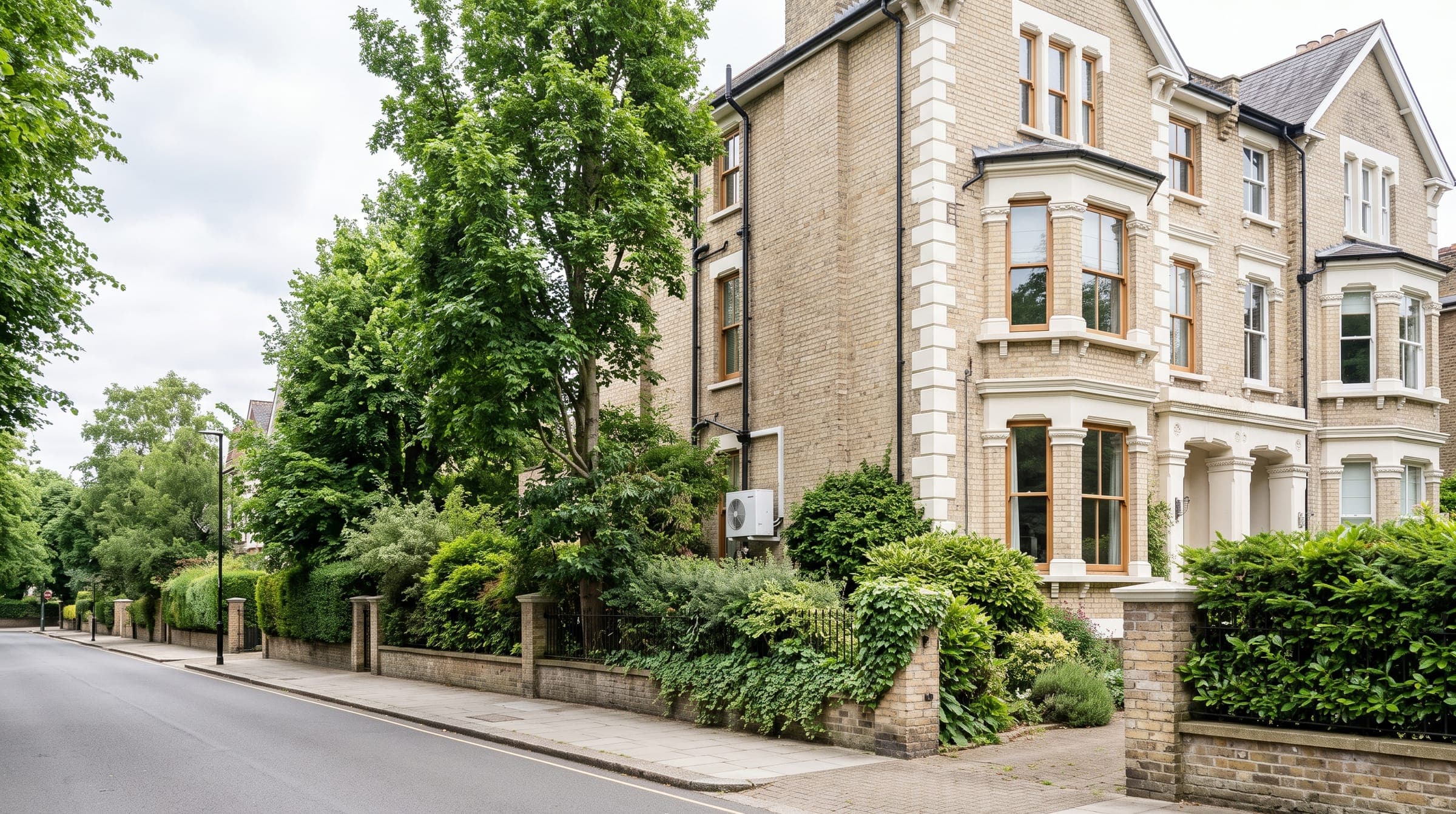
- Parkleys, the first big Span estate
- 1954
- Ham House first built
- 1610
- conservation areas centred on Ham
- 3
- postcode district
- TW10
Air conditioning installation in Ham
We fit air conditioning in Ham homes, flats and businesses: wall-mounted units for a single room, multi-split systems for several rooms on one outdoor unit, and ducted systems where nothing should show. A single room starts from £1,850 fitted, two rooms on one outdoor unit from £3,650.
Every install starts with a free survey. Our engineer checks where the units and pipes can go and gives you a fixed price in writing, and most single rooms are fitted in a day. We install Daikin, Mitsubishi Electric, LG and more. See how installation works or get a free quote.
Ham air conditioning servicing and repairs
We service and repair split, multi-split and ducted systems of most makes, whoever installed them. Near the river and the common we keep an eye on leaves in the outdoor coil and on condensate drains.
Air conditioning prices in Ham
Standard London starting prices. Work on listed Span buildings is priced after the survey, with consent drawings in our design pack.
- from£1,850
A bedroom or study
2.5 kW wall unit, 5 m pipe, fitted in a day
- from£2,050
A living room
3.5 kW wall unit
- from£3,650
Two rooms, one outdoor unit
Multi-split
- from£2,350
Floor-standing unit
2.5 kW console
- from£795
A design pack for a consent application
Drawings, specification and sound data; taken off the install if you go ahead
- from£149
An annual service
Keeps the manufacturer warranty valid
Span flats, a common and a 17th century house: air con in Ham
Ham has one of the most influential estates of the 1950s. Parkleys, south of Ham Common, was built in 1954 and 1955 as the first large development by Span, the firm of Eric Lyons and Geoffrey Townsend. It was designed for first-time buyers and run by a residents' management company. Parkleys is listed grade II and became a conservation area in 2003.
Its flats are brick, with concrete slab floors, flat roofs, large timber windows and concrete tile-hanging, set among trees kept from the old Ham Farm Nursery. Along Ham Farm Road, thirteen detached houses were designed individually in the 1950s by architects including Leslie Gooday, Bernard Kreeger and Eric Lyons.
For air conditioning that means two approvals before anything else: the residents' management company and, because the blocks are listed, listed building consent.
Air conditioning installation in a Parkleys flat or Ham Farm Road house
What we sort out before fitting:
- Agreement from the residents' management company for the outdoor unit and any pipe route.
- Listed building consent, which Richmond Council says is needed for any heat pump on a listed building.
- A position that keeps the timber windows and tile-hanging untouched, often a low ground-level spot.
- A pipe route planned around the concrete floors.
- The estate's trees and landscape, which the layout was designed around.
- Noise figures for the nearest window, since flats here face shared courtyards.
Planning permission for air conditioning in Ham
Outside the listed groups, Richmond Council's heat pump guidance applies. Air-to-air units that heat as well as cool count as air source heat pumps. In a conservation area the unit must not be nearer any road than the house, or on a wall or roof facing a road. A detached house may have two units, a semi, terrace or block of flats one.
Ham's conservation areas are Ham Common (1969), Ham House (1975) and Parkleys Estate (2003). The Article 4 register lists directions for Ham Gate Avenue and Ham Street in Ham Common, and for Ham Street and Wiggins Lane in Ham House, but the council says none of its conservation area directions remove heat pump rights.
If an application is needed for one unit, Richmond's Noise SPD accepts a desktop noise assessment, checked against 45 dB(A) by day and 35 dB(A) at night at the nearest window.
Ham Common, Ham Street and the riverside estate
Around the triangular green of Ham Common, homes range from terraced cottages to 18th century mansions such as Ormerley Lodge, listed grade II*. Langham House Close, a listed brutalist group of flats, stands in the former garden of an 18th century house on the green. Ham Street runs north to Ham House, built in 1610 and listed grade I, past the 18th century Manor House and Beaufort House.
West of Ham Street, a large estate of 1960s houses and flats stands on former river meadows. These are often simpler to fit. In the 2021 Census, Ham, Petersham and Richmond Riverside ward had 4,402 households, with 1,518 in purpose-built flats and 1,340 in terraced houses.
Shops, cafes and offices on Ham Parade and Ham Farm Road
Ham's main shops are on Ham Parade, which Richmond lists as a local centre. The council's business hub counts 33 shops there, including two cafes, a coffee shop and an Indian restaurant, and the community-run Ham Parade Market. Parkleys adds a parade of six shops with maisonettes above on Ham Farm Road, designed in an even more modern style than the flats.
Where homes sit over a shop, we site the outdoor unit away from their windows and fit it on anti-vibration mounts. For shops, cafes, surgeries and small offices we prepare the planning application and noise assessment, plus listed building consent where needed. See shop air conditioning, cafe air conditioning and restaurant air conditioning.
Postcodes and areas we cover near Ham
We work across TW10 and the edge of Kingston. Richmond's parking zone list names no Ham zone, but we check the plates on your street before the day.
- TW10: Ham, Ham Common and Ham Street
- TW10: Parkleys and Ham Farm Road
- TW10: Petersham and Richmond Hill, to the north
- KT2: north Kingston, to the south, see Kingston upon Thames
Richmond upon Thames in official figures
- households (2021 Census)
- 80,705
- live in a flat
- 40 in 100
- live in a house
- 60 in 100
- listed building entries
- 818
Of 80,705 households in the 2021 Census, 60 in 100 lived in a house (8 detached, 25 semi-detached, 27 terraced) and 40 in 100 in a flat. Most installs here are on houses, where a back or side wall is usually the simplest place for the outdoor unit.
In a conservation area an outdoor unit can't go on a wall or roof facing a road without planning permission, and an Article 4 direction can remove permitted development rights altogether. Check your postcode to see whether either applies to your street.
Sources: ONS Census 2021, table TS044 (accommodation type); Historic England's National Heritage List entries within the council boundary, through planning.data.gov.uk (one entry can cover several buildings). Checked October 2026.
Air conditioning for shops, cafes and restaurants in Ham
- shops and other retail premises
- 1,075
- licensed restaurants
- 205
- cafes and unlicensed restaurants
- 160
- pubs and bars
- 100
The Richmond upon Thames area has about 1,075 shops and other retail premises, 365 restaurants and cafes and 100 pubs and bars. Restaurants and cafes are a bigger share of trade here than in most of the areas we cover. Kitchens, ovens and grills add heat of their own, so a dining room is sized for the equipment as well as the covers, with the outdoor unit kept clear of the kitchen extract.
Permitted development for heat pumps covers homes, not shops, cafes or restaurants, so check with the council and your landlord before an outdoor unit goes up, and take extra care with a shopfront in a conservation area. Check your postcode.
- Shop air conditioning
- Cafe and coffee shop air conditioning
- Restaurant air conditioning
- Pub and bar air conditioning
- Salon and barber air conditioning
Business premises (local units) in the whole Richmond upon Thames area, rounded by the ONS. Source: ONS UK Business Counts 2026, through Nomis.
Ham air conditioning questions
How much does air conditioning cost in Ham?
A bedroom unit starts from £1,850 and a living room from £2,050. Two rooms on one outdoor unit start from £3,650. The survey gives you a fixed price.
Do I need planning permission for air conditioning in Ham?
On an unlisted house, often not, if the unit also heats and sits at the back or side. Parkleys and other listed buildings need listed building consent, and shops and cooling-only units need planning permission.
Can I have air conditioning in a listed Parkleys flat?
It can be possible, but it needs the residents' management company's agreement and listed building consent first. We look for a discreet ground-level position and keep the original windows and tile-hanging untouched.
Can you fit air conditioning in a Ham flat outside Parkleys?
Usually. For flats in the 1960s estate west of Ham Street, we need the freeholder's agreement and, for a second unit on a block, planning permission.
Is a house near Ham House treated differently?
Houses on Ham Street fall in the Ham House conservation area, and several are listed. Article 4 directions cover parts of Ham Street and Wiggins Lane, but they don't remove heat pump rights.
Who services and repairs air conditioning in Ham?
We do, for most brands. An annual service starts from £149, plus £120 for each additional indoor unit.
Sources for this page
10
- Richmond Council: Parkleys Estate conservation area statement
- Richmond Council: Ham Common conservation area statement
- Richmond Council: Ham House conservation area statement
- Richmond Council: Article 4 directions in conservation areas
- Richmond Council: planning guidance for heat pumps
- Richmond Council: Noise Generating and Noise Sensitive Development SPD (2018)
- Richmond Council: controlled parking zone times
- Census 2021 accommodation type (TS044) by Richmond ward, Nomis
- Richmond Council business hub: Ham town centre
- Richmond Council: assessment of borough centres (2023)